
Corrugated board shock absorption is determined by three primary specifications: the flute profile, the wall construction, and the material quality of the liners and medium. Selecting the right combination ensures that transit vibrations and drop impacts are absorbed by the packaging rather than transferred directly to the enclosed items. Understanding how these specifications interact allows businesses and consumers to make informed packaging decisions that protect valuable goods.
Evaluating these physical properties is essential before purchasing packaging materials. By analyzing the structural design of the board, you can match its protective capabilities to the specific fragility and weight of your products.
Flute Profiles and Their Impact on Cushioning
Flutes are the wave-shaped arches glued between the flat linerboards. Their height determines the thickness of the board’s air gap, while their density—the number of flutes per linear unit—determines the structural support. The relationship between flute height and density directly governs how the board absorbs energy during an impact.
Products mentioned in this guide

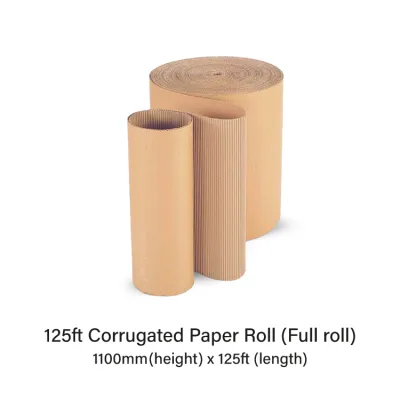
Prices are valid at publication and may change. Please refer to the product page for the latest price.
Larger flutes, such as A and C flutes, have greater height and wider spacing. This structure provides more vertical displacement, allowing the board to compress and cushion heavy items during drops. These profiles are typically utilized for outer shipping cartons where vertical cushioning is the primary defense against rough handling.
Smaller flutes, such as B and E flutes, feature a higher density of arches. This compact structure offers superior flat crush resistance and a flatter surface, making the board highly rigid and resistant to punctures. While smaller flutes provide less vertical cushioning, they are excellent for lightweight items, retail packaging, and applications requiring high-quality surface printing.
However, a flute profile alone does not guarantee complete shock absorption. The overall protective performance depends heavily on the internal packaging design, including void fill, custom inserts, and how tightly the item is secured within the box to prevent movement during transit.
Wall Construction: Single, Double, and Triple Wall
Wall construction refers to the number of fluted mediums and flat linerboard plies layered together. Single-wall board consists of one wavy medium glued between two flat liners. Double-wall adds another medium and liner layer, while triple-wall features three fluted mediums separated by four liners.

Adding walls significantly increases the board’s puncture resistance and vertical stacking strength, allowing boxes to withstand heavy loads in transit or warehouse storage. However, shock absorption does not scale linearly with thickness. A triple-wall box is highly rigid but may actually transfer more sudden impact energy to a delicate item if there is no internal cushioning to absorb the shock.
To evaluate the appropriate wall construction, consider this conditional checklist based on your specific shipping hazards:
- Item Weight: Light items often perform well with single-wall board, whereas heavy industrial components require double- or triple-wall structures.
- Fragility: Highly fragile items require a more flexible outer wall combined with internal cushioning, rather than an ultra-rigid box that lacks give.
- Transit Hazards: Long-distance shipping with multiple sorting transfers increases the risk of punctures, making double-wall construction a safer baseline.
- Supplier Verification: Always verify the manufacturer's specific load ratings and board grade certificates rather than assuming a wall count alone will suffice.
Material Quality and Strength Indicators
Technical strength metrics and material grades provide practical indicators of how the board will perform under stress. The two primary industry standards are the Edge Crush Test (ECT) and the Bursting Strength (Mullen) test. These metrics measure different physical limits of the corrugated board.
ECT measures the top-to-bottom compression strength of the board, which indicates how well a box will resist crushing when stacked in a warehouse. The Mullen test measures the force required to puncture the face of the board, indicating its resistance to rough handling and sharp objects. A high ECT rating does not automatically guarantee a high Mullen rating, as they measure different structural forces.
The base paper material plays a critical role in these metrics. Virgin kraft liners, made from fresh wood pulp, offer long, interlocking fibers that provide superior stiffness, tear resistance, and moisture tolerance. Recycled test liners have shorter fibers, which can reduce overall energy dissipation and make the board more susceptible to softening in humid environments, such as Singapore’s tropical climate.
Because visual inspections and generic grade names do not guarantee performance, always request official test certificates from your supplier. These documents verify the exact ECT or Mullen rating of the board batch, ensuring consistency and safety for your shipments.
How to Match Specs to Your Packaging Needs
To convert technical specifications into a verified packaging plan, you must systematically assess the item being shipped. Begin by measuring the item’s dimensions and identifying its center of gravity to ensure even weight distribution. Next, assess fragility by identifying delicate components that cannot tolerate vibration, and map the transit environment, noting potential drop heights, humidity levels, and stacking durations.
Before committing to a large order, conduct small-batch trial packing. Perform standardized drop tests or vibration trials using mock-ups to observe how the board and internal cushioning deform under stress. This physical verification is crucial because the exact interaction between the board and the item’s surface cannot be determined by specifications alone.
There are specific stopping conditions where self-selection should end. If your items are of exceptionally high value, contain hazardous materials, or have highly complex geometries with sensitive calibration needs, halt self-selection. In these scenarios, consult a professional packaging engineer or a certified supplier to design custom molded inserts and perform laboratory-grade transit simulations.
Frequently Asked Questions (FAQ)
Does thicker corrugated board always mean better shock absorption?
No, thickness does not automatically equate to better shock absorption. While thicker boards offer higher compression resistance, shock absorption depends on the material’s ability to flex and dissipate energy. An overly rigid, thick board without appropriate internal void fill or cushioning can act as a solid transmitter of force, passing the impact energy directly to the fragile item inside.
Can I use single-wall corrugated board for heavy, fragile items?
Single-wall corrugated board is generally designed for light to medium-duty applications. While it can occasionally be used for heavier items, doing so requires extensive internal dunnage, such as molded pulp, foam inserts, or bubble wrap, to compensate for the lower puncture and stacking limits of the board. For heavy and highly fragile goods, it is highly recommended to upgrade to a double-wall construction to ensure structural integrity under load.

Community discussion
Share your experience or ask a question. Comments are reviewed before publication.