
Selecting the right carton box size depends on measuring your items’ maximum dimensions, adding a 5 to 10 cm clearance for protective cushioning, and matching the total volume to a box’s internal dimensions rather than its external profile. Choosing the correct size prevents items from shifting during transit, avoids structural failure, and keeps shipping costs manageable.
Whether you are preparing for a residential move across Singapore, organizing office files, or shipping products to customers, matching your items to the correct box specifications is crucial. Standardizing your packaging choices not only protects your belongings but also streamlines the entire packing process.
Understanding Carton Box Dimensions and Material Specs
Box manufacturers list dimensions as Length x Width x Height (L x W x H). However, external measurements include the thickness of the corrugated cardboard. Internal dimensions dictate the actual usable space. Corrugated walls and folded flaps can reduce the usable internal space by 1 to 3 cm depending on the board thickness. Always check the manufacturer’s specification sheet for internal dimensions to ensure your items actually fit.
Products mentioned in this guide
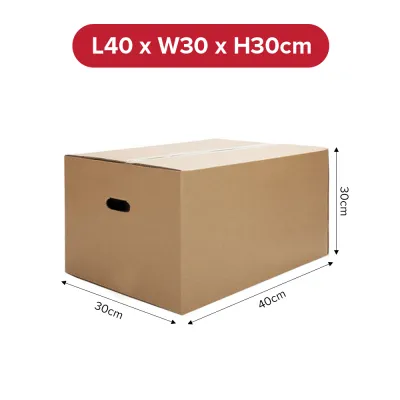
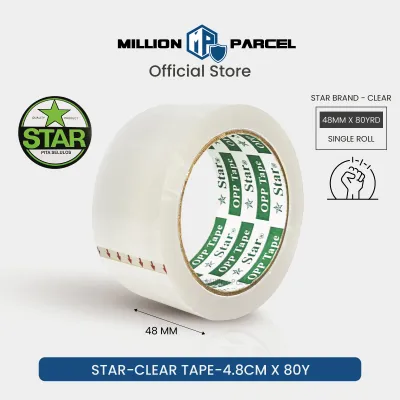
Prices are valid at publication and may change. Please refer to the product page for the latest price.
Cardboard thickness is determined by corrugated layers and flute profiles. Single-wall cardboard boxes (typically 3-ply, B-flute or C-flute) are lightweight and ideal for shipping everyday items, books, or stationery. Double-wall cardboard boxes (5-ply, BC-flute) feature two layers of corrugated fluting, providing superior structural rigidity and puncture resistance. These are highly recommended for fragile, heavy, or high-value goods that require stacking.
In Singapore, standard single-wall boxes typically range from S$1.50 to S$4.00, while heavy-duty double-wall boxes can cost between S$4.50 and S$8.00 depending on size. While box manufacturers state maximum weight capacities, these assume static, evenly distributed loads. Dynamic handling—such as lifting, stacking in a moving truck, or accidental drops—puts far greater stress on the cardboard. Always maintain a conservative safety margin, packing well below the maximum rated limit to prevent the box from buckling.
Some specifications have little impact on basic packing tasks. For instance, the exact shade of brown or white kraft paper, the print quality of external branding, or minor variations in flap styles (like regular slotted containers versus half-slotted containers) do not change the box’s structural capacity. Focus primarily on internal dimensions and wall thickness to simplify your purchasing decision.
Matching Box Sizes to Common Household and Office Items
Using the correct box category for specific item types prevents damage and ensures that loaded boxes remain safe to lift.

Small Boxes for Heavy, Dense, or Fragile Items
Small boxes (typically around 30 x 20 x 20 cm) are best for dense, heavy objects. Items like books, legal documents, A4 files, small tools, and heavy stationery should always be packed in smaller containers. This keeps the concentrated weight manageable for a single person to lift.
Placing heavy items in a large box creates a major risk of “bottom blowout,” where the bottom flaps fail under concentrated weight. It also makes the box incredibly difficult to carry safely, increasing the risk of personal injury or dropped items. Keeping heavy items in compact spaces ensures the box structural integrity remains intact.
Small boxes are also ideal for fragile items like glassware, ceramics, or small electronics. A smaller internal cavity naturally limits the distance items can shift during transit. This makes it easier to secure them with minimal cushioning material, reducing the risk of friction-induced damage.
Medium Boxes for Mixed Everyday Goods
Medium boxes (often ranging around 40 x 30 x 30 cm to 50 x 40 x 40 cm) serve as the workhorses of household moving and office relocation. They offer a balanced volume that accommodates a wide variety of standard objects without becoming excessively heavy.
This size is ideal for items like shoes, toys, small kitchen appliances, folded clothing, and medium-sized home decor. They are large enough to hold multiple items but small enough to remain manageable when fully loaded. Most standard shelving units and car trunks accommodate medium boxes easily.
To pack a medium box safely, always place heavier items at the bottom and lighter items on top. This maintains a low center of gravity, prevents the box from tipping, and ensures lighter items are not crushed. Fill any remaining empty spaces with crumpled paper to prevent shifting.
Large Boxes for Bulky and Lightweight Items
Large and extra-large boxes (typically exceeding 60 x 40 x 40 cm) should be reserved strictly for bulky, low-density items. Suitable contents include pillows, blankets, winter jackets, bed linens, and large empty plastic containers. These items occupy significant space but add very little weight.
Never pack books, files, or heavy kitchenware in a large box. The cumulative weight will quickly exceed safe lifting limits, and the cardboard walls will likely buckle or tear at the handles when lifted. A box that is too heavy to handle safely is a hazard to both the carrier and the contents.
To maximize space efficiency when packing soft goods like duvets or winter wear inside large boxes, consider sealing them in vacuum storage bags first. This compresses the volume significantly, allowing you to fit more items without exceeding the box’s physical dimensions or weight capacity.
Factoring in Cushioning Space and Courier Limits
When choosing a box, never select one that matches your item’s dimensions exactly. A tight fit leaves zero room for shock absorption, meaning any external impact will transfer directly to the item. Always add a minimum of 5 to 10 cm of clearance on all sides to accommodate protective materials like bubble wrap, packing peanuts, crumpled packing paper, or foam edge protectors.
Courier services and postal carriers do not charge shipping fees based solely on physical weight. They also calculate the space a package occupies in their transport vehicles. If you ship a large, lightweight box, you will likely be billed based on its dimensional weight rather than its actual weight.
Most logistics providers calculate this by multiplying the external Length, Width, and Height in centimeters and dividing the total by a specific carrier divisor (commonly 5,000 or 6,000). For example, a box measuring 50 x 40 x 30 cm divided by 5,000 yields a volumetric weight of 12 kg. If the actual weight is only 3 kg, you will still pay the 12 kg shipping rate.
Oversizing a box unnecessarily drives up shipping costs. To keep logistics expenses low, select the smallest box possible that still allows for safe cushioning. If an item is durable and non-fragile, you can reduce the buffer space to save on volumetric weight and overall packaging material costs.
Step-by-Step Guide to Measuring and Selecting Your Box
Follow this systematic checklist to ensure you select the correct box size for any item:
- Step 1: Measure the item. Use a standard measuring tape to find the maximum length, width, and height of the item at its widest points. If you are packing multiple items together, stack them tightly as they would sit in the box, then measure the entire grouped pile.
- Step 2: Add cushioning allowance. For fragile items, add at least 5 to 10 cm to each measurement to account for protective wrapping. For non-fragile items, a smaller buffer of 2 to 3 cm is usually sufficient to allow easy insertion and removal.
- Step 3: Compare with internal dimensions. Check the box supplier's specifications to ensure the internal dimensions (not external) meet or exceed your calculated target measurements. Verify that the total weight of the items does not exceed the manufacturer's recommended capacity.
- Step 4: Verify courier limits. If you plan to ship the box, check your chosen courier's maximum size and weight limits for standard parcels. Exceeding these limits can trigger expensive oversized surcharges or result in the parcel being rejected.
- Step 5: Perform a physical test. Once packed, check the box's shape. If the sides bulge or the top flaps do not meet flatly, the box is overloaded. Forcing a box closed compromises its structural integrity, making it highly susceptible to bursting open during transport. If this occurs, transfer the items to the next size up.
Frequently Asked Questions (FAQ)
How do I calculate the internal volume of a carton box?
To calculate the internal volume, multiply the internal Length, Width, and Height of the box in centimeters. This gives you the volume in cubic centimeters (cm³). To convert this figure into liters—which is often easier to visualize—simply divide the total cubic centimeters by 1,000. For example, a box with internal dimensions of 40 cm x 30 cm x 20 cm has a volume of 24,000 cm³, which equals exactly 24 liters of capacity.
Is it better to use one large box or multiple small boxes?
Using multiple small boxes is generally better for heavy, fragile, or high-density items. Small boxes are easier to lift, maintain their structural integrity better, and reduce the risk of items shifting and breaking. However, if you are packing lightweight, bulky items like linens or soft toys, consolidating them into a single large box is more efficient. This saves on packing tape, reduces the number of individual tracking numbers to manage, and simplifies handling, provided the box remains within standard courier size limits.

Community discussion
Share your experience or ask a question. Comments are reviewed before publication.