
Choosing the right carton size is a balance between protecting your items, managing shipping costs, and ensuring easy handling. To select the perfect box, you must consider the physical dimensions of your goods, their total weight, and the space required for protective cushioning. Selecting an incorrect size can lead to transit damage, inflated courier fees, or structural failure of the packaging itself.
Decoding Carton Dimensions: Internal vs. External Measurements
When browsing packaging supplies, you will consistently encounter two sets of measurements: internal and external dimensions. Understanding the difference between these two metrics is the first step toward successful packing and avoiding costly shipping mistakes.
Internal dimensions measure the actual usable space inside the box after it is assembled. These are the dimensions you must use to determine whether your items will physically fit inside the carton. Packaging manufacturers list these measurements in a standard Length (L) x Width (W) x Height (H) format. Length refers to the longer side of the open flap, width is the shorter side, and height is the vertical depth of the box.
Products mentioned in this guide
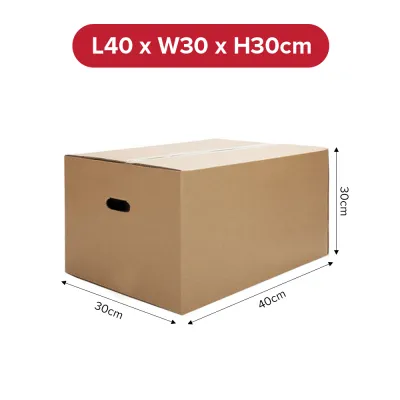
Prices are valid at publication and may change. Please refer to the product page for the latest price.
External dimensions, on the other hand, represent the outer physical footprint of the carton, including the thickness of the corrugated cardboard flaps. These measurements are critical for logistics, as courier services use them to calculate volumetric weight and plan cargo space. They are also essential when planning shelf storage or pallet configurations in a warehouse.
For general packing and office organization, you can safely focus on the internal clearances. Minor manufacturing tolerances in the external dimensions rarely impact general packing tasks, provided you have secured the necessary internal volume for your goods and their protective wrapping.
Standard Carton Size Categories and What Fits Inside
In Singapore, packaging suppliers and logistics providers standardise carton sizes using metric measurements (centimetres). While exact dimensions can vary slightly depending on the manufacturer, cartons generally fall into three primary categories: small, medium, and large or extra-large.

Selecting the right category depends on both the physical volume of your items and their weight. Matching your items to these standard categories simplifies purchasing and ensures you do not pay for unnecessary space.
Small Cartons
Small cartons typically measure around 30 x 20 x 15 cm or smaller. These compact boxes are highly rigid and are designed to hold smaller, denser, or heavier items that would otherwise make a larger box difficult to lift.
Ideal use cases for small cartons include heavy books, bulk stationery supplies like printer paper or notebooks, small electronics, cosmetics, and fragile glassware. Because these items do not compress, they pack tightly and benefit from the structural support of a smaller frame.
However, be cautious when packing exceptionally dense items like metal components or heavy liquid bottles. Even if they fit physically within a small carton, their combined weight can easily exceed the box’s maximum weight capacity, leading to a ruptured bottom during transit.
Medium Cartons
Medium cartons generally feature dimensions around 40 x 30 x 30 cm. This size represents the sweet spot of the packaging industry, offering a balanced combination of volume and manageable carrying weight.
This category is the most versatile option for general e-commerce fulfillment, office relocations, and standard household moves. It easily accommodates mixed office supplies, shoes, small kitchen appliances, toys, and folded clothing without becoming too heavy for a single person to carry.
When packing a medium carton, distribute the weight evenly. Place heavier items at the bottom and lighter items on top to maintain the box’s center of gravity and prevent it from tipping or collapsing when stacked.
Large and Extra-Large Cartons
Large and extra-large cartons range from 50 x 40 x 40 cm up to 60 x 50 x 50 cm or larger. These boxes provide massive volume but require careful handling to prevent structural failure.
These cartons are designed exclusively for bulky, lightweight items. Excellent examples include bedding, pillows, large plush toys, winter jackets, and lightweight plastic equipment. These items fill the large volume of the box without adding excessive physical weight.
You must avoid using extra-large cartons for heavy items like books, files, or kitchenware. Overloading a large carton compromises its corrugated structure, causing the bottom to give out or the sides to bulge. Furthermore, an over-dense large box becomes a safety hazard, as it is difficult to lift safely and can easily cause injury or damage during transit.
Understanding Board Thickness and Corrugated Flute Types
Beyond physical dimensions, the strength of your carton depends heavily on its board thickness and corrugated flute type. These specifications determine how much weight a box can support and how well it resists crushing when stacked.
The most fundamental choice is between single-wall and double-wall corrugated boards. Single-wall cartons consist of one layer of fluted paper sandwiched between two flat linerboards. This is the default, cost-effective choice for standard shipping, lightweight to medium items, and general storage.
Double-wall cartons feature two layers of fluted paper and three flat linerboards, providing significantly higher structural strength. You should opt for double-wall cartons when packing highly fragile, heavy, or high-value items, or when boxes will be stacked high on pallets in a warehouse.
The “flute” refers to the wave-like arches inside the cardboard wall. B-flute is thinner (around 3mm) and offers excellent puncture resistance, making it ideal for smaller items, die-cut mailers, and retail packaging. C-flute is thicker (around 4mm) and provides better stacking strength, making it the standard choice for shipping boxes.
For standard office, stationery, or household packing, a single-wall C-flute or B-flute carton is entirely sufficient. You do not need to worry about complex flute specifications unless you are shipping industrial equipment or highly delicate goods.
How to Match Your Items to the Right Carton Size
When your items do not perfectly match standard carton dimensions, you must apply a structured approach to select the best fit. This involves accounting for protective packaging and handling oddly shaped items.
The golden rule of shipping is to always leave a 5 to 10 cm buffer on all sides of your item for void fill. This space should be filled with bubble wrap, packing peanuts, or crumpled kraft paper to absorb shocks and prevent the item from shifting during transit. Therefore, your ideal carton’s internal dimensions should be 10 to 20 cm larger than the item itself in every direction.
For oddly shaped items, measure the absolute widest, longest, and tallest points of the object. Treat these maximum points as a rectangular boundary, add your buffer space, and look for a carton that meets those minimum internal clearances.
If you are packing exceptionally long or awkwardly shaped items like posters, tripods, blueprints, or rolled documents, standard rectangular cartons may not work. In these cases, look for specialized packaging such as telescoping boxes or heavy-duty mailing tubes, which prevent bending and protect long items efficiently.
Finally, always verify the manufacturer’s stated weight limit or Edge Crush Test (ECT) rating before sealing your box. Relying solely on physical dimensions can lead to failure if the item’s density exceeds the material limits of the cardboard.
Frequently Asked Questions (FAQ)
How to calculate volumetric weight for shipping
To calculate volumetric weight, use the standard formula: multiply the external Length x Width x Height in centimetres, then divide the result by the courier’s dimensional factor (typically 5000 or 6000). For example, a box measuring 40 x 30 x 30 cm has a volume of 36,000 cubic centimetres; dividing this by 5000 yields a volumetric weight of 7.2 kg. Logistics providers in Singapore will compare this calculated volumetric weight against the actual physical weight of the package and charge you based on whichever figure is higher.
Risks of using an oversized carton with extra padding
While filling an oversized carton with extra bubble wrap or crumpled paper might seem like a safe option, it introduces significant structural and financial risks. Excessively large boxes with too much void fill are prone to collapsing because the outer walls lack internal support from the items inside, making them vulnerable to crushing when stacked under heavier boxes. Additionally, using an oversized box unnecessarily inflates your shipping costs by raising the volumetric weight and wastes packing materials, which runs counter to sustainable packaging practices.

Community discussion
Share your experience or ask a question. Comments are reviewed before publication.