
Selecting the correct wedding envelope size depends entirely on the dimensions of your largest invitation card and the total thickness of your assembled suite. To ensure a smooth fit, your envelope must be slightly larger than your invitation card—typically by one-quarter of an inch (about 6 millimetres) in both width and height. This small clearance prevents the edges of your stationery from bending during insertion and allows your guests to slide the contents out easily. If you are including multiple inserts, RSVP cards, or decorative embellishments, you will also need to account for the added physical bulk to avoid torn paper or split seams.
Understanding Standard Card and Envelope Dimensions
To begin planning your stationery suite, it helps to understand how standard invitation sizes correspond to specific envelope designations. In the stationery industry, envelopes are categorized by standard letter codes and numbers, with the “A” series being the most common format for social announcements and invitations. For example, a standard 5×7 inch (approximately 127×178 mm) invitation card pairs with an A7 envelope, which typically measures 5.25×7.25 inches (approximately 133×184 mm).
Other common pairings include the A6 envelope (4.75×6.5 inches) for a 4.5×6.25 inch card, and the A8 envelope (5.5×8.125 inches) for a 5.25×7.75 inch card. Smaller enclosures, such as RSVP cards, often use an A2 envelope (4.375×5.75 inches) to house a 4.25×5.5 inch card. These standard pairings are designed to provide just enough room for a single flat card to slide in without shifting excessively.
Products mentioned in this guide

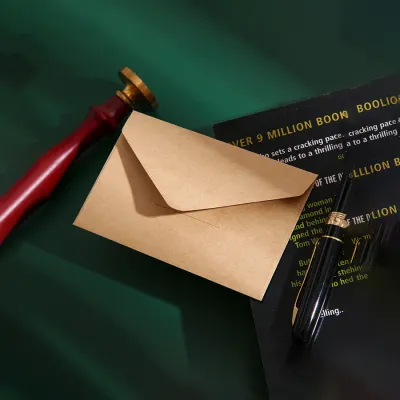
Prices are valid at publication and may change. Please refer to the product page for the latest price.
However, you should never rely solely on generic size names or assume that every manufacturer uses identical dimensions for an “A7” or “A6” label. Minor manufacturing tolerances can vary by a few millimetres between different paper mills and stationery brands. Always verify the exact physical measurements in millimetres or inches listed on the product packaging before purchasing your cards or ordering custom envelopes.
Sizing Your Envelope for Multiple Inserts and RSVP Cards
When your wedding invitation suite includes more than just a single card, determining the correct envelope size requires a more systematic approach. A traditional suite often features the main invitation, an RSVP card with its own return envelope, a details card, and perhaps a map or reception card. To find the minimum envelope size required, always measure the largest single card in your entire stack, which is almost always the main invitation itself.

Once you have the exact dimensions of the largest card, add a standard clearance of 1/8 to 1/4 inch (approximately 3 to 6 mm) to both the width and the height. This clearance creates a protective buffer around the edges of your paper. If your largest card is exactly 5×7 inches, an envelope measuring 5.25×7.25 inches provides the ideal clearance for a standard flat stack.
Next, evaluate the cumulative thickness of your stacked inserts. As you stack multiple layers of heavy cardstock, the overall height of the pile increases, which naturally pulls the sides of the envelope inward when inserted. A thick stack of three or four high-GSM (grams per square metre) cards will require more room than a single card of the same face dimensions. If your assembled suite feels tight or causes the envelope to bulge, you may need to step up to the next standard envelope size or reduce the thickness of your cardstock.
Verifying Thickness, Weight, and Postage Limits
The physical bulk and weight of your completed wedding invitation suite directly impact how it travels through the postal system and how much it will cost to mail. Heavy cardstock, multiple inserts, and protective inner envelopes quickly add up, potentially pushing your mailpiece into a higher weight tier. In Singapore, postal services categorize mail by weight steps, and exceeding a tier by even a single gram can significantly increase the required postage per envelope.
Thickness is another critical factor that couples often overlook during the design phase. Standard automated sorting machines process mailpieces through tight rollers; if your envelope is too thick, rigid, or uneven, it cannot pass through these machines. This requires manual sorting, which typically incurs a surcharge. To avoid unexpected costs, check if your stuffed envelope exceeds the standard thickness limits set by your local postal service.
Before purchasing your stamps or printing your envelopes in bulk, always assemble one complete, final prototype of your invitation suite. Take this fully stuffed and sealed sample to a local post office in Singapore to have it weighed and measured by a postal worker. They can verify the exact weight, check the thickness, and advise you on the correct postage rate in S$, ensuring your invitations reach your guests without being returned for insufficient postage.
Choosing Envelope Paper Weight and Flap Styles
The material quality and structural design of your envelope are just as important as its physical dimensions. Envelope paper weight is measured in GSM, and choosing the right weight ensures your invitations arrive undamaged. Standard mailing envelopes are often made from 80 to 100 GSM paper, but for wedding invitations, a heavier weight of 120 GSM or higher is generally recommended. This thicker paper provides a premium, tactile feel, prevents the contents from showing through, and offers better resistance to tearing during transit.
The shape of the envelope flap also plays a major role in both the visual presentation and the ease of assembly. Pointed flaps (often called Euro flaps) offer a classic, elegant look that pairs beautifully with wax seals or custom liners. Square flaps provide a modern, clean aesthetic that works well with contemporary designs. If you are assembling and sealing dozens or hundreds of invitations yourself, consider choosing a peel-and-seal adhesive strip, which saves significant time and eliminates the need for moisture activation.
Finally, verify that the envelope paper is compatible with your chosen addressing method. Highly textured papers, metallic finishes, or dark colours can pose challenges for standard home printers or calligraphy inks. If you plan to print addresses directly onto the envelopes, test a sample sheet first to check for ink smudging, bleeding, or feeding issues in your printer.
Frequently Asked Questions (FAQ)
Do I need a larger envelope if I use a belly band or ribbon?
Yes, decorative elements like belly bands, twine, ribbons, or wax seals add localized thickness that can make a standard-sized envelope too tight. A bulky ribbon knot or a thick wax seal can distort the flat shape of the envelope, making it difficult to seal the flap securely without crushing the contents. If your decorative wrap adds more than 2 to 3 millimetres of thickness, you should opt for an envelope that is one size larger than your standard recommendation, or choose a flat, printed belly band instead of a dimensional ribbon.
Can I use a square envelope for my wedding invitations?
You can certainly use square envelopes to match square invitation cards, which offer a highly distinct and modern look. However, you must verify the mailing regulations and potential surcharges with your local postal service before finalizing this choice. Because square envelopes do not fit standard aspect ratios for automated sorting machines, they are classified as non-standard mail in Singapore and many other regions. This classification means they must be sorted by hand, which typically requires additional postage fees in S$ regardless of how light the envelope is.

Community discussion
Share your experience or ask a question. Comments are reviewed before publication.