
Finding the perfect wedding envelope requires matching the dimensions of your largest invitation card while leaving enough clearance for inserts, ribbons, or wax seals. If your envelope is too small, your invitation suite will bend or tear during transit; if it is too large, the contents will slide around, risking damage to delicate edges. A well-fitted envelope ensures your stationery arrives in pristine condition, presenting a polished first impression.
How to Measure Your Invitation Suite Accurately
To find the correct envelope size, first measure the complete invitation stack as a single unit. Lay your main invitation card flat, then place all accompanying inserts—such as RSVP cards and detail sheets—directly on top in the exact order they will be assembled. Use a precise ruler to measure the length and width of the largest card in the stack, which is typically the main invitation.
Next, measure the total thickness of the assembled suite. If you plan to include embellishments like belly bands, silk ribbons, twine, or wax seals, place these on the stack before measuring. These decorative elements add physical height, which pulls the sides of the envelope inward and reduces the available internal width and length.
Products mentioned in this guide
Prices are valid at publication and may change. Please refer to the product page for the latest price.
To prevent a tight fit that could split envelope seams or bend card corners, always add a standard clearance margin. For flat, single-card invitations, adding 3 mm to 5 mm to both the length and width of the card is generally sufficient. For thicker, multi-piece suites or those with raised embellishments, increase this clearance margin to at least 6 mm to 8 mm to ensure the contents slide in and out smoothly.
Standard Wedding Envelope Sizes Decoded
Understanding standard paper and envelope sizing systems makes it much easier to source the right stationery. In many regions, including Singapore, the international ISO 269 C-series is the standard for envelopes, designed to fit corresponding A-series paper sizes. For example, a C5 envelope is designed to fit an A5 card perfectly, while a C6 envelope fits an A6 card.

Another common option is the DL envelope, which stands for “Dimension Lengthwise.” This format measures 110 mm by 220 mm and is designed to hold a third-of-A4 card or a standard folded letter. DL envelopes offer a sleek, modern, elongated look that works beautifully for contemporary, minimalist wedding designs.
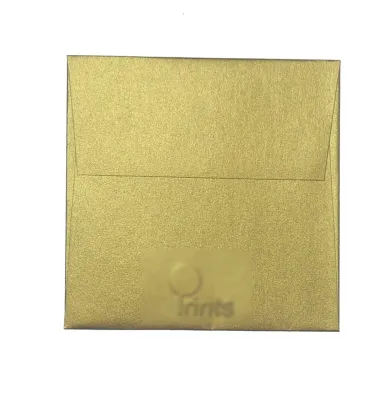
Square envelopes are also highly popular for weddings due to their distinct, symmetrical aesthetic. Common square sizes include 160 mm by 160 mm or 140 mm by 140 mm, which accommodate square invitation cards. However, square mailpieces often require manual sorting by postal services, which can attract non-standard postage surcharges compared to rectangular formats.
When sourcing envelopes from commercial suppliers or online marketplaces, keep in mind that manufacturing tolerances can cause slight variations from strict ISO standards. Always verify the exact millimetre dimensions listed by the manufacturer rather than relying solely on the generic size name.
Matching Envelopes to Common Invitation Configurations
The structure of your invitation suite dictates the type of envelope configuration you need. For a simple, single-piece invitation consisting of just one flat A5 card, a standard C5 envelope is the direct and most efficient choice. This combination provides a clean, classic presentation with minimal bulk, making it easy to address and mail.
Multi-piece suites that include RSVP cards, return envelopes, and detail cards require a more structured approach. In these configurations, the smaller inserts are typically stacked on top of the main invitation and secured with a belly band or pocket fold. To accommodate this added bulk, you will need to size up your outer envelope to ensure the entire bundle fits without stretching the paper or straining the adhesive seals.
Folded invitations, gatefolds, and pocket folds present unique sizing challenges because they are inherently thicker than flat cards. A pocket fold enclosure that folds to an A5 size, for instance, will not fit comfortably in a standard C5 envelope due to the thickness of the folded cardstock. In such cases, you must look for oversized C5 envelopes or custom-made options designed specifically for pocket folds.
For highly formal or complex multi-piece suites, using an inner and outer envelope system is an excellent way to organize and protect your stationery. The inner envelope, which is slightly smaller and usually unsealed, holds the invitation suite and keeps all loose inserts neatly together. This inner envelope is then placed inside a slightly larger, sturdier outer envelope that bears the mailing address and postage, protecting the delicate inner presentation from dust and transit wear.
Factoring in Thickness, Weight, and Postal Requirements
Before finalizing your envelope selection, consider how the physical properties of your completed suite will affect mailing costs and delivery. The total weight of your invitation, including the envelope, cards, inserts, and embellishments, determines the postage tier. Heavy cardstocks, such as 300 gsm or 600 gsm cotton paper, can quickly push your mailpiece into a higher weight category, requiring additional postage.
Thickness limits are equally critical for standard postal rates. Postal services use automated sorting machines that require mailpieces to pass through narrow slots to qualify for standard letter rates. If your invitation suite exceeds the standard thickness limit—often around 5 mm—due to thick cardstock, ribbons, or wax seals, it will be classified as a large letter or a parcel, which incurs higher shipping fees.
Card rigidity is another factor that influences postal handling. Extremely rigid cards, such as those made from extra-thick board, wood, or acrylic, cannot bend to pass through automated sorting rollers. These items must be hand-cancelled and processed manually, which typically requires a surcharge. To avoid unexpected costs, it is highly recommended to take a fully assembled prototype to your local post office to verify the exact postage requirements before purchasing stamps in bulk.
Practical Checks Before Stuffing and Mailing
Conducting a physical test run is the best way to prevent costly mistakes before assembling your entire guest list’s invitations. Create a complete prototype of your invitation suite, using the exact paper stocks, inserts, and embellishments you plan to use for the final production. Carefully insert the prototype into a sample envelope to observe how it fits.
Check for any signs of resistance or tight spots as you slide the suite inside. If you have to force the cards into the envelope, or if the edges of the envelope bulge or stretch, the envelope is too small. A tight fit can cause the seams of the envelope to burst during transit, or make it difficult for your guests to extract the invitation without tearing the cards.
Finally, ensure there is adequate blank space on the front of the envelope for addressing. If you are hiring a calligrapher or printing addresses directly onto the paper, the envelope surface must be large enough to accommodate the text clearly without overlapping any design elements, borders, or the postage stamp area. Leaving a clean, legible space ensures the postal service can route your invitations accurately and efficiently.
Frequently Asked Questions (FAQ)
Do I need an inner envelope for my wedding invitations?
Inner envelopes are traditional and highly functional for complex, multi-piece suites, as they keep loose cards organized and protect delicate designs from dust and transit wear. However, they are entirely optional. For simpler, single-card invitations or modern designs, a single high-quality outer envelope is perfectly sufficient and helps reduce overall stationery and postage costs.
Can I use square envelopes for wedding invitations?
Yes, square envelopes offer a modern, distinctive look that pairs beautifully with square invitation cards. However, you should be aware that square mailpieces cannot be processed by standard automated sorting machines. Because they require manual handling, postal services typically apply a non-standard postage surcharge, which will increase your overall mailing expenses.
How much extra space should I leave inside the envelope?
For standard flat cards, you should leave a clearance margin of at least 3 mm to 5 mm in both length and width. If your invitation suite is thick, multi-layered, or features raised embellishments like wax seals or thick ribbons, increase this clearance to 6 mm to 8 mm to ensure the contents slide in easily without bending.

Community discussion
Share your experience or ask a question. Comments are reviewed before publication.