
Selecting the right shipping bag size is a critical decision for any online business looking to optimize fulfillment efficiency, protect products during transit, and manage operational costs. The SmartPac Mini is the optimal choice for small, lightweight, and non-fragile items where minimal packaging reduces material waste and keeps shipping costs low. In contrast, larger sizes are designed to accommodate bulkier, rigid, or multi-item orders that require more physical volume. When choosing between these options, your decision should focus on dimensional fit, volume capacity, and structural limits rather than assuming a single size fits all product lines. Because packaging specifications and courier weight limits can update over time, always verify the exact dimensions and weight ratings on the manufacturer’s current specification sheet before purchasing in bulk.
In the competitive e-commerce landscape of Singapore, where fast delivery and neat presentation are highly valued, your choice of packaging directly influences customer satisfaction. A package that is too large can make your business look unprofessional due to excess, crumpled plastic, while a package that is too small risks bursting at the seams during sorting. By aligning your product dimensions with the correct packaging size, you can ensure a secure fit that maintains its professional appearance from your warehouse to the customer’s doorstep.
Core Dimensions for Comparing Shipping Bags
To make an informed choice, you must understand how flat dimensions translate to three-dimensional usable space. When a shipping bag is laid flat, its listed width and length do not account for the thickness of your product. As an item is inserted, the bag must expand, which pulls the sides inward and reduces the effective length and width. If your product has a significant height or gusset expansion, a flat mailer will struggle to close, putting immense pressure on the seams. You must always account for this dimensional reduction when comparing the SmartPac Mini to larger alternatives.
Products mentioned in this guide
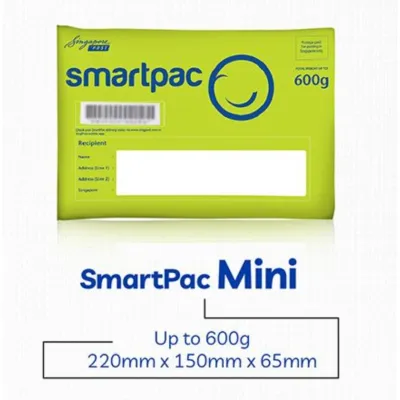
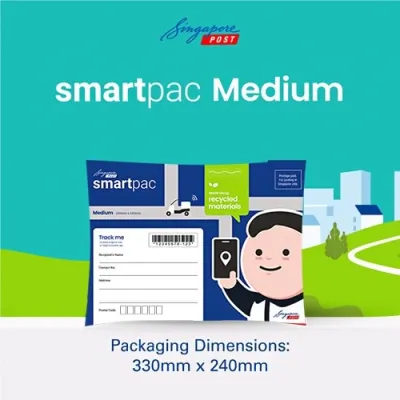
![*FREE SHIPPING* [CHOOSE OPTION] Singapore Post Smartpac Small Smartpac Medium Mini Lite 600g 1kg Singpost Smart pac Sing Post PolyM Poly M](https://img.lazcdn.com/g/p/ca35df7d5aaeef118422794879cc317a.jpg_400x400q80.jpg_.webp)
Prices are valid at publication and may change. Please refer to the product page for the latest price.
Weight limits and material thickness are equally critical factors that vary across different packaging sizes. Rather than assuming a larger bag is inherently stronger, you should check the manufacturer’s weight ratings and the mil thickness of the plastic. A thin, oversized bag carrying a heavy, dense object is highly susceptible to tearing during sorting and transit. Conversely, a smaller, thicker bag may offer superior puncture resistance for compact but heavy items. Always verify the maximum weight capacity specified by the courier service to avoid surcharges or rejected shipments.
Shipping cost implications also play a major role in your packaging strategy. In Singapore, courier fees and postal rates are often determined by a combination of physical weight, dimensional weight, and the specific packaging tier used. Opting for a bag that is larger than necessary not only increases the initial material cost but can also push your shipment into a higher pricing tier. For high-volume sellers, saving even S$0.50 to S$1.00 per package by downsizing to the SmartPac Mini can significantly boost overall profitability over hundreds of monthly shipments.
Finally, you must evaluate the specific protection requirements of your products. Standard poly mailers and shipping bags provide excellent moisture resistance and dust protection, but they offer virtually no cushioning against impacts. If you are shipping delicate items, you must determine whether a standard shipping bag is sufficient, or if your product requires a corrugated box, a padded mailer, or additional protective void fill to survive the journey. Understanding these protective boundaries prevents costly product damage and returns.
Decision Framework: SmartPac Mini vs Larger Sizes
To streamline your packaging selection, you can apply a conditional decision framework based on your product types, shipping volumes, and storage constraints.

You should choose the SmartPac Mini if you are shipping flat, small, and lightweight items. This size is highly efficient for single cosmetics, small stationery items, jewelry, keychain accessories, or thin apparel items like socks. Using the smallest possible footprint minimizes material waste, reduces the storage space needed for your packaging inventory, and ensures your packages easily fit into standard residential letterboxes in Singapore, which simplifies delivery for local postal services. This is particularly beneficial for home-based businesses or small offices where storage space is at a premium.
You should choose larger SmartPac sizes if you are fulfilling multi-item orders or shipping rigid, irregularly shaped goods. When customers purchase multiple items together, attempting to squeeze them into a mini mailer can stretch the seams to their breaking point. Larger sizes provide the necessary volume to accommodate diverse product shapes, and they offer the extra space required if you need to wrap items in protective bubble wrap or include promotional inserts, catalogs, and return labels. This flexibility is essential for businesses that offer product bundles or experience highly variable order sizes.
Neither option may fit if your products are highly fragile, excessively heavy, or exceed the maximum weight rating of the poly mailer line. For instance, heavy books, glass bottles, or delicate electronics should not be shipped in standard flexible bags, regardless of size. In these scenarios, you should transition to rigid corrugated boxes paired with appropriate cushioning materials to prevent damage and ensure the package remains intact. Relying on a flexible bag for heavy or fragile items often leads to torn packaging and damaged goods.
Before finalizing your choice, always verify if your product has sharp edges, protruding parts, or high value. Sharp corners on plastic packaging or metal accessories can easily puncture standard shipping bags during transit. If your items present these risks, you will need to implement protective corner guards, wrap the items in tissue paper, or select a packaging option that features tamper-evident security seals and reinforced materials to safeguard high-value goods.
How to Measure, Test, and Verify Your Packaging Fit
To avoid costly shipping errors and product damage, you should follow a systematic process to measure and verify your packaging fit before committing to a bulk order.
To calculate the required bag width and length, you must account for the product’s thickness and a standard sealing allowance. A reliable formula to determine the minimum flat bag width is to add the product’s width and its thickness, plus a safety margin of at least 15 to 20 millimeters. For the flat bag length, add the product’s length and its thickness, then add the manufacturer’s recommended sealing flap allowance (typically 30 to 40 millimeters). This ensures the adhesive strip can seal flat against the bag without being pulled at an angle, which could compromise the water-resistant seal.
Once you have calculated the theoretical size, order a small sample pack to conduct trial packing on your fulfillment line. Have your packing team physically place the products inside the sample bags to evaluate the ease of packing. If the packing process requires excessive force, or if the adhesive strip is difficult to align and seal, the bag is too small. A smooth, efficient packing flow is essential for maintaining high fulfillment speeds during peak sales periods and reducing labor fatigue.
After packing the samples, perform a basic transit simulation to test the structural integrity of the package. You can conduct simple drop tests from a height of approximately one meter onto a hard surface, as well as squeeze tests to simulate the pressure the package will experience when stacked under heavier boxes in a courier vehicle. Observe the seams, the adhesive seal, and the material for any signs of stretching, tearing, or failure. This hands-on verification provides concrete proof of performance that specifications alone cannot guarantee.
You should stop and switch to a larger size or a rigid box if you observe any warning signs during testing. These signs include overstretched plastic that turns white or translucent, seams that begin to pull apart, or an adhesive seal that lifts under pressure. If the product’s shape is clearly outlined and straining against the bag, it lacks the necessary clearance to survive the automated sorting systems used by local couriers. Transitioning to a larger size or a rigid box ensures your products arrive in pristine condition.
Frequently Asked Questions (FAQ)
Can I use SmartPac Mini for shipping fragile items?
Standard shipping bags, including the SmartPac Mini, lack structural rigidity and impact protection. They are designed primarily to protect items from moisture, dust, and minor surface abrasions during transit. If you need to ship fragile items such as glassware, ceramics, or delicate electronics, you should not rely on a standard poly mailer alone. Instead, use a rigid corrugated box or a specialized padded mailer, and wrap the items securely in protective cushioning to prevent breakage.
How do I calculate the usable space inside a shipping bag?
To calculate the usable space, you must subtract the product’s thickness from the flat dimensions of the bag. As a general rule, the maximum width of an item that can fit inside a flat bag is equal to the bag’s flat width minus the item’s thickness. Similarly, the maximum length is the bag’s flat length minus the item’s thickness and the length of the sealing flap. Always allow an extra margin of 10 to 20 millimeters to ensure the product slides in easily without putting tension on the side seams.
Are standard poly mailers accepted by all local couriers?
Yes, standard poly mailers are widely accepted by major couriers and postal services in Singapore. However, you must ensure that the shipping label is completely flat and fully visible on one side of the bag. Avoid wrapping the barcode or address details around the edges, corners, or seams of the package, as this can prevent automated scanning machines from reading the label, leading to delivery delays or sorting errors.

Community discussion
Share your experience or ask a question. Comments are reviewed before publication.