
When preparing items for delivery in Singapore, choosing the correct Smart PAC shipping bag size ensures your items arrive safely without incurring extra postage costs or risking transit damage. These pre-paid, tracked shipping envelopes are highly popular for their convenience, especially because they are designed to fit directly into standard residential letterboxes. However, selecting the right fit requires a clear understanding of how these bags are measured and how your items occupy three-dimensional space. By learning how to interpret size labels, calculate the necessary clearance, and verify official specifications, you can confidently select the ideal packaging for your shipping needs.
How to Read Smart PAC Size Labels
Understanding how shipping bag dimensions are listed on packaging is the first step to selecting the right size. Manufacturers and postal services typically print dimensions as flat-lay measurements, which represent the bag’s total width and length when empty and laid completely flat. However, these outer dimensions do not represent the actual usable space inside the bag once an item is inserted.
The difference between inner and outer dimensions is critical because the seams, heat-sealed edges, and the self-adhesive sealing flap reduce the interior volume. Additionally, the thickness of the material itself—whether it is made of durable plastic or reinforced paper—can slightly decrease the flexible space inside. When reading local packaging labels, measurements are usually formatted in millimeters (mm) or centimeters (cm), representing the width followed by the length. Always look for the specified “usable dimensions” or “inner dimensions” on the label to determine if your item will physically fit inside the opening.
Products mentioned in this guide
![[2pcs] SingPost Smartpac Medium size - for using within Singapore only - Prepaid Packaging with Tracking](https://img.lazcdn.com/g/p/3723bb51383d082fe8de03c34ecc0c93.jpg_400x400q80.jpg_.webp)
![[3pcs] SingPost Smartpac Medium size - for using within Singapore only - Prepaid Packaging with Tracking](https://img.lazcdn.com/g/p/8f2c3c3994c2d6fb1e87feebed85f10b.jpg_400x400q80.jpg_.webp)
![[1 pc] SingPost Smartpac - A postage-paid packaging for local delivery. Trackable via the SingPost mobile app.](https://img.lazcdn.com/g/ff/kf/Sbacc9034b1bf4b8b8aa42368084e6051F.jpg_400x400q80.jpg_.webp)
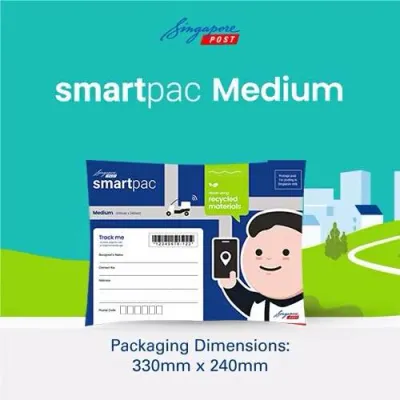
![[SINGPOST] smartpac - 10pcs. A postage-paid packaging for local delivery. Trackable!](https://img.lazcdn.com/g/ff/kf/S10459dde07ab48bfb250270670ebeb7fS.jpg_400x400q80.jpg_.webp)
![*FREE SHIPPING* [CHOOSE OPTION] Singapore Post Smartpac Small Smartpac Medium Mini Lite 600g 1kg Singpost Smart pac Sing Post PolyM Poly M](https://img.lazcdn.com/g/p/ca35df7d5aaeef118422794879cc317a.jpg_400x400q80.jpg_.webp)
Prices are valid at publication and may change. Please refer to the product page for the latest price.
How to Measure Your Items for the Right Fit
To ensure your items fit comfortably inside a shipping bag without overstretching the seams, you must take three precise measurements of your item: the maximum length, the maximum width, and the maximum thickness. Because shipping bags are flat, any thickness or depth in your item will pull the sides of the bag inward, effectively reducing the available width and length.

To calculate the minimum required bag width, use a simple formula: add the item’s width to its thickness, and then add a small clearance allowance of at least 10 mm to 20 mm. This extra space ensures the item can slide into the bag easily without tearing the plastic or paper material. For the required bag length, add the item’s length to its thickness, and ensure this total is well below the bag’s inner length. You must also account for the self-adhesive sealing flap; the flap must fold over completely and seal flat against the back of the bag to ensure a secure, tamper-evident closure. Furthermore, keep in mind that for letterbox delivery, the total thickness of the packed bag should generally not exceed the standard letterbox slot limit, which is typically around 50 mm.
Where to Find the Official Smart PAC Size Chart
Because product offerings, weight limits, and exact dimensions can occasionally be updated by the postal service or authorized manufacturers, it is best to verify the current size matrix directly from official sources. You can find the most accurate and up-to-date Smart PAC size chart by visiting the official website of the national postal service or checking the digital catalogs of authorized local distributors.
If you are purchasing packaging in person, you can read the physical product packaging or specification sheets available at local post offices and retail outlets to verify the batch dimensions. For businesses planning to purchase these pre-paid bags in bulk, contacting supplier support directly is an excellent way to confirm current size availability, check for any recent packaging updates, and ensure the stock meets your specific shipping requirements. Checking these official sources also helps you verify the maximum weight limits associated with each size, ensuring your package complies with local delivery standards.
Common Sizing Mistakes to Avoid When Packing
One of the most common packing errors is ignoring the length of the sealing flap when calculating usable space. If you choose a bag that matches your item’s length exactly, you will not have enough material left to fold the flap over, leaving the bag open or forcing you to use external tape, which may violate postal guidelines for pre-paid mailers.
Another frequent mistake is assuming that outer dimensions equal usable packing space. This assumption often leads to an extremely tight fit, which puts excessive pressure on the heat-sealed side seams. Selecting a bag that is too tight risks seam bursts or tearing during transit, potentially exposing your items to moisture, dirt, or loss. Always opt for a slightly larger size if your calculations place your item right at the limit of a specific bag’s capacity. Additionally, avoid overstuffing the bag to the point where it becomes rigid and bulbous, as this can prevent it from fitting through standard residential letterbox slots, leading to delivery delays.
Frequently Asked Questions (FAQ)
Do standard Smart PAC bags have a gusset for thicker items?
Standard flat Smart PAC mailers typically do not feature a gusset, meaning they do not have expandable sides or a flat bottom. Because they are flat envelopes, any thickness in your item will directly reduce the usable width and length of the bag. If you are shipping bulky or thick goods, you must perform the manual width and thickness calculations described above, or check the manufacturer’s specific product lines to see if expandable or box-shaped options are currently available.
Is it better to use a slightly larger bag if my exact size is unavailable?
Yes, selecting a slightly larger bag is always safer than choosing one that is too tight and risks bursting during transit. If the bag is slightly too large and the item shifts excessively inside, you can fold the excess material over neatly and secure it with clear packaging tape, or use a minimal amount of lightweight void fill to keep the item stable. This ensures the package remains compact and secure while protecting the contents from moving around.

Community discussion
Share your experience or ask a question. Comments are reviewed before publication.