
Choosing the right singpost bag or compatible polymailer is a critical step in ensuring your items arrive safely at their destination. Whether you are sending a lightweight document via normal mail, utilizing tracked services, or dispatching a larger parcel through Speedpost, selecting the correct bag size prevents transit damage and keeps shipping costs predictable. To find the perfect fit, you must look beyond generic size labels and understand how a parcel’s three-dimensional volume affects a flat bag’s usable space.
In Singapore’s busy logistics network, parcels undergo automated sorting, stacking, and manual handling. A bag that is too small risks splitting at the seams, while an excessively large bag can get caught in sorting machinery or allow contents to slide around and suffer friction damage. By mastering bag specifications, matching sizes to specific item categories, and using a simple measurement formula, you can streamline your packaging process and protect your shipments.
Decoding Courier Bag Specifications: Dimensions, Thickness, and Materials
When shopping for shipping supplies, the specifications printed on courier bag packaging can sometimes be misleading if you do not know how to interpret them. The most important detail to recognize is that the stated dimensions of a bag almost always refer to its external flat measurements. This means the actual usable internal space is slightly smaller. Crucially, these dimensions do not include the sealing flap, which typically adds another 40 to 50 millimeters to the total length but cannot be used to hold the actual product.
Products mentioned in this guide
![[1/2/3/4 pcs] SingPost Smartpac Medium size - for using within Singapore only - Prepaid Packaging with Tracking](https://img.lazcdn.com/g/p/8f2c3c3994c2d6fb1e87feebed85f10b.jpg_400x400q80.jpg_.webp)
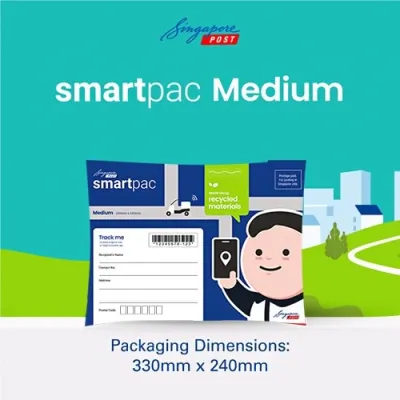
![[2pcs] SingPost Smartpac Medium size - for using within Singapore only - Prepaid Packaging with Tracking](https://img.lazcdn.com/g/p/3723bb51383d082fe8de03c34ecc0c93.jpg_400x400q80.jpg_.webp)
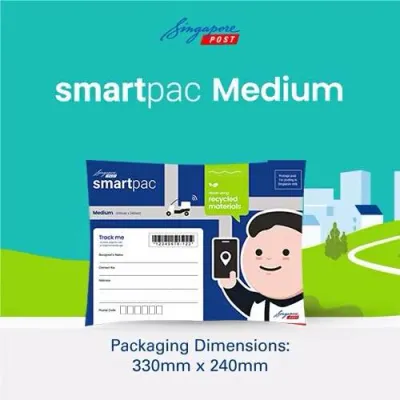
![[3 Pcs]SingPost Smartpac Small/Medium- A postage-paid packaging for local delivery. Trackable via the SingPost mobile app.](https://img.lazcdn.com/g/ff/kf/S98f844099c9d4689ad00c15c15908ddbe.jpg_400x400q80.jpg_.webp)
![[SINGPOST] BOX smartpac - A postage-paid packaging for local delivery. Trackable via the SingPost mobile app.](https://img.lazcdn.com/g/p/3360d819ebee92c4900de5d10f98c2e8.png_400x400q80.png_.webp)
Prices are valid at publication and may change. Please refer to the product page for the latest price.
Thickness is another vital parameter that directly dictates the bag’s strength and weight capacity. Usually measured in microns (µm) or mils, thickness determines how well the plastic resists tearing and puncturing. Standard lightweight bags generally range from 45 to 55 microns, which is perfectly adequate for soft, light items like clothing. For heavier goods, items with rigid packaging, or products with sharp corners, you should opt for heavy-duty bags measuring 70 to 80 microns or more to prevent accidental punctures during transit.
The material composition of the bag also plays a major role in its performance. Most high-quality courier bags are made from Polyethylene (PE) or co-extruded (co-ex) plastic films. Co-extruded bags are manufactured by fusing multiple layers of plastic together, resulting in superior puncture resistance, flexibility, and complete opacity. Before purchasing, always check the manufacturer’s product label or specifications to verify the material type and thickness to ensure they align with your specific shipping requirements.
Matching Bag Sizes to Your Parcel Types
While courier bags are commonly categorized under broad terms like small, medium, or large, exact millimeter dimensions vary significantly between different brands and third-party manufacturers. Relying solely on these generic size names can lead to purchasing errors. A more reliable approach is to map your specific parcel types to standard dimension ranges and verify the physical fit before packing.

Small Items: Accessories, Cosmetics, and Single Garments
Small courier bags, typically measuring around 170mm x 250mm (similar to an A5 sheet of paper), are ideal for lightweight, compact items. This category includes jewelry, phone cases, cosmetics, small stationery items, or a single lightweight t-shirt.
When packing these items, avoid the temptation to use a bag that is significantly larger than the product. Excess empty space allows the contents to shift constantly during transit, which can lead to surface scratches or cosmetic damage. If you must use a larger bag for a small item, fold the excess plastic over tightly and secure it with packing tape to keep the contents stationary.
Medium Items: Folded Apparel, Books, and Small Retail Boxes
Medium bags, generally ranging from 250mm x 350mm to 300mm x 400mm (roughly A4 size or slightly larger), are the most versatile option for online sellers and everyday mailers. They easily accommodate multiple folded clothing items, thick books, or small retail boxes.
However, shipping rigid items like books or hard boxes in medium polymailers introduces a puncture risk. The sharp, unyielding corners of these items can easily pierce thin plastic when parcels are stacked in delivery vans. To mitigate this risk, wrap the rigid corners in bubble wrap or cardboard protectors before bagging, or select a medium bag with a higher thickness rating of at least 60 to 70 microns.
Large Items: Multiple Garments, Shoes, and Bulky Soft Goods
Large courier bags, measuring 400mm x 500mm or larger (A3 size and above), are designed for bulky but relatively lightweight goods. They are perfect for shipping winter coats, multiple pieces of apparel, shoeboxes, or plush toys.
While these bags offer generous volume, they have clear physical limits. If an item is exceptionally heavy, highly irregular in shape, or stretches the plastic tight, a flexible bag may no longer be the appropriate packaging medium. In these scenarios, evaluate whether you should switch to a corrugated cardboard box. Cardboard provides the structural integrity needed to support heavy weights and protect bulky items from being crushed under other parcels.
Beyond Dimensions: Adhesive, Privacy, and Tamper-Evident Features
Selecting the right bag size is only half the battle; you must also consider the security features that protect your parcel from external elements and unauthorized access. The quality of the self-seal adhesive strip is paramount. High-quality bags feature a hot-melt adhesive that creates a permanent, destructive bond once pressed shut. This means the bag cannot be peeled open and resealed without visibly tearing the plastic, which acts as an excellent deterrent against tampering.
Privacy is another crucial factor when sending personal items or valuable merchandise. Co-extruded polymailers typically feature a dual-color design—often white or grey on the outside and black on the inside. This complete opacity ensures that the contents of your parcel remain entirely invisible under bright sorting lights, protecting recipient privacy and reducing the risk of opportunistic theft.
When shopping on a budget, it is helpful to know which features you can safely deprioritized. Aesthetic elements such as custom pastel colors, pre-printed patterns, or decorative borders add to the cost but do not improve the security or transit performance of the bag. To maximize value, focus your budget on core functional specifications like adhesive strength, material thickness, and opacity rather than visual design.
A Simple Formula to Measure and Select the Perfect Fit
To avoid purchasing bags that are either too tight or wastefully large, you can use a straightforward mathematical formula to determine the minimum bag dimensions required for any three-dimensional parcel. First, use a ruler or measuring tape to find the maximum length (L), width (W), and thickness or height (H) of your item in millimeters.
Because a flat bag must stretch to accommodate the height of a three-dimensional object, its usable width and length shrink as the item’s thickness increases. To calculate the minimum flat bag dimensions you need, apply the following formulas:
- Minimum Bag Width = Parcel Width (W) + Parcel Thickness (H) + 20mm (safety margin)
- Minimum Bag Length = Parcel Length (L) + Parcel Thickness (H) + 40mm (for the sealing flap and safety margin)
For example, if you are shipping a rectangular box that is 200mm wide, 250mm long, and 50mm thick, your minimum bag width should be 270mm (200 + 50 + 20), and your minimum bag length should be 340mm (250 + 50 + 40). Always round up to the nearest commercially available bag size. Buying a bag that is only “just large enough” when flat will leave you with insufficient plastic to fold the sealing flap over securely, compromising the integrity of the seal.
Frequently Asked Questions (FAQ)
Can I use a courier bag for fragile or easily crushed items?
Standard polymailers and courier bags do not provide any structural crush or impact protection. If you are shipping fragile items, glassware, delicate electronics, or products in collectible retail packaging, you should not rely on a flexible bag alone. These items must be thoroughly wrapped in multiple layers of bubble wrap and placed inside a rigid corrugated cardboard box to withstand the drops, vibrations, and heavy stacking that occur during transit.
Do standard polymailers provide enough weather protection in Singapore?
Yes, polyethylene and co-extruded courier bags are inherently waterproof and provide excellent protection against Singapore’s high humidity and sudden tropical downpours. However, the adhesive seal area remains a potential vulnerability if the parcel is left exposed to prolonged, heavy rain. To ensure maximum weather protection, check the manufacturer’s water-resistance claims, and always press the self-seal flap down firmly and completely flat across the entire width of the bag to eliminate any gaps where water could seep in.

Community discussion
Share your experience or ask a question. Comments are reviewed before publication.