
Selecting the correct singpost bag for your shipping needs in Singapore depends entirely on the specific service tier you choose—ranging from flat, machine-sortable envelopes for Basic Mail to three-dimensional poly mailers for tracked parcel services. To avoid unexpected surcharges or rejected packages, you must match your packed bag’s external dimensions to SingPost’s official service thresholds rather than relying on the empty bag’s nominal size.
Why Exact Bag Dimensions Dictate Your SingPost Postage
When preparing a shipment in Singapore, selecting the wrong packaging size is more than a minor inconvenience—it carries direct financial and logistical consequences. If you choose a shipping bag that is even slightly too large or thick, SingPost’s automated sorting systems or counter staff will reclassify your item. A package intended for a cheaper Basic Mail tier can instantly jump to a significantly more expensive parcel class, or be returned to sender due to insufficient postage.
The operational realities at Singapore’s central sorting facility rely heavily on high-speed optical scanners and automated slot-sorting machines. A flat mail sorting machine expects uniform, flexible envelopes. When a poly mailer bulges unevenly, it cannot glide through these machine tracks, risking mechanical jams, tearing, or manual sorting diversion. Treating your packaging as a precise cost-control measure is essential for e-commerce sellers and casual shippers alike. Every millimeter of excess thickness directly impacts your margins, making precise size selection a logistical necessity.
Products mentioned in this guide
![[1/2/3/4 pcs] SingPost Smartpac Medium size - for using within Singapore only - Prepaid Packaging with Tracking](https://img.lazcdn.com/g/p/8f2c3c3994c2d6fb1e87feebed85f10b.jpg_400x400q80.jpg_.webp)
![[2pcs] SingPost Smartpac Medium size - for using within Singapore only - Prepaid Packaging with Tracking](https://img.lazcdn.com/g/p/3723bb51383d082fe8de03c34ecc0c93.jpg_400x400q80.jpg_.webp)
![[1 pc] SingPost Smartpac - A postage-paid packaging for local delivery. Trackable via the SingPost mobile app.](https://img.lazcdn.com/g/ff/kf/Sbacc9034b1bf4b8b8aa42368084e6051F.jpg_400x400q80.jpg_.webp)
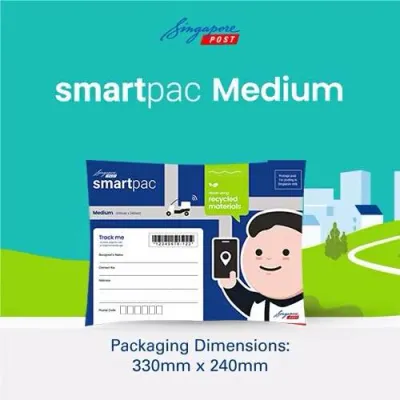
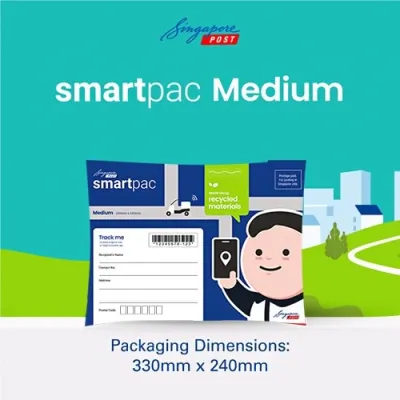
Prices are valid at publication and may change. Please refer to the product page for the latest price.
The Three Critical Dimensions SingPost Checks
To keep your shipping costs predictable, you must master the three physical parameters that SingPost evaluates: length, width, and thickness.

Length and Width: These define the overall footprint of your package. When purchasing a singpost bag (poly mailer), remember that excessive empty space can cause the plastic to fold over itself during transit. This accidental folding can create double-thick layers or alter the measured footprint, causing automated sensors to flag the package as oversized.
Thickness (Depth): This is the single most common point of failure for poly mailers. Standard mail services enforce strict thickness limits. A bag that bulges even slightly past the threshold—perhaps due to a folded collar or a thick product label—shifts the entire package into a higher pricing bracket.
Weight vs. Volume: Physical size limits apply independently of weight. You might be shipping a feather-light silk scarf that weighs under 20 grams, but if you pack it in an oversized, puffy bag that exceeds the maximum dimensional limits, SingPost will charge you based on the volume bracket rather than the actual weight. Always select a bag that closely hugs your item to minimize excess volume.
Matching SingPost Bag Sizes to Specific Services
Selecting the right singpost bag requires matching your packaging directly to the service tier you plan to use. Since postal guidelines can be updated, always align your choices with the primary categories below.
Basic Mail and Small Packets (Regular Mail)
For standard letters, printed papers, and small, flat items, Basic Mail remains the most economical option in Singapore. However, this tier has the strictest physical constraints. You must consult the official SingPost Basic Mail size chart to verify the exact maximum thickness and length-to-width ratios currently in effect.
Poly mailers used for regular mail must remain flat, uniform, and sufficiently rigid to pass through automated sorting machines without buckling. If your item is lumpy or uneven, it will not qualify. Avoid using heavily padded bubble mailers for Basic Mail. The built-in bubble wrap layer often consumes the entire allowable thickness threshold before you even insert your product, leaving virtually no room for the actual contents.
Speedpost and Tracked Parcel Services (SVTR)
When shipping larger items, books, or multiple goods, you will rely on tracked options like Speedpost or Singapore’s tracked parcel services. These tiers offer much greater physical flexibility, using a maximum length combined with girth (the perimeter around the thickest part of the bag) to determine compliance.
While these services easily accommodate thicker, three-dimensional poly mailers, they still have absolute maximum limits. Exceeding these limits determines whether your package can be accepted at a standard drop-off point, such as a POPStation or post office counter, or if it requires specialized, high-cost freight handling. For instance, Speedpost standard shipments have generous weight allowances but strict volumetric caps. If your poly mailer is too long, even if it is light, it cannot be processed through standard lockers or drop-off chutes, forcing you to pay premium courier rates. Before bulk-purchasing large shipping bags for your business, verify the current dimensional limits for your specific tracked service tier on the official SingPost website to ensure your inventory matches their operational limits.
How to Measure Packed Poly Mailers for Accurate Compliance
Ensuring your package passes inspection requires measuring it the exact same way postal staff do.
Measure the Packed Item, Not the Empty Bag: The dimensions printed on a pack of unused poly mailers represent their flat, empty state. Once you insert an item, the plastic stretches, pulls the sides inward, and expands outward. Always measure the final, fully packed product rather than relying on the manufacturer’s packaging label.
Accounting for the Gusset and Bulge: When a flat poly mailer is filled, it transitions into a three-dimensional shape. This bulging effect increases the package’s thickness while simultaneously reducing its effective flat length and width. You must measure the widest and thickest points of the bulge, not the flat seams.
Sealing and Folding Rules: Do not simply fold excess bag material over and tape it down loosely. SingPost measures the outermost edges of the sealed package. Any loose flaps, dog-eared corners, or uneven seams that stick out will be included in the final measurement, potentially pushing your package into a more expensive tier. Secure all loose plastic flat against the body of the package with clear packaging tape.
Pre-Mailing Checks to Avoid Rejection or Surcharges
To ensure a seamless drop-off experience at the post office or POPStation, implement a few simple quality checks at home.
First, construct or purchase a simple physical sizing template—a rigid piece of cardboard or plastic with cut-out slots matching SingPost’s standard thickness limits. If your packed poly mailer cannot slide easily through the designated slot without forcing it, you must repackage it or prepare to pay the higher service rate.
Second, ensure your shipping bag material is robust enough to maintain its shape. Cheap, ultra-thin plastic can easily tear, stretch, or deform under the weight of other packages, creating sudden size irregularities that expose your contents or cause handling issues.
Finally, apply your address labels and postal barcodes completely flat. Avoid placing labels over seams, wrinkles, or the curved edges of the bag. If a barcode is distorted by a fold or packaging bulk, automated scanners cannot read it, leading to manual processing delays.
Frequently Asked Questions (FAQ)
Can I use a standard poly mailer for SingPost Basic Mail?
Yes, but acceptance depends entirely on the final packed thickness and overall dimensions, not the material itself. You must ensure the packed poly mailer remains completely flat and fits comfortably within the official Basic Mail thickness limits. If the contents cause the bag to bulge or exceed the maximum slot size, it will be reclassified to a higher rate.
What happens if my shipping bag is slightly over the size limit?
If your package exceeds the limit for your chosen tier, SingPost will reclassify the item into a higher, more expensive parcel class, requiring you or the recipient to pay an unexpected postage surcharge. If the bag exceeds the absolute maximum dimensions allowed for standard parcel services, it may be rejected entirely, requiring you to retrieve it or arrange for alternative freight shipping.

Community discussion
Share your experience or ask a question. Comments are reviewed before publication.