
Selecting the correct plastic courier bag size is essential for protecting your shipments, minimizing shipping costs, and ensuring a professional presentation. To find the perfect fit, you must evaluate the physical dimensions of your product—including its length, width, and depth—and match them against standard industry bag sizes. Choosing a bag that is too small leads to split seams and damaged goods, while an oversized bag increases dimensional weight charges and allows items to slide around excessively during transit.
Understanding Plastic Courier Bag Dimensions and Specifications
When browsing packaging supplies, you will typically see dimensions listed as Width x Length. However, it is crucial to verify whether the stated length includes the adhesive sealing flap. Most manufacturers list the usable length of the bag, with the flap (usually measuring between 4 cm and 5 cm) treated as an additional dimension. Always check the product specification sheet to confirm if a bag listed as 25 cm x 35 cm actually offers 35 cm of internal depth or if that measurement includes the flap.
Standard courier bags come in several sizes. Small bags (15 cm x 20 cm to 17 cm x 30 cm) are ideal for flat documents, jewelry, or small stationery. Medium bags (25 cm x 35 cm to 30 cm x 40 cm) are the industry standard for apparel, books, and notebooks. Large bags (exceeding 40 cm x 50 cm) are designed for bulky items like winter coats, bedding, or consolidated orders.
Products mentioned in this guide
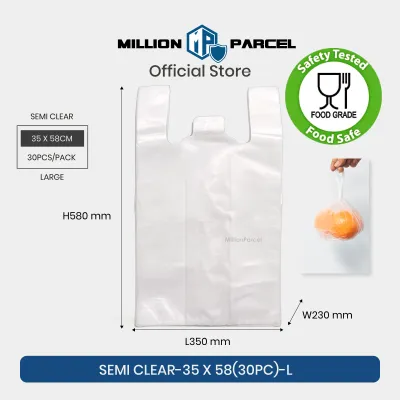
Prices are valid at publication and may change. Please refer to the product page for the latest price.
The thickness of the plastic, measured in microns, plays a critical role in the bag’s performance. Standard courier bags generally range from 40 to 60 microns in thickness. Thicker bags provide higher puncture resistance and greater opacity, which is vital for security. However, thicker plastic is also stiffer, reducing the bag’s ability to stretch around irregular shapes. Understanding this balance helps you select a material thickness that matches the physical profile of your inventory.
Calculating the Right Bag Size for Your Products
To determine the exact bag size you need, measure the maximum dimensions of your product. For a standard rectangular item, measure the length, width, and height at its thickest points. If you are shipping soft items like clothing, fold them as tightly and flatly as possible before measuring, as loose folds increase the required bag volume.

Once you have these measurements, apply a straightforward calculation formula. To find the minimum bag width, add the product’s width to its height, then add a safety margin of 1 cm to 2 cm. For the minimum bag length, add the product’s length to its height, plus a 1 cm to 2 cm safety margin. If the manufacturer’s stated bag length does not include the sealing flap, this calculated length is your target; if the flap is included, add another 4 cm to 5 cm to your calculation.
Adjust your sizing based on whether your goods are compressible or rigid. Soft items like apparel can conform to the shape of the bag, allowing for a tighter fit. Conversely, rigid items such as boxed stationery, books, or plastic cases do not yield. For these non-compressible goods, strictly adhere to the formula and add an extra centimeter of clearance to prevent rigid corners from puncturing the plastic or splitting the side seams during handling.
Evaluating Thickness, Opacity, and Material Features
Evaluating the physical characteristics of your courier bags ensures they can withstand the rigors of the postal system. Rather than relying on unverified weight capacity claims, focus on the micron rating and the construction of the plastic. High-quality courier bags are often made from co-extruded polyethylene, which bonds multiple layers of plastic together to create a material that resists tearing even when stretched or scraped against sorting machinery.
Opacity is another critical factor for security. Opaque bags, featuring a dark interior lining and a colored exterior, prevent transit handlers from identifying the contents, which is highly recommended for retail goods. Conversely, transparent plastic bags are useful for internal warehouse organization, cataloging, or when shipping items that already reside within a protective outer box where barcodes must remain scannable.
Before purchasing courier bags in bulk for your business, perform simple visual and physical checks on a sample batch. Inspect the side seams to ensure they are cleanly cut and fused without any weak spots or gaps. Test the adhesive strip by sealing a sample bag and attempting to pull it open after a few minutes; a high-quality adhesive should form a permanent, tamper-evident bond that tears the plastic rather than peeling away cleanly.
Packing Best Practices for Secure Shipping
Proper packing techniques are just as important as choosing the right bag size. When placing an item inside a plastic courier bag, gently press out any excess air before sealing the flap. Trapped air turns the bag into a balloon, making it highly susceptible to bursting when stacked under heavy boxes in delivery vans or automated sorting facilities.
When applying the self-adhesive strip, ensure the sealing area is completely clean and dry. Dust, moisture, or stray fibers from apparel can compromise the adhesive bond. Align the flap straight across the opening, fold it down tightly over the product to minimize movement, and press firmly along the entire length of the adhesive strip. Giving the pressure-sensitive adhesive a few seconds of firm contact ensures a secure, tamper-evident seal.
While plastic courier bags are highly versatile, they are not suitable for every product. If you are shipping items with sharp edges, highly fragile components, or extreme weight, you must use supplementary protective packaging. Wrap sharp corners in thick cardboard or bubble wrap before bagging them, or transition to a rigid corrugated shipping box to ensure the item arrives safely.
Frequently Asked Questions (FAQ)
Can I use standard plastic shopping bags for shipping products?
Standard plastic shopping bags are not designed to withstand the mechanical stresses of shipping. Unlike purpose-built courier bags, they lack integrated, tamper-evident self-adhesive flaps, requiring external tape that easily peels off during transit. Additionally, shopping bags are typically made from much thinner, single-layer plastic that punctures easily, and their open handles can catch on automated conveyor belts, leading to torn packages.
Using non-standard packaging also increases the risk of water damage, as shopping bags rarely offer a moisture-tight seal. Furthermore, standard shipping labels do not adhere well to the low-density plastics often used for retail shopping bags, raising the likelihood that your package will lose its tracking label.
How can I test if a courier bag is strong enough for my specific product?
To verify if a specific courier bag is suitable for your product, conduct a simple physical stress test. Place your heaviest or sharpest product inside a sample bag, seal it completely, and simulate the handling process by lifting, shaking, and gently dropping the package onto a flat surface.
Inspect the bag closely for any signs of stress whitening along the seams, which indicates the plastic is stretching close to its breaking point. Check the side seals to ensure they have not begun to separate, and verify that the adhesive flap remains firmly bonded. If you observe any tearing or seam separation, select a bag with a higher micron thickness or transition to a larger size.

Community discussion
Share your experience or ask a question. Comments are reviewed before publication.