
Committing to a 100-piece bulk pack of paper envelopes is a practical, cost-effective choice for home offices, businesses, or personal correspondence, but only if you select the correct size. Purchasing the wrong dimensions can leave you with a stack of useless paper products that either crush your documents or fail to seal properly. To find the perfect fit, you must match the envelope’s standard designation—such as C4, C5, or DL—to the exact dimensions and folding style of the documents you intend to send.
Standard Envelope Sizes and Their Paper Compatibility
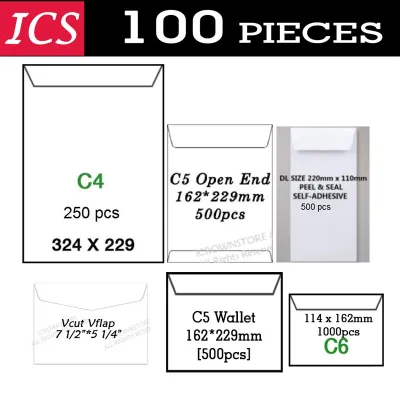
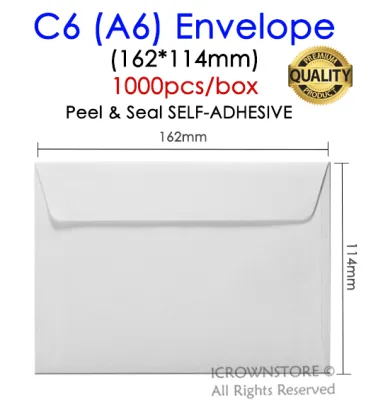
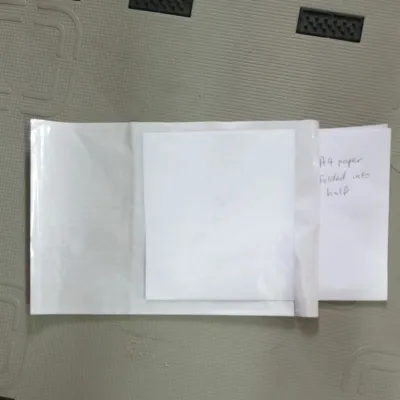
Understanding standard envelope sizes requires a quick look at the international ISO C-series system, which is designed to correspond directly with standard A-series paper sizes. The numbering system is straightforward: a C-series envelope is sized to fit the matching A-series sheet of paper perfectly. For example, a C4 envelope is designed to hold an unfolded A4 sheet of paper, while a C5 envelope fits an A5 sheet (or an A4 sheet folded once in half). A C6 envelope is sized for an A6 sheet, which is equivalent to an A4 sheet folded twice into quarters.
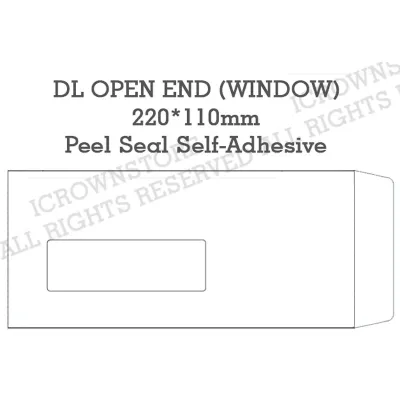
Another highly common option found in bulk packs is the DL envelope. The letters stand for “Dimension Lengthwise,” and this format does not follow the standard C-series numbering. Instead, a DL envelope is specifically designed to accommodate a standard A4 sheet of paper that has been folded horizontally into three equal parts, often referred to as a tri-fold. This is the classic format used for professional correspondence, invoices, and formal letters.
Products mentioned in this guide
Prices are valid at publication and may change. Please refer to the product page for the latest price.
When browsing 100-piece bulk packs, always check the physical dimensions printed on the packaging, which are typically listed in millimeters. A C4 envelope measures 229 mm by 324 mm, a C5 measures 162 mm by 229 mm, and a DL envelope measures 110 mm by 220 mm. Comparing these millimeter measurements to your documents ensures a precise fit, especially if you are using non-standard paper sizes or custom cardstock.
How to Match Envelope Dimensions to Your Documents
Selecting the right envelope size depends heavily on how you prepare your documents and the impression you want to make on the recipient. For standard business letters, invoices, and multi-page statements, the DL envelope is the most efficient choice. Folding your A4 documents into a tri-fold configuration keeps the presentation neat and professional while keeping the envelope compact and easy to handle.

If you are mailing documents that should only be folded once, such as greeting cards, invitations, or A5-sized flyers, a C5 envelope is the ideal match. This size is also highly practical for A4 documents folded in half, offering a balance between a compact mailing size and minimal folding. It is a popular choice for both personal mailings and mid-sized promotional materials.
For official contracts, certificates, legal documents, or high-end brochures that must remain completely flat, a C4 envelope is non-negotiable. Folding these types of documents can look unprofessional or even damage official seals and signatures. A C4 envelope ensures your A4 documents arrive in pristine, uncreased condition.
When choosing your bulk pack, always factor in the thickness of your contents. While a single sheet of paper slides easily into its corresponding envelope size, multiple sheets or thick cardstock will expand the envelope’s depth. This expansion pulls the sides inward, reducing the available width and height. To prevent tearing during insertion, ensure there is a margin of at least 2 to 3 millimeters of clearance on all sides of your document stack.
Essential Specifications to Check Before Buying a 100-Piece Pack
Beyond physical dimensions, the paper weight of your envelopes—measured in grams per square meter (GSM)—plays a critical role in durability and privacy. Standard utility envelopes typically range from 80 GSM to 90 GSM, which is sufficient for everyday billing and light correspondence. For professional mailings, legal documents, or confidential letters, opting for 100 GSM to 120 GSM provides a sturdier feel and better opacity, preventing sensitive text from showing through the paper.
The sealing mechanism is another vital consideration for a 100-piece pack, as it directly affects how quickly and easily you can prepare your mail. Gummed envelopes require moisture to activate the adhesive, making them highly shelf-stable but less convenient for manual bulk sealing. Self-seal envelopes feature two adhesive strips that bond when pressed together, while peel-and-seal options use a protective paper strip over a strong adhesive layer. Peel-and-seal designs generally offer the longest shelf life for bulk storage, as the adhesive remains protected from dust and air until use.
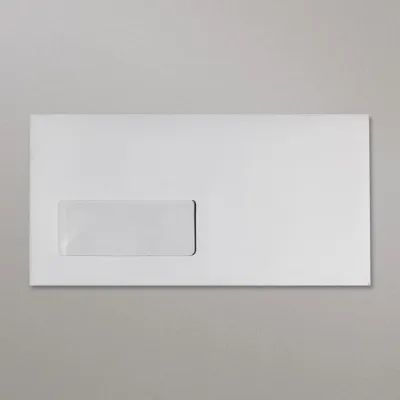
Finally, decide whether your mailing process requires a window or non-window design. Window envelopes feature a transparent plastic panel that aligns with the recipient’s address printed directly on the enclosed document, eliminating the need to print separate address labels. If you choose a window design, verify the exact placement and dimensions of the window on the packaging to ensure it aligns perfectly with your document templates. For personal letters or hand-addressed mail, a classic non-window envelope remains the standard choice.
Frequently Asked Questions (FAQ)
Can I fit multiple A4 pages in a single C4 or C5 envelope?
Yes, you can fit multiple pages, but the total capacity depends on the paper weight and the envelope’s construction. A standard flat C4 or C5 envelope can comfortably hold up to 10 to 15 sheets of standard 80 GSM paper before the seams begin to strain. If you need to mail thick booklets, catalogs, or large stacks of documents, look for bulk packs labeled as pocket envelopes or gusset envelopes, which feature expandable sides designed to accommodate bulkier contents.
What is the difference between C5 and B5 envelopes?
A C5 envelope is designed to fit an A5 sheet of paper, measuring 162 mm by 229 mm. A B5 envelope is slightly larger, measuring 176 mm by 250 mm, and is designed to fit B5-sized documents or thicker A5 booklets that require extra clearance. Because these two sizes are close in name but distinct in dimensions, always verify the exact millimeter measurements on the 100pcs pack label to avoid purchasing an envelope that is too small for your specific inserts.

Community discussion
Share your experience or ask a question. Comments are reviewed before publication.