
Finding the perfect leather journal cover for your favorite notebook requires looking past generic size labels like “A5” or “A6” and focusing on precise physical dimensions. Because stationery manufacturers use different standards for height, width, and spine thickness, a cover designed for one brand may pinch, warp, or slide off another. To ensure a secure and functional fit, you must measure your notebook’s exact dimensions, account for its binding style, and match it to a cover designed with the appropriate tolerances.
Investing in a high-quality leather cover protects your thoughts and sketches, but a mismatch in sizing can ruin the writing experience. A cover that is too tight will bend the corners of your notebook and strain the binding, while a cover that is too loose will allow the notebook to slide around, making it difficult to write evenly. By understanding how different brands construct their journals, you can select a leather cover that feels like a natural extension of your notebook.
How to Measure Your Notebook for a Leather Cover
To find a leather cover that fits your notebook like a glove, you must obtain precise measurements rather than relying on nominal size names. Start by closing your notebook completely and placing it on a flat surface. Using a metal ruler or a pair of calipers, measure the height from the top edge to the bottom edge of the cover. Next, measure the width from the outer edge of the front cover to the folded edge of the spine. Finally, measure the thickness of the spine at its widest point, which is often the center of the book block.
Products mentioned in this guide
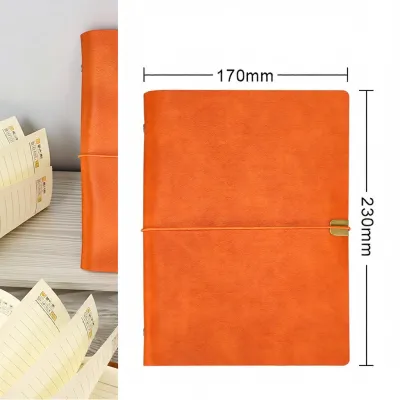
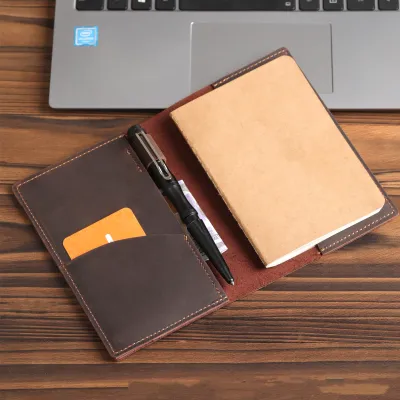
Prices are valid at publication and may change. Please refer to the product page for the latest price.
It is important to understand that manufacturer tolerances mean nominal sizes vary significantly between brands. An “A5” notebook from one manufacturer might be cut to the exact ISO standard of 148 mm by 210 mm, while another brand might trim their notebook slightly narrower to make it more portable. Hardcover notebooks also add extra millimeters to their height and width to protect the paper pages inside, whereas softcover notebooks typically match the paper dimensions exactly.
The binding type of your notebook also dictates the style of leather cover you need. Stitched and glued bindings create a rigid spine that requires a cover with a structured spine area or flexible slip-in pockets. Elastic-bound systems, on the other hand, rely on the notebook’s spine being flexible enough to sit flat against the leather cover. If you try to force a rigid hardcover notebook into a cover designed for a flexible softcover, you risk tearing the leather pockets or damaging the notebook’s binding.
Size Compatibility Guide for Popular Notebook Brands
A universal leather cover that fits every notebook brand perfectly does not exist. Stationery manufacturers design their products with unique proportions, cover materials, and page counts, all of which affect how the notebook sits inside a leather sleeve. A cover that fits a slim, softcover notebook will be far too tight for a thick, hardcover journal of the same nominal size.

When choosing a leather cover, you must match the cover’s holding mechanism to your notebook’s physical structure. Slip-in covers feature internal pockets or flaps that hold the front and back covers of the notebook. This design works exceptionally well for traditional hardcovers and softcovers. In contrast, traveler-style covers use elastic bands running down the spine to hold individual notebook refills, which is ideal for modular, slim notebooks but incompatible with standard bound journals.
Midori Traveler's Notebook & Refill Systems
The Midori Traveler’s Notebook system uses a proprietary sizing method that does not align with standard ISO paper sizes. The Regular size measures approximately 218 mm by 120 mm, creating a tall and narrow profile designed for travel logs and planning. The Passport size is much smaller, measuring approximately 134 mm by 98 mm, making it highly portable. When shopping for a leather cover for these systems, you must ensure the cover is specifically designated for “Traveler’s Regular” or “Traveler’s Passport” rather than standard A5 or A6 sizes.
Because the Midori system relies on elastic bands to hold multiple refills, you must verify the spine width of the leather cover before purchasing. If you plan to carry three or four paper refills, a standard leather cover may not have enough depth, causing the cover to flare open in an “alligator mouth” shape. This puts unnecessary strain on the elastic bands and leaves the edges of your paper refills exposed to wear and tear. Look for covers with wider spines or adjustable elastic configurations if you prefer a bulkier setup.
Hobonichi Techo (A6 & Cousin Sizes)
The Hobonichi Techo is famous for its use of ultra-thin Tomoe River paper, which allows the planner to contain hundreds of pages while remaining remarkably slim. The A6 Original and Planner models measure 105 mm by 148 mm, while the A5 Cousin measures 148 mm by 210 mm. Because these notebooks are standard ISO sizes, they fit a wider variety of universal covers, but their high page count means you must pay close attention to the spine thickness.
A standard Hobonichi planner has a spine thickness of approximately 14 mm to 17 mm. However, many Hobonichi users love to customize their planners with stickers, photos, and ephemera, which causes the notebook to swell significantly over the course of the year. If you plan to use your planner this way, choose a leather cover that offers a generous spine allowance or an adjustable closure mechanism. A cover that fits snugly in January may become impossible to close by June if you do not account for this paper expansion.
Leuchtturm1917 & Moleskine (Classic A5 & Pocket)
Leuchtturm1917 and Moleskine are two of the most popular notebook brands in the world, but their “A5” and “Large” sizes are not interchangeable. A classic Leuchtturm1917 A5 hardcover measures 145 mm by 210 mm, making it wider than a standard ISO A5. In contrast, a Moleskine Classic Large hardcover measures 130 mm by 210 mm, which is 15 mm narrower. A leather cover tailored specifically for a Leuchtturm1917 will leave a Moleskine notebook sliding around loosely, while a cover made for a Moleskine will be far too narrow to fit a Leuchtturm1917.
You must also check the corner radius and spine curvature of these notebooks. Leuchtturm1917 hardcovers have slightly rounded corners and a flat spine, while Moleskine hardcovers feature more pronounced rounded corners and a curved spine. If the leather cover’s internal slip-in flaps are too tight or rigid, sliding these thick hardcover boards inside can warp the cardboard covers or put pressure on the spine, eventually splitting the notebook’s binding. Ensure the leather cover has flexible, deep pockets that can accommodate the thickness of these hardcover boards without bending them.
Key Fit Factors Beyond Basic Dimensions
Beyond height and width, several environmental and material factors influence how a leather cover fits your notebook over time. One of the most overlooked variables is paper swelling. In humid climates, paper naturally absorbs moisture from the air, causing the pages to expand and the entire notebook to thicken. This natural swelling, combined with heavy ink usage from fountain pens or watercolor paints, can increase a notebook’s thickness by several millimeters, turning a once-perfect fit into a tight squeeze.
The characteristics of the leather itself also play a massive role in the long-term fit of your journal. Full-grain and vegetable-tanned leathers are organic materials that possess a natural elasticity. When you first insert your notebook, the fit may feel incredibly snug, but over a brief break-in period of a few weeks, the leather will naturally stretch and mold to the unique contours of your notebook’s spine and covers. Chrome-tanned or heavily finished leathers, however, have very little stretch and will remain rigid, meaning you must ensure a perfect fit right out of the box.
Pen loop sizing is another critical detail that can impact the usability of your leather cover. Many leather covers feature an attached pen loop, but if the loop is stitched too close to the edge of the cover, inserting a thick fountain pen or multi-pen can pull the leather tight and prevent the journal from closing flat. Verify that the pen loop is either elasticized or designed with a diameter that matches your preferred writing instrument, ensuring it does not distort the spine of your cover when a pen is inserted.
How to Verify Fit Before You Buy
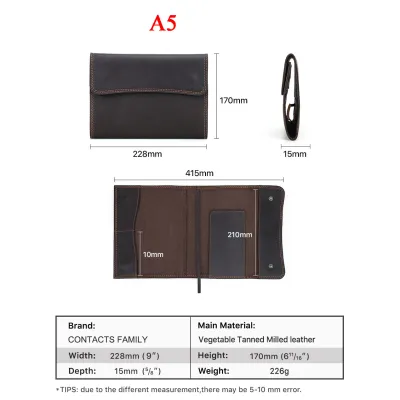
Before purchasing a leather journal cover, especially from an online marketplace, it is essential to follow a systematic verification process to avoid sizing errors. Always prioritize exact millimeter or inch specifications provided by the manufacturer over generic size names like “A5” or “medium.” Compare these specifications directly against the measurements you took of your notebook, keeping in mind that a leather cover should ideally be 2 mm to 4 mm larger than the notebook in height and width to allow for easy insertion and protection.
It is also wise to evaluate the seller’s return policy, particularly for high-end or custom leather goods. Custom-made covers with personalized monograms or non-standard dimensions are almost always final sale. For standard covers, check if the seller charges restocking fees—which can range from S$5 to S$15 on local online platforms—or requires you to cover the cost of return shipping. Understanding these potential costs beforehand can save you from a frustrating return process if the cover does not fit as expected.
To make your final decision, use this simple framework:
- Choose a brand-specific cover if your notebook has proprietary dimensions (such as Midori Traveler's or Hobonichi Techo) to ensure all pockets and closures align perfectly.
- Choose a universal slip-in cover if your notebook matches standard ISO sizes (like standard A5 or A6 softcovers) and you enjoy swapping between different notebook brands.
- Verify the return policy first if your notebook's spine thickness is near the cover's stated maximum limit, as paper swelling and leather rigidity can make the fit unpredictable.
- Avoid the cover entirely if your notebook's binding style (such as spiral binding or exceptionally thick hardcovers) conflicts with the cover's internal flap design.
Frequently Asked Questions (FAQ)
Can I use an A5 leather cover for a slightly smaller notebook?
While you can physically place a smaller notebook inside a larger A5 leather cover, it is generally not recommended. Slip-in flap designs rely on a snug fit to keep the notebook secure; if the notebook is too small, it will slide around inside the cover, making it difficult to write on a stable surface. This lack of structural support can also cause the pages of your notebook to rub against the leather, leading to bent corners, curled pages, and premature wear on the notebook’s binding.
Will a thick leather cover stretch over time to fit a thicker notebook?
High-quality leather does have some natural elasticity and will stretch slightly around the width and spine hinge as it breaks in, but this stretch is limited. It will not stretch enough to accommodate a notebook that is significantly thicker than the cover’s designed capacity. Forcing an oversized notebook into a tight leather cover puts excessive tension on the leather stitching and can permanently warp the leather or split the glued binding of your notebook.

Community discussion
Share your experience or ask a question. Comments are reviewed before publication.