
Selecting the right paper weight is a balance between operational cost, document presentation, and machine compatibility. For daily office tasks and high-volume printing, the choice typically comes down to two standard options: 70gsm and 80gsm. While they might look identical at a casual glance, their physical properties behave differently under the heat and pressure of modern office copiers and printers.
The primary difference lies in their density and thickness, which directly impact how ink sits on the page and how smoothly the sheets feed through your equipment. Choosing 70gsm paper is generally the most economical path for high-volume, single-sided internal documents. Conversely, 80gsm paper provides the added stiffness and opacity required for professional, double-sided reports and client-facing materials.
To make the right investment for your workspace, you must evaluate your typical print jobs, your printer’s mechanical requirements, and your storage environment. This guide breaks down the technical differences, practical applications, and key trade-offs between IK Plus 70gsm and 80gsm paper to help you select the ideal weight for your needs.
Products mentioned in this guide
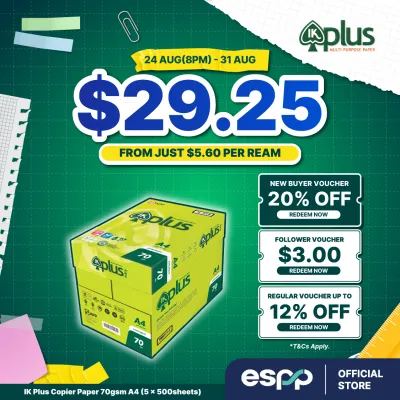
Prices are valid at publication and may change. Please refer to the product page for the latest price.
Understanding Paper Weight: What 70gsm and 80gsm Actually Mean
To choose the right paper, it helps to understand what these numbers represent. The acronym GSM stands for grams per square meter. This is a standard metric measurement used globally to determine the weight and density of paper. It measures how much a single sheet of paper would weigh if it were cut to exactly one square meter in size.
Because a standard A4 sheet is exactly one-sixteenth of a square meter, a single sheet of 80gsm A4 paper weighs approximately 5 grams, while a 70gsm sheet weighs about 4.375 grams. While this fraction of a gram seems negligible, it accumulates significantly across a standard ream of 500 sheets. This weight difference directly correlates to the paper’s physical thickness, structural stiffness, and overall opacity.
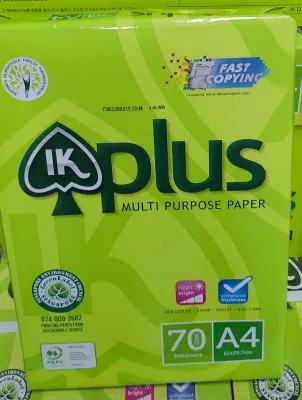
When purchasing IK Plus paper, you can verify these specifications directly on the packaging label. The outer wrapper typically displays the brand name, the paper size (such as A4, which measures 210 by 297 millimeters), the brightness rating, and the prominent GSM weight. Checking these details ensures you are getting the exact grade intended for your specific printing tasks.
It is important to note that the physical feel and actual performance of the paper are not determined by weight alone. The final result on the page depends heavily on your specific printer model, the complexity of its paper path, and whether you are using dry toner in a laser printer or liquid ink in an inkjet system. Different machines apply heat and pressure in unique ways, which can alter how the paper behaves during a print run.
When to Choose IK Plus 70gsm Paper
IK Plus 70gsm paper is engineered primarily for high-volume, everyday utility where cost efficiency and physical space are the primary concerns. This lighter weight is highly suitable for printing internal drafts, daily memos, single-sided text documents, and temporary reference sheets. If your office generates large volumes of paperwork that eventually end up in physical archives, the thinner profile of 70gsm paper is a distinct advantage.

Using thinner paper allows you to fit more sheets into standard filing cabinets, binders, and folders, effectively maximizing your physical storage capacity. Over thousands of printed pages, the reduced thickness can prevent filing systems from becoming prematurely overcrowded. Additionally, the lighter weight makes transporting large boxes of documents much easier for office staff.
However, the lighter weight comes with specific limitations that you must check before committing to a purchase. Because 70gsm paper is thinner, it has lower opacity, meaning there is a higher potential for show-through or ghosting. This occurs when text printed on one side is visible from the reverse side. This effect is particularly noticeable when printing documents with heavy ink coverage, dark images, or when using high-flow inkjet cartridges that saturate the paper fibers.
Before adopting 70gsm paper as your primary office standard, you should also verify your printer’s compatibility. Consult your printer’s user manual to confirm its minimum supported paper weight. Some high-speed office copiers or older printer models are calibrated for heavier media and may experience feeding issues, multi-sheet pulls, or excessive paper curling when processing lighter 70gsm sheets.
When to Choose IK Plus 80gsm Paper
IK Plus 80gsm paper is the widely accepted standard for professional business correspondence and general office use. This weight strikes an optimal balance between structural integrity and versatility, making it the preferred choice for external client proposals, formal contracts, resumes, and presentation decks. The extra thickness gives the paper a more substantial, premium tactile feel that conveys quality to the recipient.
One of the most significant benefits of 80gsm paper is its superior opacity, which makes it highly suitable for double-sided printing. The denser fiber structure prevents ink and toner from easily showing through to the opposite side, ensuring that both sides of the document remain clean, legible, and professional. This is especially crucial when printing charts, color graphics, or bold headings that require heavy ink coverage.
Furthermore, the added stiffness of 80gsm paper helps it maintain its flat shape during the printing process. When laser printers apply intense heat to fuse toner to the page, lighter papers can sometimes curl or warp. The structural resilience of 80gsm paper resists this thermal curling, resulting in flatter finished documents that are easier to stack, staple, and distribute.
Despite these advantages, there are practical limitations to consider. A ream of 80gsm paper is physically thicker and heavier than a ream of 70gsm paper, which means it will occupy more space in your supply closet and filing cabinets. Additionally, because more raw wood pulp is used in its manufacturing, 80gsm paper carries a higher cost per ream, which can impact your overall stationery budget over time.
Comparing 70gsm and 80gsm Across Key Dimensions
To help you evaluate the trade-offs between these two common paper weights, it is helpful to compare them across the key performance dimensions that affect daily office operations. The following table outlines how IK Plus 70gsm and 80gsm papers compare in practical scenarios:
| Performance Dimension | IK Plus 70gsm Paper | IK Plus 80gsm Paper |
|---|---|---|
| Opacity & Show-Through | Moderate; best suited for single-sided text. High-contrast images may show through. | High; excellent for double-sided printing with minimal ghosting. |
| Double-Sided Printing | Limited suitability; heavy ink or toner may bleed or show through clearly. | Highly suitable; handles duplex text and moderate graphics cleanly. |
| Printer Feed Reliability | Good; requires well-maintained rollers and proper humidity control. | Excellent; higher stiffness helps prevent feeding errors in most machines. |
| Relative Cost Efficiency | High; lower cost per sheet makes it ideal for high-volume, budget-conscious tasks. | Moderate; higher cost per sheet, justified by professional presentation needs. |
When reviewing printer feed reliability, it is crucial to understand that paper weight is only one variable in a larger system. A machine’s feeding performance is heavily influenced by the condition of its pickup rollers, the ambient humidity in your workspace, and the manufacturer’s engineering specifications. In humid environments, paper can absorb moisture from the air, making 70gsm paper limp and more prone to misfeeds if the printer’s rollers are worn.
If you are planning to switch paper weights for the first time in a specific printer model, we highly recommend testing a small batch first. This trial allows you to observe how the paper interacts with your specific machine. Pay close attention to ink drying times, the flat lay of the output pages, and whether the printer handles the sheets smoothly without static buildup or double-feeding.
Your Decision Framework: Which IK Plus Paper to Buy
To finalize your purchase decision, use this straightforward framework to match your specific printing environment and document requirements to the correct IK Plus paper weight.
Choose IK Plus 70gsm if:
- Your primary tasks involve high-volume, single-sided printing such as internal drafts, daily packing slips, or temporary reference sheets.
- You operate on a strict stationery budget and want to minimize your cost per printed page.
- Physical storage space in your office filing cabinets or archives is highly limited, and you need to maximize sheet capacity.
- Your printer is relatively new, well-maintained, and explicitly rated to handle lighter paper weights without feeding issues.
Choose IK Plus 80gsm if:
- You regularly print double-sided documents, formal reports, client proposals, or contracts that require a professional presentation.
- Your documents contain color graphics, charts, or heavy blocks of text that require high opacity to prevent show-through.
- You prefer a stiffer, more premium tactile feel that resists curling under the high heat of laser printers.
- You want a versatile, standard paper weight that performs reliably across a wide variety of office copiers and printers.
Verify first if:
- Your printer has a history of frequent paper jams or worn pickup rollers, as this may require a specific paper weight or mechanical maintenance.
- You are using third-party or high-yield ink cartridges, which may deposit more liquid ink and require the higher absorption and opacity of 80gsm paper.
- You are printing on non-standard paper sizes or using specialized bypass trays, which can alter the feeding dynamics of your machine.
Before committing to a large bulk order, remember to check current stock availability and bulk pricing options from authorized office suppliers or reputable online marketplaces. Comparing the total cost in S$ for bulk cartons versus individual reams can help you secure the best value for your workspace while ensuring a steady supply of high-quality paper.
Frequently Asked Questions (FAQ)
Does 80gsm paper prevent printer jams better than 70gsm?
While 80gsm paper is physically stiffer and can feed more reliably through worn rollers, it is not a universal cure for printer jams. Paper jams are frequently caused by factors unrelated to paper weight, such as accumulated paper dust, worn rubber pickup rollers, high ambient humidity, or improper loading in the paper tray. To ensure reliable feeding, always check your printer manufacturer’s manual to confirm the supported weight range (typically 60gsm to 105gsm) and ensure your paper is stored in a cool, dry place.
Can I use IK Plus 70gsm for double-sided printing?
You can use 70gsm paper for double-sided printing, but it is generally not recommended for professional or high-contrast documents. Because 70gsm paper is thinner, text and images printed on one side will often show through to the other side, reducing legibility. If you are printing simple, low-density text drafts for internal review, it may be acceptable. However, we recommend testing a single double-sided page first to evaluate the level of show-through and ink bleed before running a large duplex print job.
Is there a noticeable price difference between the two weights?
Yes, there is typically a consistent price difference between the two weights. Because 80gsm paper requires more raw wood pulp and material during the manufacturing process, it generally costs more per ream than 70gsm paper. When managing a tight office budget, you should compare the price per sheet in S$ rather than just the price per ream. Weigh this cost difference against the professional requirements of your documents and their expected lifespan to determine if the premium feel of 80gsm is worth the additional investment.

Community discussion
Share your experience or ask a question. Comments are reviewed before publication.