
Selecting the right foam box requires looking beyond the listed external dimensions to focus on the internal usable space, wall thickness, and structural design. Suppliers often highlight external measurements because they dictate shipping logistics, but the actual space available for your items is significantly smaller due to the thick insulating walls. Choosing an incorrect size can lead to items being crushed, insufficient space for protective cushioning or ice packs, or unnecessary shipping surcharges.
By understanding how to interpret specification sheets and account for manufacturing variables like wall taper, you can ensure your goods remain secure and temperature-controlled. This guide provides a practical framework for reading foam box sizes, evaluating wall thickness, and measuring your items accurately to find the perfect packaging fit.
Understanding External vs. Internal Dimensions
External dimensions represent the outermost boundaries of the foam box, including the lid when it is fully closed. These measurements are critical for logistics, as they determine how much physical space the box occupies in a warehouse, storage room, or delivery vehicle. Courier services use these external dimensions to calculate the volumetric weight of a shipment. If you use a box that is unnecessarily large, you may face higher shipping fees, as many local delivery services apply volumetric surcharges for oversized packages.
Products mentioned in this guide
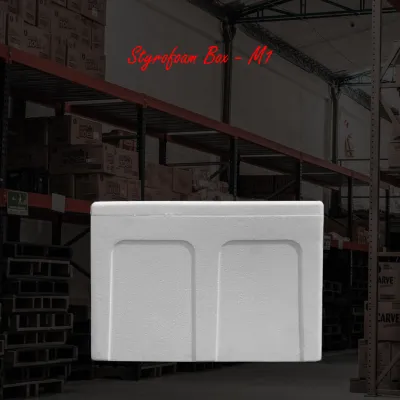
Prices are valid at publication and may change. Please refer to the product page for the latest price.
Internal dimensions define the actual usable cavity where your items, cushioning materials, and cooling agents are placed. Because expanded polystyrene (EPS) foam boxes require thick walls to maintain structural integrity and thermal insulation, the internal space is always substantially smaller than the external footprint. When browsing online marketplaces or supplier catalogs, never assume the primary listed size represents the internal capacity.
To identify which measurement a supplier is listing, look closely at the specification sheet or product description. Reputable packaging suppliers will explicitly label measurements as “External” or “Internal.” If a listing only provides a single set of dimensions, it is highly likely referring to the external size. In such cases, you must obtain the wall thickness to calculate the usable space.
To calculate the internal dimensions manually, use these straightforward formulas:
- Internal Length = External Length – (2 x Wall Thickness)
- Internal Width = External Width – (2 x Wall Thickness)
- Internal Height = External Height – Base Thickness – Lid Thickness
How Wall Thickness Affects Protection and Space
Wall thickness is the primary factor governing a foam box’s structural rigidity, impact absorption, and thermal insulation performance. Thicker walls contain more expanded polystyrene beads, which create a denser barrier against physical impacts and external temperature fluctuations. However, this protective barrier comes at the direct expense of internal capacity.

For lightweight, non-fragile, or non-perishable items, a thinner wall thickness of 1.5 cm to 2 cm is generally sufficient. These boxes are lighter, easier to handle, and maximize internal storage space relative to their external footprint. They are ideal for short-distance transport where temperature control is not a primary concern.
For heavy, highly fragile, or temperature-sensitive goods, thicker walls of 3 cm to 5 cm are necessary. These thicker barriers absorb severe shocks during transit and prevent external heat from penetrating the box, which is vital for preserving chilled or frozen items. The trade-off is a significantly larger external footprint; for example, a box with 4 cm walls reduces both the internal length and width by a total of 8 cm.
Rather than relying on generic product titles like “heavy-duty” or “insulated shipper,” always check the manufacturer’s technical specifications for the exact wall thickness in millimeters or centimeters. This ensures you select a box that balances physical protection with efficient space utilization.
Step-by-Step Guide to Sizing Your Items for a Foam Box
To ensure a secure fit and prevent damage during transit, follow this systematic measurement and selection workflow:
Step 1: Measure the item’s maximum dimensions. Use a firm measuring tape to find the absolute length, width, and height of your item. Always measure the widest points, taking into account any irregular protrusions, handles, cords, or product packaging. Treat the item as a perfect rectangle to find its maximum bounding box.
Step 2: Calculate the required internal clearance. Do not choose a box that matches your item’s measurements exactly. You must add a clearance buffer on all sides to accommodate protective cushioning materials or cooling elements. If you plan to wrap the item in bubble wrap, add the thickness of the wrap on both sides of each dimension. For temperature-sensitive shipments, ensure there is sufficient space to place gel packs or dry ice blocks alongside or on top of the item.
Step 3: Cross-reference with the supplier’s specification sheet. Compare your calculated target dimensions against the supplier’s listed internal dimensions. If your required measurements fall between two standard box sizes, always round up to the larger size. It is much easier to fill a slight void with extra packing paper than to force an item into a box that is too tight.
Step 4: Verify the box’s weight capacity. Physical dimensions are only half of the equation. You must also check the maximum weight limit of the foam box. Placing a heavy item in a low-density foam box can cause the bottom to bow or blow out when lifted. Ensure the structural limits of the box match or exceed the actual weight of your packaged goods.
Common Sizing Mistakes and How to Avoid Them
One of the most frequent errors is mistaking external dimensions for internal capacity. This mistake often results in purchasing boxes that are physically impossible to pack, leading to costly returns and project delays. Always double-check that your item’s dimensions plus clearance are smaller than the listed internal measurements.
Another common oversight is forgetting to account for the volume of internal void fill. Packing peanuts, air pillows, and paper dunnage occupy physical space. If you do not factor this space into your initial calculations, you may end up compressing your protective materials, which reduces their ability to absorb shocks.
Measuring irregularly shaped items incorrectly also leads to sizing failures. If you measure only the base of a flared vase or a T-shaped component, the wider sections will not fit inside the box. Always use the maximum bounding box method to ensure every part of the item is accommodated.
Finally, many buyers overlook the internal taper of molded foam boxes. During manufacturing, molds are designed with a slight slope, known as a draft angle, so the finished foam box can be easily released from the tooling. This means the internal bottom of the box is often slightly narrower than the top opening. If your item is a rigid, tight-fitting block, check if the supplier lists both the top-internal and bottom-internal dimensions to prevent the item from getting wedged halfway down.
Frequently Asked Questions (FAQ)
Do foam box dimensions include the lid?
Yes, the listed external height of a foam box almost always includes the lid when it is fully closed. However, the internal depth is measured from the interior bottom of the base to the underside of the closed lid. Because some lids feature a recessed plug design that extends downward into the box cavity to create a tight seal, the actual usable height may be slightly less than the physical wall height of the base. Always check the supplier’s technical drawings or measure the base and lid separately if you require high precision.
How much extra space should I leave inside the foam box for padding?
For standard fragile items, you should leave a clearance buffer of at least 2 cm to 5 cm on all six sides of the item. The exact space required depends on the type of cushioning you use. Loose-fill packing peanuts and thick bubble wrap require a larger buffer to be effective, whereas custom-cut foam inserts or thin foam sheets may require less. The primary goal is to ensure that the item does not make direct contact with the internal walls of the foam box, preventing external impact forces from transferring directly to your product.

Community discussion
Share your experience or ask a question. Comments are reviewed before publication.