
When preparing items for shipping, storage, or relocation, selecting the right packaging is more than a matter of finding a box that looks big enough. The numbers and technical specifications printed on a carton represent precise physical dimensions, structural wall configurations, and weight capacities. Understanding how to read these specifications ensures your items remain secure during transit while preventing unnecessary spending on oversized boxes or excess shipping fees.
Decoding Carton Dimensions: Length, Width, and Height
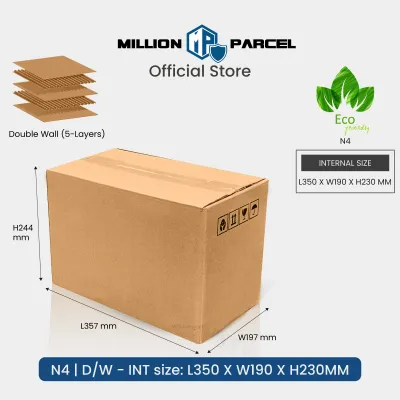
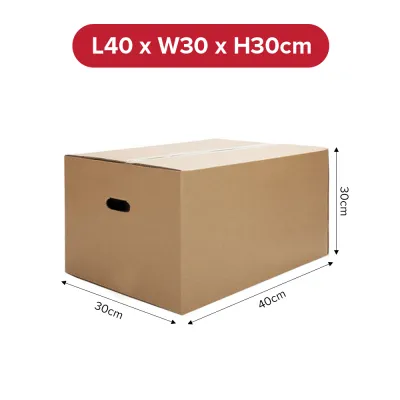
Every standard carton is specified using a three-dimension sequence: Length x Width x Height (L x W x H). To identify these sides correctly, look at the open top of the box. The longer of the two sides forming the opening is the Length, while the shorter side is the Width. The Height is the vertical distance measured from the top opening down to the inside bottom of the box.
A common pitfall is confusing internal dimensions with external dimensions. Manufacturers almost always list internal dimensions on product spec sheets because they dictate the actual usable space for your items. External dimensions, on the other hand, include the thickness of the corrugated board and the outer flaps. These external measurements are critical for calculating shipping costs—especially when local couriers charge based on volumetric weight—and can help you avoid unexpected courier surcharges of S$10 or more for volumetric weight discrepancies.
Products mentioned in this guide
Prices are valid at publication and may change. Please refer to the product page for the latest price.
When choosing a carton, you must also account for protective void fill. If you are packing fragile items that require bubble wrap, foam inserts, or crumpled paper, you cannot simply match the box dimensions to the item size. A good rule of thumb is to add at least 20 to 50 millimetres of clearance on all sides to accommodate cushioning materials, ensuring the item does not press directly against the outer walls of the carton.
Understanding Wall Types and Flute Profiles
The strength and protective qualities of a carton depend heavily on its wall construction. Single-wall cartons consist of a single wavy layer of paper (the flute) glued between two flat outer layers (the liners). These are lightweight, cost-effective, and highly suitable for everyday shipping of non-fragile items. Double-wall cartons feature two layers of fluting separated by an extra flat liner, providing significantly higher crush resistance and structural rigidity for heavy or delicate goods.

The wavy middle layer, or flute, comes in various profiles designated by letters such as A, B, C, E, and F. These letters do not represent a quality grading scale; instead, they indicate the height of the waves and the number of flutes per linear metre. For instance, C-flute is relatively thick and offers excellent stacking strength, making it common for shipping boxes. B-flute is thinner and offers superior puncture resistance and a flatter surface for printing, while E-flute is very thin and typically used for retail packaging or small mailer boxes.
Before packing heavy or valuable items, always inspect the manufacturer’s board grade markings. High-quality cartons often feature a combination of different flute profiles in double-wall configurations (such as BC-flute) to balance cushioning with puncture resistance. Verifying these material specifications helps you avoid structural failures when boxes are stacked or subjected to rough handling.
Interpreting Load Ratings and Weight Limits
To prevent a box from failing during handling, you must locate and understand its weight capacity indicators. Most commercial cartons feature a circular stamp printed on an outer flap, known as the Box Maker’s Certificate (BMC). This stamp acts as an official declaration of the box’s structural capabilities, listing key metrics such as the gross weight limit and the board’s strength rating.
The strength rating is typically expressed through either the Bursting Test (Mullen test) or the Edge Crush Test (ECT). The Bursting Test measures the force required to rupture the face of the corrugated board, indicating its resistance to internal punctures from sharp objects. The Edge Crush Test measures the top-to-bottom compression strength of the board, which directly correlates with how much weight a box can support when stacked in a warehouse or delivery truck.
It is vital to distinguish between a single box’s maximum weight capacity and its actual stacking strength. While a carton might be rated to hold up to 15 kilograms of internal weight, high humidity levels—common in tropical climates like Singapore—can weaken paper fibres over time, reducing its stacking capacity by up to half. If your packed boxes exceed these rated limits or show signs of bowing, stop packing immediately and consult your packaging supplier for heavy-duty, moisture-resistant alternatives.
Matching Carton Specs to Your Packing Needs
Selecting the right carton requires a systematic approach that balances the physical characteristics of your items with the realities of the shipping journey. For lightweight, self-supporting items like clothing or soft goods, a standard single-wall carton is usually sufficient. However, heavy, dense, or fragile items like books, electronics, or glassware demand double-wall construction to prevent the box from sagging or bursting under pressure.
Your chosen transit method also dictates the required box strength. Standard courier networks involve frequent sorting, conveyor belts, and manual handling, which expose packages to drops and vibrations; this environment requires robust cartons with ample internal cushioning. Conversely, palletized freight shipments, where boxes are wrapped together and moved by forklifts, prioritize high stacking strength (ECT ratings) over individual puncture resistance.
For standard shipping needs, off-the-shelf cartons are highly economical and readily available from local stationery and packaging suppliers. However, if you are shipping highly valuable, oddly shaped, or extremely heavy items, relying on standard boxes can lead to excessive void fill costs or transit damage. In these scenarios, seeking custom packaging solutions from a professional manufacturer ensures a precise fit and optimized structural protection.
Frequently Asked Questions (FAQ)
Does a higher wall thickness always mean a stronger carton?
No, wall thickness alone does not guarantee a higher weight capacity. The structural strength of a carton is determined by a combination of the paper grade (the weight and quality of the liners), the flute structure, and whether it is single- or double-walled. A thin, high-density board can easily outperform a thicker, low-grade board; always verify the official Edge Crush Test (ECT) or gross weight rating on the manufacturer’s stamp rather than relying on visual thickness.
How do I measure a carton if it is already assembled?
To measure an assembled carton accurately, use a stiff tape measure to find the dimensions of the interior floor and the vertical depth. Measure from the inside of one wall to the inside of the opposite wall, ensuring you do not include the thickness of the cardboard itself. Keep in mind that inward-bulging walls or overlapping flaps can slightly reduce the usable space, so it is wise to subtract a few millimetres from your measurements to ensure a safe fit for your items.
Community discussion
Share your experience or ask a question. Comments are reviewed before publication.