
To choose the right kraft box size, you must measure your item’s maximum length, width, and height, add a specific buffer for protective padding (typically 2 to 5 cm), and compare these final dimensions against the manufacturer’s specified internal box dimensions rather than the external ones. Selecting the correct size ensures your items remain secure during transit while keeping your packaging and shipping costs as low as possible.
Why Accurate Kraft Box Sizing Matters
In Singapore’s competitive e-commerce and retail landscape, shipping efficiency is a major factor in business viability. Local courier services and international shipping networks calculate delivery fees based on either actual weight or volumetric weight—whichever is greater. Volumetric weight is determined by multiplying the outer length, width, and height of a package and dividing by a standard courier factor (typically 5000). If you use a kraft box that is even slightly larger than necessary, you pay to ship empty air, which quickly erodes your profit margins.
Beyond shipping fees, oversized boxes require excessive void fill materials like bubble wrap, packing peanuts, or crumpled paper. This increases your material expenses and slows down your packing workflow. Furthermore, storage space is highly prized in Singapore. Whether you are running an online business from a compact warehouse in Ubi or storing packaging supplies in a residential HDB flat, storing bulky, unnecessarily large boxes reduces your available storage capacity.
Products mentioned in this guide
Prices are valid at publication and may change. Please refer to the product page for the latest price.
Conversely, choosing a box that is too small poses severe physical risks to your products. When items are crammed into a tight space, there is no room for protective cushioning. If the box is subjected to impact, dropped, or stacked under heavier parcels during transit, the force is transferred directly to the product inside. This can result in crushed corners, bent paper edges for stationery items like planners and notebooks, or shattered glass components in fragile goods. A box packed too tightly also puts outward pressure on the seams, increasing the risk of the box bursting open before it reaches its destination.
Step-by-Step Guide to Measuring Your Items
To establish the baseline dimensions for your packaging, you must measure your items with high precision. Avoid using flexible sewing tape measures, which can stretch over time and yield inaccurate readings. Instead, use a rigid metal tape measure or a set of digital calipers for smaller, high-precision stationery items like fountain pens, ink bottles, or custom wax seals.

For standard rectangular items, such as books, sketchpads, or boxed stationery sets, lay the item flat on a hard surface. Measure the three primary dimensions:
- Length: The longest side of the item's base.
- Width: The shorter side of the item's base, measured perpendicular to the length.
- Height: The vertical distance from the flat surface to the highest point of the item.
If you are packaging irregular, asymmetrical, or non-rectangular items, you must use the “bounding box” method. Imagine a tight, invisible rectangular box that completely encloses your item. Measure the maximum distance between the furthest points on opposite sides for each dimension. For example, if you are shipping an L-shaped desk organizer or a handmade ceramic mug with a prominent handle, your width measurement must extend to the outer edge of the handle, and your height must capture the tallest point of the structure.
Always account for rigid or protruding elements that cannot be folded or disassembled. If your item has delicate knobs, decorative bows, or rigid plastic packaging, these elements define the absolute minimum boundaries of your box. If you plan to ship multiple items together in a single kraft box, arrange them in the exact configuration they will be packed—whether stacked vertically or laid out side-by-side—and measure the overall combined length, width, and height of the entire bundle as a single unit.
Calculating Space for Padding and Void Fill
Once you have the exact dimensions of your item, you cannot simply buy a box of those exact dimensions. You must calculate the necessary buffer zone for protective padding and void fill. The amount of extra space you need depends directly on the fragility of the product and the type of cushioning material you plan to use.
First, categorize your products by fragility levels:
- Sturdy items: Products like hardcover journals, heavy-duty metal rulers, or wooden desk organizers are highly resilient. They primarily need protection from surface scratches, dust, and moisture. For these items, a thin layer of tissue paper, a kraft paper sleeve, or a single layer of bubble wrap is sufficient. You only need to add 0.5 to 1.5 cm of clearance to your item's dimensions.
- Fragile items: Products like glass inkwells, delicate ceramic pen rests, or electronic accessories are highly vulnerable to impact. These items require comprehensive shock absorption. For adequate protection, you must plan for a minimum of 3 to 5 cm of cushioning space on all six sides of the item.
Next, factor in the thickness of your chosen wrapping materials. Wrapping a notebook in two layers of standard small-bubble wrap adds approximately 1 cm to each side, which translates to an additional 2 cm to both the total length and width, and 2 cm to the height. If you are using thick foam inserts, molded pulp trays, or heavy-duty air pillows, the space requirements will be even larger.
When using loose-fill materials like crumpled kraft paper or starch-based packing peanuts, remember that these materials compress under weight. To maintain their shock-absorbing properties, they must be packed densely enough to prevent the item from shifting. Ensure your box dimensions allow for a consistent, thick layer of loose-fill material surrounding the product completely, preventing it from migrating toward the outer walls of the box during transit.
Understanding Inner vs. Outer Box Dimensions
A frequent mistake when purchasing packaging supplies is confusing the inner and outer dimensions of a kraft box. Manufacturers and suppliers usually list both sets of measurements, and understanding the distinction is critical to ensuring your items fit safely.
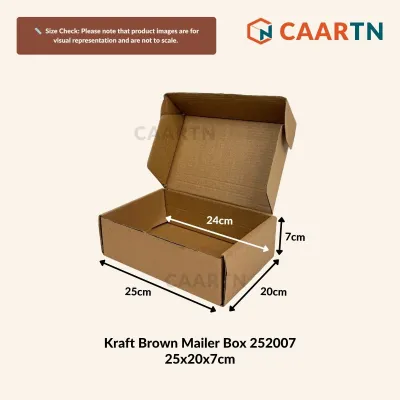
The inner dimensions represent the actual usable space inside the box. This is the only measurement that matters when determining if your wrapped product and its padding will fit. The outer dimensions represent the total physical footprint the box occupies in the real world. This measurement is used by logistics providers to calculate shipping volumes, and it determines how many boxes can be stacked on a warehouse shelf or loaded into a delivery vehicle.
The difference between these two measurements is determined by the thickness of the box walls, which depends on the corrugated flute type:
- Single-wall corrugated boxes: Typically use B-flute (about 3 mm thick) or E-flute (about 1.5 mm thick). These are ideal for lightweight items, offering a good balance of structural strength and space efficiency.
- Double-wall corrugated boxes: Often use BC-flute (about 6 mm thick). These are designed for heavy or highly valuable goods, providing superior puncture resistance and stacking strength.
Because double-wall boxes have much thicker walls, their internal dimensions can be up to 12 mm smaller than their external dimensions in length, width, and height. In Singapore’s humid climate, corrugated cardboard can naturally absorb ambient moisture, which slightly softens the fibers and can cause the walls to expand or flex. Choosing a slightly thicker wall or a double-wall box provides necessary structural integrity under humid conditions, but you must compensate by selecting a larger outer size to maintain the required internal volume. Always base your purchasing decisions on the supplier’s listed internal dimensions to avoid ordering boxes that are too small.
Diagnosing Your Box Choice: Signs It Is Too Big or Too Small
Before placing a bulk order for kraft boxes, it is highly recommended to purchase a single sample box to perform a physical test packing. This allows you to diagnose whether your chosen size is optimal or if you need to adjust your measurements.
Look for clear physical signs that a box is too small. If the sides of the box bulge outward when closed, or if you must apply downward force to get the top flaps to meet, the box is too small. This puts excessive tension on the adhesive tape and the box joints, making it highly likely to burst open during transit. It also indicates that your item is pressed directly against the outer wall of the box, leaving zero protective buffer against external impacts.
Conversely, identify the warning signs of an oversized box. Place your wrapped item inside, add your void fill, seal the box, and perform a gentle “Shake Test.” If you can feel or hear the item shifting, sliding, or knocking against the sides, there is too much empty space. An oversized box requires a disproportionate amount of void fill to stabilize the contents, which increases your unit packaging costs. Furthermore, if a box has large pockets of empty space inside, it loses its structural integrity and is highly susceptible to collapsing when stacked under heavier parcels in a courier’s delivery van.
Frequently Asked Questions (FAQ)
Should I measure the kraft box from the inside or the outside?
Always measure the kraft box from the inside to determine if your product and its protective padding will fit. Inner dimensions represent the actual usable volume of the box. Outer dimensions are only used to calculate shipping costs, volumetric weight, and storage space requirements.
How do I measure a cylindrical or round item for a square kraft box?
To measure a cylindrical or round item, such as an ink bottle, a rolled poster, or a circular tin, measure the maximum diameter of the circle and the total height of the object. The diameter of the cylinder represents both the minimum length and the minimum width required for the inner box space. The height of the cylinder represents the required height of the box. This ensures the round item fits securely without being squeezed or rolling excessively.

Community discussion
Share your experience or ask a question. Comments are reviewed before publication.