
Choosing the right shipping materials is a critical step in streamlining your business logistics, reducing shipping costs, and ensuring that products arrive at their destination undamaged. For many e-commerce sellers, home businesses, and logistics coordinators, the smartpack poly mailer is a staple packaging solution. However, selecting the wrong bag size can lead to wasted material, excessive shipping fees due to volumetric weight calculations, or worse, split seams that expose your products to the elements.
To find the ideal fit, you must look beyond the flat dimensions of the bag and understand how three-dimensional products interact with flexible plastic. By learning how to interpret manufacturer size labels, apply a simple measurement formula, and evaluate key physical specifications, you can select the perfect mailer size for every item in your inventory.
Decoding Smartpack Courier Bag Dimensions and Size Labels
When browsing shipping bags, you will typically see sizes listed in a standard Width x Length (W x L) format, such as 250 mm x 350 mm or 320 mm x 450 mm. While these numbers seem straightforward, they represent the external dimensions of the bag when it is laid completely flat. They do not represent the actual volume of the space inside once an item is inserted.
Products mentioned in this guide

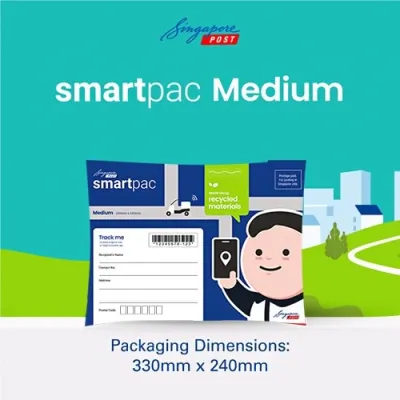
Prices are valid at publication and may change. Please refer to the product page for the latest price.
The usable internal space of a courier bag is always smaller than its external dimensions. When you place a three-dimensional object inside a flat bag, the plastic must stretch around the object’s thickness. This displacement pulls the sides of the bag inward, effectively reducing both the available width and length.
Another critical factor is the self-seal lip, or flap, which contains the adhesive strip. Depending on the manufacturer and the specific product line, the listed length of the bag may or may not include this flap. Some brands measure the bag from the very top of the flap to the bottom seam, while others measure only the usable body of the bag up to the opening. To avoid purchasing bags that are too short, you must verify this detail on the physical packaging label or the manufacturer’s official specification sheet rather than assuming a standard industry convention.
While sizes vary across different production lines, courier bags generally fall into a few non-exhaustive categories to help guide your initial selection:
- Small Mailers (e.g., 15 x 20 cm to 20 x 28 cm): Best suited for flat, lightweight items like jewelry, cosmetics, small stationery items, or phone accessories.
- Medium Mailers (e.g., 25 x 35 cm to 30 x 40 cm): The standard choice for single apparel items, t-shirts, notebooks, thin novels, and medium-sized soft goods.
- Large Mailers (e.g., 35 x 45 cm to 40 x 55 cm): Designed for bulkier apparel like hoodies, winter wear, multiple clothing items packed together, or shoeboxes.
- Extra-Large Mailers (e.g., 50 x 60 cm and larger): Ideal for large bedding, pillows, backpacks, or multiple consolidated orders.
Because sizing categories are not standardized across all brands, always consult the specific smartpack size catalog or technical datasheet before placing a bulk order.
A Practical Formula for Measuring Your Products
To prevent bag rupture and ensure a professional presentation, you should never guess which size bag your product needs. Instead, use a simple mathematical formula that accounts for the three dimensions of your item: length, width, and thickness (height).

Before calculating, use a rigid ruler or measuring tape to find the maximum points of your product’s dimensions. If the item is irregular, measure the widest, longest, and thickest points. Once you have these numbers, apply the following calculations:
- Required Bag Width = Product Width + Product Thickness + 2 cm (Allowance)
- Required Bag Length = Product Length + Product Thickness + 5 cm (Allowance for sealing and movement)
Ignoring product thickness is the single most common cause of seam failure during transit. When a flat bag is forced to accommodate a thick item, the lateral tension on the side seals increases exponentially. During sorting and transit, packages are subjected to drops, stacking, and conveyor belt friction. If the plastic is already stretched to its physical limit just to close the bag, any minor impact will cause the seams to burst open.
Adding a practical margin of 2 to 5 cm is essential for a safe seal. For highly compressible items like a folded cotton t-shirt, you can stick to the lower end of this margin because the product will naturally yield to the bag’s shape. For rigid, non-compressible items like a wooden photo frame, you must use the maximum margin. This extra space ensures that you can fold the self-seal flap over smoothly without putting structural stress on the seams.
Matching Bag Sizes to Your Most Shipped Products
Different types of merchandise require distinct packaging strategies to balance protection, presentation, and shipping efficiency.
Clothing and Soft Textiles
Soft goods are the easiest items to pack in flexible mailers because they can be compressed and folded into various configurations. When packing apparel, the goal is to create a snug, compact bundle. A loose bag allows the clothing to shift around, which can cause the package to look unprofessional and increase the risk of the plastic snagging on sorting machinery.
Fold the garment neatly to match the proportions of your chosen bag size. Compress as much air out of the package as possible before sealing the flap. This snug fit keeps the volumetric profile of the shipment small, which is highly beneficial for keeping local delivery rates economical.
Books, Electronics, and Rigid Items
Unlike textiles, rigid items cannot conform to the shape of a bag. This means your measurements must be precise, and you must account for sharp edges. The corners of hardback books, plastic retail boxes, and electronic components can easily puncture thin poly material if the bag is pulled too tight.
Before placing a rigid or delicate item into a courier bag, wrap it in a protective cushioning layer, such as bubble wrap or foam sheeting. Once wrapped, measure the item again. Bubble wrap can easily add 1 to 3 cm of thickness to all sides of a product, which completely changes the bag size you will require.
When to Skip Courier Bags for Boxes
While poly mailers are incredibly versatile and cost-effective, they do not offer structural protection. They are designed to keep items clean and dry, not to absorb impacts.
You should skip courier bags entirely and opt for corrugated boxes or rigid cardboard mailers if your products meet any of the following criteria:
- The item is highly fragile, such as glassware, ceramics, or delicate mechanical parts.
- The product is heavy or dense enough to tear through flexible plastic under its own weight during a drop.
- The item's value or structural integrity depends on its retail packaging remaining pristine (such as collectable toys or high-end cosmetics boxes).
- The product is easily crushed, like structured hats or leather handbags that could lose their shape under pressure.
If you still want the waterproofing benefits of a poly mailer for these items, you can pack the product securely inside a box first, and then slide the box into a larger courier bag as an outer protective skin.
Beyond Size: Other Specifications That Affect Your Choice
Finding the right dimensions is only half the battle. To ensure your packages survive the shipping journey, you must also evaluate the material specifications of the mailer.
- Material Thickness (Microns): The strength of a plastic bag is largely determined by its thickness, measured in microns. Standard utility mailers typically range from 45 to 60 microns. If you are shipping heavy, dense, or sharp-edged items, look for heavy-duty mailers that feature a thickness of 70 to 90 microns. Always check the manufacturer's product specifications to verify the micron count.
- Opacity and Privacy: High-quality courier bags utilize co-extruded plastic layers. This usually involves a dark grey or black interior layer paired with a colored or white exterior layer. This co-extrusion ensures the bag is 100% opaque, preventing anyone from seeing the contents of the package. This privacy is essential for security and reducing the risk of theft during transit.
- Seal Adhesion: The self-seal adhesive strip must form a permanent, tamper-evident bond. In warm, humid tropical climates like Singapore, low-grade adhesives can soften, slip, or lose their stickiness. Look for mailers that utilize high-performance hot-melt adhesives. Once sealed, the only way to open the bag should be by cutting or tearing the plastic, ensuring that any tampering is immediately obvious.
Because these performance traits depend heavily on the specific manufacturing batch and material blends, always refer to the physical product label or official technical documentation to confirm these details before committing to a specific line of mailers.
Frequently Asked Questions (FAQ)
Does the stated bag length include the self-seal flap?
This measurement convention varies by manufacturer. Some brands include the 4 to 5 cm self-seal flap in their total listed length, while others only measure the usable body of the bag up to the opening. To ensure your products fit, always check the product specification sheet or physically measure a sample from the bottom seam to the opening line before purchasing in bulk.
What should I do if my product falls between two standard sizes?
If your calculated dimensions fall between two standard bag sizes, always choose the larger size. A bag that is slightly too large can easily be folded over, pulled tight, and taped down to secure the contents. Conversely, a bag that is too small will stretch the plastic, weaken the side seams, and significantly increase the risk of the package bursting open during transit.

Community discussion
Share your experience or ask a question. Comments are reviewed before publication.