
Choosing the right SmartPac size requires matching your item’s packed volume to the bag’s usable internal dimensions, rather than relying solely on flat measurements. To ensure safe transit, you must account for the thickness of protective wrapping, the reduction in length caused by the sealing flap, and the structural limits of the packaging material. Selecting the correct size prevents items from shifting, protects seams from bursting, and avoids unnecessary postage costs or sorting delays. By understanding how to measure your products and evaluate packaging specifications, you can streamline your shipping process and ensure your items arrive in pristine condition.
How to Measure Your Items for Shipping Bags
To find the correct bag size, start by preparing your item exactly as it will be shipped. If you are shipping clothing, fold or roll it tightly. If you are shipping a rigid item, place it on a flat surface.
Use a reliable ruler or measuring tape to record the maximum length, width, and thickness of the item. The thickness is especially critical, as a three-dimensional object will pull the sides of a flat shipping bag inward, significantly reducing the available width and length.
Products mentioned in this guide
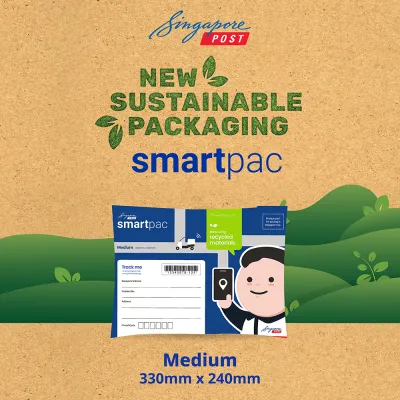

![[1/2/3/4 pcs] SingPost Smartpac Medium size - for using within Singapore only - Prepaid Packaging with Tracking](https://img.lazcdn.com/g/p/8f2c3c3994c2d6fb1e87feebed85f10b.jpg_400x400q80.jpg_.webp)
![[2pcs] SingPost Smartpac Medium size - for using within Singapore only - Prepaid Packaging with Tracking](https://img.lazcdn.com/g/p/3723bb51383d082fe8de03c34ecc0c93.jpg_400x400q80.jpg_.webp)
![[SINGPOST] MEDIUM smartpac - A postage-paid packaging for local delivery. Trackable via the SingPost mobile app.](https://img.lazcdn.com/g/p/3360d819ebee92c4900de5d10f98c2e8.png_400x400q80.png_.webp)
Prices are valid at publication and may change. Please refer to the product page for the latest price.
Next, factor in any protective packaging. If you plan to wrap the item in bubble wrap, tissue paper, or place it inside a corrugated sleeve, perform these steps before taking your final measurements. A single layer of standard bubble wrap can add up to half an inch (about 1.2 cm) to every side of your item, which quickly increases the overall volume. Failing to account for this extra padding is a primary cause of shipping bags tearing during packing.
Finally, evaluate the item’s fragility and rigidity. Flexible shipping bags are excellent for non-fragile, compressible goods like textiles, but they offer minimal protection against crushing. If your item has delicate mechanical parts, glass screens, or rigid corners that could puncture plastic, you must determine whether a padded mailer or a rigid corrugated box is a safer choice. For highly fragile items, a flexible bag should only be used as an outer waterproof layer over a sturdy inner box.
Understanding SmartPac Size Specifications
When browsing SmartPac options, it is vital to distinguish between the advertised external dimensions and the actual usable internal space. Manufacturers print the outer measurements on the packaging, but the usable length is always shorter because of the space required for the sealing flap and the adhesive strip.

Always check the manufacturer’s specifications for material thickness and recommended weight limits, which are typically listed on the product packaging or official online store. Standard poly-mailers and smart packaging options are engineered to hold specific weight thresholds; exceeding these limits increases the risk of the seams splitting during high-speed automated sorting. If you are shipping dense items like stationery bundles or books, verifying these weight limits is essential to prevent transit failures.
Additionally, verify whether the specific SmartPac model features a gusset. A gusset is an extra fold of material along the sides or bottom that expands to accommodate thicker items. If a bag lacks a gusset, any thickness in your item will directly reduce the usable width and length of the bag, requiring you to select a significantly larger size than the flat dimensions suggest.
You should also consider the compatibility of the bag’s material and adhesive with your item’s packaging. Some specialty inks, varnishes, or plastic coatings on retail boxes can resist standard adhesives, preventing a secure closure. Before sending a large batch, perform a quick trial by pressing the adhesive strip onto a sample material to verify a permanent, fiber-tearing bond, and ensure the outer plastic provides sufficient water resistance for your specific transit route.
Matching SmartPac Sizes to Product Categories
Shipping Apparel and Soft Goods
Apparel and textiles are highly compressible, making them ideal candidates for flexible shipping bags. To maximize space efficiency, use tight folding or rolling techniques. Rolling garments not only minimizes their overall thickness but also creates a firm, uniform shape that distributes weight evenly inside the bag, making it easier to stack and sort.
When packing soft goods, select a bag that fits snugly around the compressed item. A snug fit prevents the clothing from shifting excessively during transit. When items slide back and forth inside a bag, they can exert continuous pressure on the adhesive seal, potentially causing it to peel open under stress or wear down the corners of the plastic.
However, avoid over-sizing your packaging. If a bag is far too large for the garment inside, the excess empty plastic will fold over itself. This loose, flapping material can easily get caught in automated sorting machinery at postal hubs, leading to torn packaging, lost shipping labels, or delivery delays.
Shipping Electronics and Fragile Items
Electronics, cables, and small accessories require a different packaging strategy because they are rigid and susceptible to impact damage. Before choosing a bag size, wrap the item securely in protective cushioning and measure the entire bundled package. The final dimensions of the wrapped item must serve as your baseline to ensure a proper fit.
Ensure the selected bag is large enough to allow the adhesive flap to seal completely flat without stretching the plastic. Forcing a rigid, sharp-cornered electronic item into a tight bag puts immense tension on the seams and corners. During transit, any sudden impact can cause these stressed areas to puncture or burst open, exposing your valuable electronics to moisture and dust.
Recognize the physical limits of flexible packaging. While padded SmartPac options offer some resistance to minor impacts, they cannot protect delicate items from heavy crushing forces. If your electronic item is highly fragile, contains sensitive screens, or requires extensive void fill to stay safe, transition from a flexible bag to a rigid corrugated box.
Common Sizing Mistakes and How to Avoid Them
One of the most frequent errors is oversizing the shipping bag. While it might seem safer to have extra room, excess empty space allows the contents to slide violently during sorting. This shifting can break the adhesive seal from the inside or cause the bag to fold awkwardly, which may result in higher volumetric weight charges on some shipping networks.
Conversely, undersizing presents immediate physical risks to your shipment. Forcing an item into a bag that is too small causes micro-tears along the seams and prevents the self-sealing flap from overlapping fully. Without a complete, flat overlap, the adhesive cannot bond properly, leaving your package vulnerable to moisture, dust, and accidental opening during transit.
Another common mistake is ignoring the dimensions of the sealing flap. Many shippers measure the total flat length of a bag and assume the entire length is usable. In reality, you must subtract the 2 to 3 inches (approximately 5 to 7.5 cm) required for the self-sealing adhesive strip to fold over and secure the opening. Always base your calculations on the length below the fold line to ensure your item fits comfortably.
Frequently Asked Questions (FAQ)
Can I use a SmartPac bag for heavy items?
Flexible shipping bags are primarily designed for lightweight to medium-weight items. While they are highly durable, they lack the structural support needed to carry dense, heavy objects safely without stretching or tearing.
Before shipping, check the specific weight limit printed on your SmartPac packaging or the manufacturer’s official guidelines. If your item is heavy or dense, such as books, metal tools, or large stationery bundles, it is best to use a reinforced box or a heavy-duty mailer to prevent the bag from tearing at the seams or handles during transit.
What should I do if my item is slightly larger than the bag's stated dimensions?
If your item’s measurements are close to or slightly exceed the bag’s usable dimensions, do not attempt to stretch the material to make it fit. Stretching compromises the plastic’s puncture resistance and prevents a secure seal.
The safest approach is to size up to the next available bag dimension. If the larger bag has excess empty space, you can fold the extra material down tightly against the item and secure it with heavy-duty packaging tape to maintain a compact, secure parcel that will pass through automated sorting systems without issue.

Community discussion
Share your experience or ask a question. Comments are reviewed before publication.