
Choosing the correct packing bag size depends on calculating the total volume of your item—including its thickness and any immediate inner packaging—rather than relying solely on the flat, external dimensions listed by manufacturers. To find the perfect fit, you must add your product’s thickness and a functional allowance to both the width and length of the flat bag. Getting this right prevents transit damage, minimizes packaging waste, and keeps shipping costs low.
Decoding Packing Bag Dimensions and Specifications
When browsing packaging catalogs, you will find that manufacturers list packing bag dimensions as flat, external measurements, typically represented as Width x Length (W x L) in millimeters or centimeters. It is a common mistake to assume a bag measuring 300 mm by 400 mm can easily accommodate a product of those exact same dimensions. In reality, these flat measurements represent the bag’s outer boundaries before any item is inserted, and they do not account for the three-dimensional volume of your product. When you place an object inside a flat packing bag, the front and back walls must stretch outward to wrap around the item’s depth, reducing both the effective width and effective length of the bag. Consequently, the actual volume of the usable space is always smaller than the flat, two-dimensional dimensions printed on the packaging sleeve.
Beyond flat dimensions, thickness is measured in microns (mic) or mils. Common shipping bags range from 50 microns for lightweight apparel to 100 microns or more for heavy-duty mailers. While thickness indicates puncture resistance and durability, it does not increase the internal volume. However, thicker materials are stiffer and influence how easily the bag folds and seals over bulky items. Fortunately, minor manufacturing variances like the exact width of the adhesive seal flap (which often varies by 1 to 2 cm between brands) rarely impact your core sizing decision. Focus your calculations on the main body of the bag, treating the adhesive flap as a standard closure mechanism.
Products mentioned in this guide
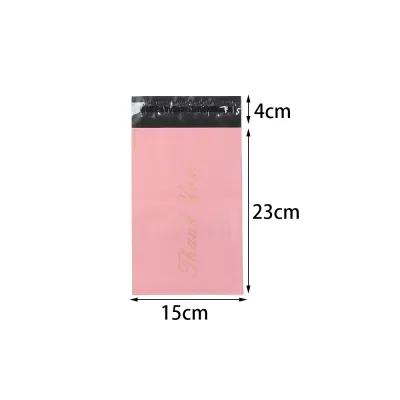
![[SG] ⭐CHEAPEST⭐ Pink Polymailer / Courier Bag / Mailer bag 100pcs shipping mailing](https://img.lazcdn.com/g/p/3124650e1fa61797e6935719cfbf1d98.png_400x400q80.png_.webp)
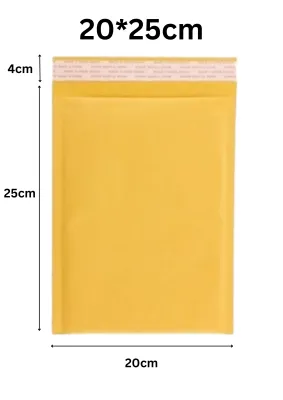
Prices are valid at publication and may change. Please refer to the product page for the latest price.
How to Calculate the Ideal Bag Size for Your Products
Determining the correct packing bag dimensions is straightforward when you use a reliable sizing formula. For rectangular or boxy items, this formula ensures that you account for the thickness of the product while leaving enough room to slide the item inside without tearing the side seams.

To calculate the required bag width, use the following formula: Required Bag Width = Product Width + Product Thickness + Clearance Allowance For most standard items, a clearance allowance of 2 to 5 cm is ideal. This extra space ensures that the bag does not stretch to its absolute limit, which makes packing faster and prevents the seams from splitting during transit.
To calculate the required bag length, use this companion formula: Required Bag Length = Product Length + Product Thickness + Flap Allowance The flap allowance typically requires 4 to 5 cm. This ensures you have enough material to fold the adhesive strip neatly over the opening and secure it flat against the back of the package.
For cylindrical or irregular items, the formula requires a slight adjustment. For a cylinder, such as a rolled poster, the required flat bag width should be at least half of the cylinder’s circumference plus a 3 to 5 cm clearance allowance. For irregular shapes, measure the absolute widest, tallest, and thickest points of the item, adding a generous clearance allowance of 5 to 7 cm to accommodate the awkward angles.
Always measure your product after placing it in its immediate inner packaging—such as tissue paper, an inner polybag, or a presentation box—as these layers add crucial millimeters to the final dimensions. Before committing to a bulk purchase, test your calculated dimensions with a physical mock-up. You can easily create a prototype bag using scrap paper or buy a small sample pack to verify that your prepped product glides in smoothly and seals without tension. This simple step prevents the headache of dealing with unusable inventory.
Sizing Guidelines for Common E-commerce Items
Different types of merchandise behave uniquely when packed, meaning your approach to sizing should adapt to the physical properties of the items you sell.
Flat and Rigid Items (Books, Stationery, Documents)
Rigid products like hardcover books, desk planners, and heavy document folders possess zero flexibility. Because these items cannot be compressed, the packing bag must accommodate their exact dimensions and sharp corners without any structural compromise. Add a modest but precise width allowance; if the bag is too loose, the heavy item will slide during transit, causing dented corners or torn bag edges. A snug but un-stretched fit is essential to keep the item immobilized and protected.
Soft and Compressible Items (Apparel, Textiles)
In contrast, soft goods such as t-shirts, sweaters, and linens are highly compressible and forgiving. Squeezing these items reduces their volume, allowing you to utilize slightly tighter, more compact bag sizes to improve shipping efficiency. However, avoid overstuffing thin poly mailers. Squeezing a bulky item into a bag that is too small puts immense pressure on the heat-sealed side seams, increasing the risk that the package will burst open when handled by courier services.
Fragile or Irregular Items (Requiring Extra Padding)
Fragile goods like glassware, ceramics, or delicate electronics require substantial protective layers like bubble wrap, foam sheets, or corrugated cardboard inserts. This cushioning significantly inflates the outer dimensions of the package. You must measure the fully padded assembly—not the raw product—before calculating your bag size. Ensuring the bag is large enough prevents the outer plastic from compressing the bubble wrap, which would flatten the air pockets and destroy the cushioning properties needed to absorb shocks.
How Material and Thickness Affect Your Size Choice
The physical properties of the packing bag material play a major role in how a bag fits your product. The thickness of the material, typically measured in microns, directly affects its flexibility and folding radius. A standard 50-micron poly mailer is highly pliable and wraps easily around sharp corners, requiring minimal extra length to seal. Conversely, a heavy-duty 100-micron co-extruded bag or a padded bubble mailer is much stiffer, increasing the folding radius at the edges. This means you must add an extra 1 to 2 cm of tolerance to both the width and length formulas to achieve a clean, secure seal.
Different polymer blends also exhibit varying degrees of stretch. Low-Density Polyethylene (LDPE) is highly flexible and offers excellent elasticity, allowing the bag to stretch slightly around irregular shapes without immediately tearing. High-Density Polyethylene (HDPE) is crinklier, stiffer, and offers very little stretch. If you decide to switch your packaging material—such as transitioning from standard poly mailers to eco-friendly kraft paper mailers—always consult the manufacturer’s specific sizing charts and order samples. Paper mailers have zero stretch, requiring significantly larger dimensions to accommodate the same product volume that a flexible plastic bag could easily hold.
Common Sizing Mistakes That Increase Shipping Costs
Avoiding common sizing errors is one of the easiest ways to protect your profit margins and ensure customer satisfaction. The most frequent mistake is the ‘exact fit’ error, where a seller orders a bag that matches the product’s dimensions perfectly on paper. This leaves zero room for the thickness of the item or the seal flap, resulting in packages that cannot be closed securely or bags that rip at the corners during packing. Similarly, ignoring the volume of inner packaging like tissue paper or boxes leads to ordering bags that are too small, forcing you to repack or use multiple bags.
On the other end of the spectrum, choosing oversized bags to ‘play it safe’ can quietly erode your profits through increased shipping fees. While the physical weight of an oversized plastic bag is negligible, major courier services in Singapore—such as SingPost, Ninja Van, and international carriers—calculate shipping rates based on either actual weight or volumetric (dimensional) weight, whichever is greater. An excessively large bag with loose, flapping material increases the overall dimensions of the package, pushing it into a higher volumetric weight bracket and inflating your shipping bills.
Frequently Asked Questions (FAQ)
How do I account for volumetric weight when choosing a bag size?
Volumetric weight is a pricing method used by couriers that calculates a package’s density based on its length, width, and height. To prevent paying inflated shipping rates, you should select a packing bag that fits your product as snugly as possible while still allowing room for necessary protective padding. Avoid leaving empty air pockets or excess material flapping at the ends of the bag. Folding and taping down any excess plastic flat against the package keeps the outer dimensions compact, ensuring you are billed based on the actual weight of the item rather than empty space.
What is the difference between flat bags and gusseted bags for sizing?
Flat packing bags are constructed from two sheets of plastic sealed along the sides and bottom, making them ideal for flat, thin, or highly flexible items like apparel and documents. Gusseted bags feature folded pleats along the sides or the bottom that expand when an item is inserted. This structural design makes gusseted bags far superior for bulky, boxy, or three-dimensional items, such as shoeboxes or electronics. When calculating the size of a gusseted bag, the usable width is determined by adding the flat width of the bag to the depth of the expanded gusset, providing a clean, box-like fit without overstretching the seams.

Community discussion
Share your experience or ask a question. Comments are reviewed before publication.