
To make durable, functional DIY educational letters, you need a magnetic white sheet that balances magnetic hold, print or marker compatibility, and clean cuttability. Choosing the wrong sheet can lead to letters that slide off the whiteboard, peel at the edges, or jam your cutting tools. Focusing on thickness, surface coating, and flexibility ensures your handmade learning tools withstand daily classroom or home use.
Key Specifications That Matter for DIY Letters
Selecting the right magnetic white sheet requires looking past generic marketing claims and focusing on the physical properties that affect how the letters look, stick, and cut. The primary specifications to evaluate are the sheet’s thickness and the type of white surface coating.
Magnetic Strength and Sheet Thickness
Magnetic sheets are typically made of strontium ferrite mixed with a flexible plastic binder. The magnetic pull is directly proportional to the thickness of the sheet. For lightweight DIY letters, sheets ranging from 0.3 mm to 0.5 mm are common, but laminated paper toppers may require 0.5 mm to 0.75 mm to stay secure.
Products mentioned in this guide
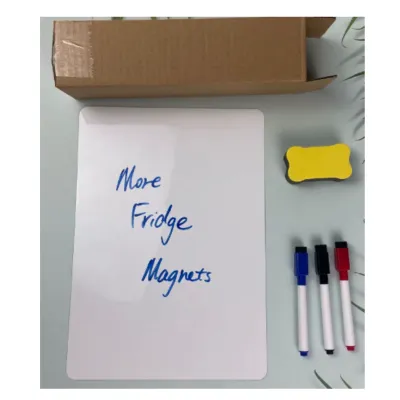
![[120*200cm] magnetic board for wall sticker thickness1.5mm magnetic whiteboard sheet wall paste on wall white board magnetic sticker magnetic wall board whiteboard wall sticker magnetic blackboard static whiteboard](https://img.lazcdn.com/g/p/248ed7eb625a0211d949b426fc56c84f.png_400x400q80.png_.webp)
Prices are valid at publication and may change. Please refer to the product page for the latest price.
To test the hold strength before cutting an entire sheet, place a small sample on your target surface—such as a classroom whiteboard or a home refrigerator. If the sample slides down when you tap it or when a piece of paper is placed behind it, the magnetic pull is too weak for your specific setup.
While thicker sheets (0.75 mm and above) offer a stronger hold, they are significantly harder to cut. They can dull standard scissors quickly and may require heavy-duty craft cutters or multiple passes with a utility knife.
Surface Coating and Printability
Magnetic white sheets come with different top layers. Some feature a matte paper or vinyl coating designed to feed through home printers, while others have a glossy, dry-erase PET coating meant only for writing with dry-erase markers.
Check the manufacturer’s label to confirm printer compatibility. Standard inkjet printers require a porous, ink-receptive coating (often labeled “printable magnetic paper”), whereas laser printers require heat-resistant sheets to prevent the magnetic backing from melting inside the fuser unit.
Because drying speed, bleed resistance, and water resistance depend heavily on the specific ink and coating combination, always perform a small test print or write-and-wipe trial. If you are using an inkjet printer, you will likely need to apply a clear laminating sheet or a spray sealant over the printed letters to prevent the ink from smudging when handled by children with damp hands.
Evaluating Cuttability and Flexibility
The flexibility of the magnetic sheet determines how easily it can be shaped into intricate letters. A high-quality sheet should bend smoothly without cracking. If you plan to use an electronic cutting machine, verify the machine’s maximum material thickness limit (often 0.5 mm or 0.8 mm) and use a deep-point blade. For manual cutting, sharp heavy-duty scissors or a rotary cutter on a self-healing mat will yield the cleanest edges.

To check the flexibility, gently bend a corner of the sheet. If you observe micro-cracks along the fold or if the white vinyl layer begins to separate (delaminate) from the black magnetic backing, the material is too brittle. Brittle sheets will chip and degrade quickly when handled frequently by young learners.
Always perform a test cut of a single letter (like an ‘O’ or ‘S’ with curves) to observe how the edges behave. If the white top layer lifts or frays at the cut line, the adhesive bond between the layers is weak, meaning the letters may peel apart over time.
Specifications You Can Safely Ignore
Many magnetic sheets list industrial temperature tolerances (such as resisting heat up to 80°C). Since educational letters are used strictly indoors in air-conditioned classrooms or homes, these thermal limits have no practical impact on your project.
Avoid paying a premium for high-energy or industrial-grade magnetic sheets designed to hold heavy tools or signage on moving vehicles. Lightweight paper or vinyl letters do not require extreme holding power; standard flexible magnets are more than sufficient and much easier to handle.
While some technical data sheets list the exact weight of the material per square meter, this metric is less useful than simply checking the physical thickness and stiffness. Focus on the millimeter thickness to gauge both weight and cutting difficulty.
Safety and Handling Checks for Children's Use
Cutting magnetic sheets can sometimes leave sharp, pointed corners, especially on letters like ‘A’, ‘K’, or ‘M’. After cutting, use a corner rounder punch or fine-grit sandpaper to gently smooth down any sharp edges to protect sensitive fingers.
Because children frequently handle these letters and may occasionally put them near their mouths, verify that the magnetic white sheets are labeled non-toxic and comply with standard safety regulations (such as EN71 or ASTM D-4236). Avoid sheets with strong chemical odors, which can indicate volatile organic compounds (VOCs) in the plasticizers.
When designing your DIY letter templates, ensure that every letter is large enough to pass a standard choke tube test. A good rule of thumb is to make each letter at least 3 centimeters in diameter so they cannot be swallowed by toddlers or younger students.
Frequently Asked Questions (FAQ)
Can I use a standard craft punch on a magnetic white sheet?
Standard paper punches are designed for thin cardstock and will easily jam, dull, or break when used on magnetic sheets, even thin ones. The rubberized magnetic backing creates high friction that resists clean shearing. For clean shapes, use heavy-duty punches rated for metal or thick plastic, or stick to a utility knife and cutting mat.
Will the magnetic sheet damage my refrigerator or whiteboard?
High-quality magnetic sheets with a smooth, clean backing will not scratch or damage standard whiteboards or refrigerator doors. However, dust, grit, or metal filings can get trapped between the magnet and the surface. To prevent scratches, periodically wipe the back of the letters and the board clean, and avoid dragging the letters forcefully across the surface.

Community discussion
Share your experience or ask a question. Comments are reviewed before publication.