
Starting your watercolour journey is an exciting step, but the sheer variety of paint sets can feel overwhelming. A portable watercolour set offers an excellent entry point for beginners, combining convenience, compact storage, and a curated colour palette in a single travel-friendly casing. Choosing a set from a trusted art brand ensures that you work with reliable pigments that behave predictably on paper, preventing the frustration often caused by chalky, low-grade alternatives. By focusing on key physical features, pigment grades, and format options, you can select a high-quality setup that fits your budget and supports your creative growth.
What Makes a Watercolour Set Truly Portable and Beginner-Friendly?
Portability in watercolour painting is about how efficiently the set functions when you are away from a dedicated studio desk. A well-designed portable set serves as a self-contained workstation. The casing must be robust enough to withstand being tossed into a bag, with a secure latching mechanism that prevents accidental openings. Look for palettes made from impact-resistant plastics or lightweight metals like tin, which protect the delicate paint pans inside from physical damage.
The palette lid is another critical component. In a travel-friendly design, the lid doubles as a mixing area, often divided into several shallow wells. These wells allow you to blend colours and create washes without needing to carry an external mixing tray. Some advanced portable designs feature fold-out mixing flaps that extend the working surface while keeping the overall footprint compact when closed. Ensure these mixing areas are smooth and easy to wipe clean, as textured plastics can cause water to bead up, making it difficult to judge your colour mixtures accurately.
Products mentioned in this guide
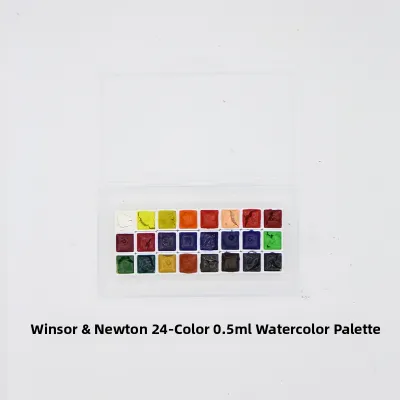
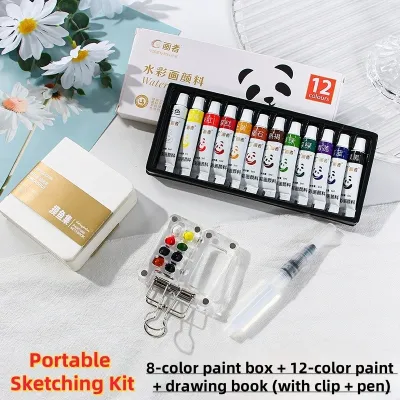
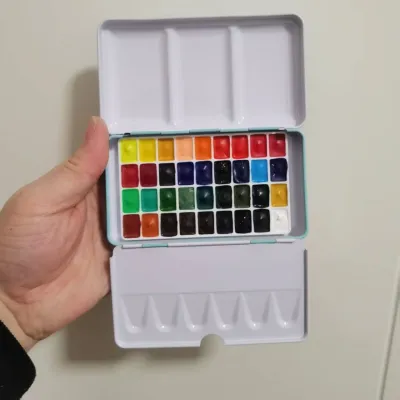
Prices are valid at publication and may change. Please refer to the product page for the latest price.
Ergonomics play a vital role when painting outdoors. Many high-quality metal travel tins feature a metal ring on the bottom, known as a thumb ring. This simple addition allows you to slide your thumb through the ring, securing the palette firmly in one hand while your fingers support your sketchbook. This setup frees up your other hand entirely for holding your brush, making it possible to paint comfortably while standing or sitting without a table.
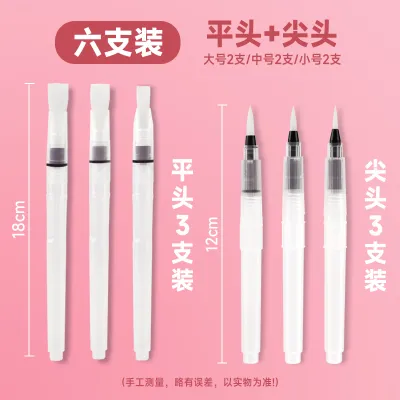
Integrated travel tools significantly enhance usability. Many beginner-friendly kits include a pocket-sized brush or a water brush—a specialized tool with a refillable water reservoir in the handle. This eliminates the need to carry a separate water container, making it possible to paint in cafes, parks, or public transport. Built-in cleaning sponges or small wiping cloths are also common additions, allowing you to control the moisture level of your brush on the go.
Finally, physical dimensions and weight dictate how often you will actually carry your set. A truly portable set should fit comfortably in one hand, allowing you to hold both the palette and your sketchbook simultaneously. Sets that measure roughly the size of a smartphone or a small paperback book strike a practical balance, offering a versatile range of colours without adding unnecessary bulk to your daily carry.
How to Identify Trusted Art Brands and Reliable Quality
Navigating the art supply market requires understanding how established manufacturers structure their product lines. Reputable art brands typically divide their watercolours into two main categories: student-grade and professional-grade (often labeled as artist-grade). For beginners, student-grade lines from trusted brands offer a strong balance of quality and affordability. These paints use the same high-quality binders, such as natural gum arabic, but substitute expensive organic pigments with reliable synthetic alternatives, often designated as “hues.”

The binder is the substance that holds the pigment particles together and adheres them to the paper. Trusted brands use gum arabic because it dissolves easily in water, flows smoothly across the paper, and retains its solubility even after drying. Cheaper, unbranded sets often use synthetic binders or dextrin, which can make the paint feel sticky, dry to a dull finish, or resist rewetting when you touch them with a damp brush.
When evaluating a set, look for clear manufacturer specifications on the packaging or the brand’s website. Trusted brands provide detailed information for each colour, including lightfastness ratings and transparency levels. Lightfastness refers to a pigment’s resistance to fading when exposed to light over time, usually rated on a scale from I (excellent) to III or IV (fair/poor). Transparency is equally important in watercolour painting, as it determines whether the paper texture or underlying paint layers will show through. Reliable student-grade sets will clearly mark whether a colour is transparent, semi-transparent, or opaque.
In contrast, unbranded, toy-grade, or extremely cheap sets often exhibit several red flags that can hinder your learning process. These sets frequently omit pigment information entirely, relying instead on generic colour names like “blue” or “green.” They often use cheap fillers and synthetic binders instead of gum arabic, resulting in a chalky texture when dry. These low-grade paints tend to lift easily from the paper, crack in the pan, and fade rapidly when exposed to sunlight. Investing in a student-grade set from an established brand ensures your paints blend smoothly without turning muddy, allowing you to develop proper colour-mixing techniques.
For beginners, it is highly recommended to start with a smaller, high-quality palette of twelve colours rather than a massive, low-quality set of forty-eight colours. A smaller selection of high-quality pigments teaches you how to mix your own shades, which is a fundamental skill in watercolour painting. It also keeps your portable setup lightweight and affordable, typically ranging from S$20 to S$60 for a reputable student-grade starter set.
Pan vs. Tube Formats: Which Portable Setup Fits Your Workflow?
Watercolours are primarily available in two formats: solid pans and moist tubes. Understanding the practical differences between these formats is essential for choosing a setup that aligns with your preferred painting style and travel habits.
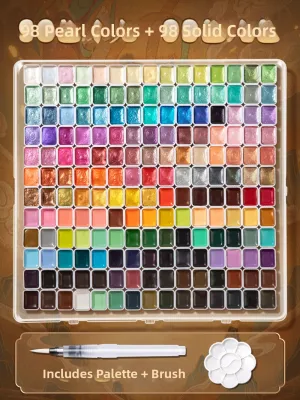
Pan watercolours are small, dried blocks of paint nestled in plastic cups (known as half-pans or full-pans) that sit securely inside the palette. Half-pans are the standard for portable sets, offering a compact way to carry twelve to twenty-four colours in a pocket-sized container. Pans are incredibly convenient for travel because they require zero preparation; you simply open the lid, wet the dry paint with a damp brush, and begin painting. They also minimize waste, as any unused paint simply dries back down in the pan, ready for your next session.
Tube watercolours contain moist, paste-like paint that you squeeze out onto a palette. While tubes are traditionally associated with studio work, they can be highly effective for portable setups if you prefer painting large, vibrant washes. Squeezing fresh paint from a tube makes it easier to mix large quantities of highly saturated colour quickly, as you do not need to spend time rewetting a dry pan. However, carrying multiple tubes can be bulky, and fresh tube paint remains wet and messy inside a closed travel palette unless you allow it to dry completely over several days before packing.
The rewetting characteristics of the paint are highly dependent on the formulation. High-quality pan paints are formulated to rewet instantly with a wet brush, releasing rich pigment with minimal effort. Some tube paints, if squeezed into a palette and left to dry, can dry rock-hard and become difficult to rewet, especially if they lack humectants like honey or glycerin. Trusted brands formulate their paints to ensure that even dried tube paint can be easily reactivated with water, making them highly versatile.
For most beginners seeking a portable solution, a pre-assembled pan set is the most practical choice. It offers immediate usability, easy cleanup, and a controlled environment that prevents accidental spills. If you eventually find yourself using certain colours rapidly, you can purchase individual tubes of those specific shades to refill your empty pans, combining the cost-effectiveness of tubes with the convenience of a pan-based travel layout.
Building Your Shortlist: Essential Checks Before You Buy
Before finalizing your purchase at a local art store or an online marketplace, running through a practical checklist will ensure your chosen set meets your expectations for durability and usability.
First, examine the physical security of the pans within the casing. In a quality portable set, the individual plastic pans should fit snugly into metal tracks or molded plastic slots. If the pans wobble or slide around, they can spill pigment into adjacent wells when the palette is shaken during travel. Look for casings that feature a metal retaining clip or a tight friction-fit design. Additionally, inspect the hinge of the palette; a flimsy plastic hinge is prone to cracking over time, whereas a metal hinge pin offers long-term durability.
Next, assess the quality of the included brush. Many portable sets come with a travel brush that unscrews or collapses to fit inside the case. Check the brush bristles; they should be made of high-quality synthetic fibers that mimic natural hair by holding a generous amount of water while maintaining a sharp point. If the set includes a water brush, verify that the valve mechanism controls the water flow smoothly without leaking from the reservoir joint.
The colour selection within the set is another crucial factor. A practical beginner set should feature a “split-primary” system, which includes both a warm and a cool version of each primary colour (red, yellow, and blue). This system allows you to mix clean, vibrant secondary colours (orange, green, and purple) without them turning dull or muddy. The set should also include a few essential earth tones, such as burnt sienna and yellow ochre, which are incredibly useful for landscape and urban sketching.
Finally, consider the long-term viability of the set by checking the availability of individual replacements. A common frustration for beginners is running out of a favorite colour—such as ultramarine blue or yellow ochre—and finding that they must buy an entirely new set to replace it. Trusted brands sell individual half-pans and tubes, allowing you to replace single colours as they run out. Verify that the palette casing uses standard half-pan dimensions (approximately 15mm x 19mm x 10mm), which allows you to mix and match pans from different reputable brands within the same travel box.
Frequently Asked Questions (FAQ)
Do I need to buy separate watercolour paper for a portable set?
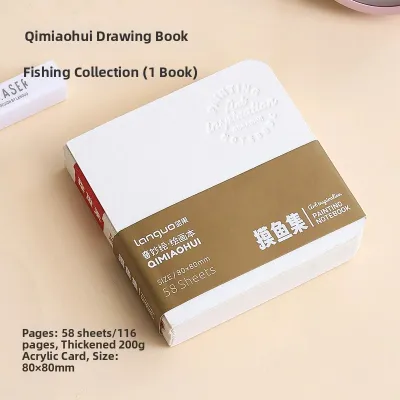
Yes, investing in dedicated watercolour paper is essential for achieving good results, regardless of the quality of your paint set. Standard sketchbook or printer paper is too thin and lacks the necessary sizing (a starch-like treatment) to handle wet washes. Without proper watercolour paper, the surface will quickly buckle, warp, and pill, causing the paint to pool unevenly. For portable painting, look for watercolour journals or paper pads with a weight of at least 300 gsm (grams per square metre). Cold-press paper, which has a slightly textured surface, is highly recommended for beginners as it absorbs water evenly and allows for versatile brush techniques.
How do I clean and maintain a portable watercolour palette?
Maintaining your portable palette is straightforward but crucial for preventing pigment contamination and mould growth, especially in warm, humid climates. After a painting session, use a damp, clean sponge or a soft microfiber cloth to gently wipe away dirty paint mixtures from the mixing wells. Avoid using harsh chemical cleaners or abrasive pads, which can scratch the plastic or metal surface and cause future paint mixtures to bead up. Always allow your palette to air-dry completely in a well-ventilated area before closing the lid. Sealing a damp palette traps moisture, which can lead to mould forming on the paint surfaces or rust developing on metal casings.
Can I replace individual colours if I run out of a specific pan?
Yes, a key advantage of choosing a portable set from an established art brand is the ease of replacing individual colours. Most reputable manufacturers sell individual half-pans of their student-grade and professional-grade lines. Before purchasing a replacement, verify the physical dimensions of your palette’s slots to ensure a proper fit. Many artists also use affordable tube paints to refill empty pans; simply squeeze the wet paint into the empty plastic pan, distribute it evenly with a toothpick, and let it dry uncovered for a few days until it solidifies into a convenient, travel-ready block.

Community discussion
Share your experience or ask a question. Comments are reviewed before publication.