
Finding the ideal metallic watercolor set as a beginner in Singapore involves balancing pigment quality, ease of reactivation, and color selection. Instead of buying the largest, most expensive palette, beginners should focus on curated sets of six to twelve high-quality pans that reactivate easily with water and show high reflectivity on both light and dark paper. This guide provides a practical framework to evaluate options in local art supply shops and online marketplaces, ensuring you invest in a set that supports your creative growth.
Understanding Metallic Watercolor Basics for Beginners
To make an informed purchase, it is essential to understand what gives metallic watercolors their unique, shimmering appearance. Standard watercolors utilize organic or inorganic pigments finely ground to suspend in a binder, allowing them to sink deep into the fibers of the paper. Metallic watercolors, on the other hand, rely on larger mica flakes or metallic dust coated with metal oxides, such as titanium dioxide or iron oxide, to reflect light. Pearlescent watercolors use similar mica particles but focus on a multi-colored, iridescent color shift, whereas true metallics mimic traditional metals like gold, bronze, copper, and silver.
Because metallic particles are significantly larger and heavier than standard pigment particles, they do not sink deep into the paper fibers. Instead, they sit directly on the surface of the medium. On thin paper under 300 gsm, the heavy water application required to activate these paints can cause severe warping and buckling. Textured papers will trap the metallic particles in their valleys, creating a varied, glittering shimmer, while smooth papers allow for a more uniform, mirror-like sheen.
Products mentioned in this guide
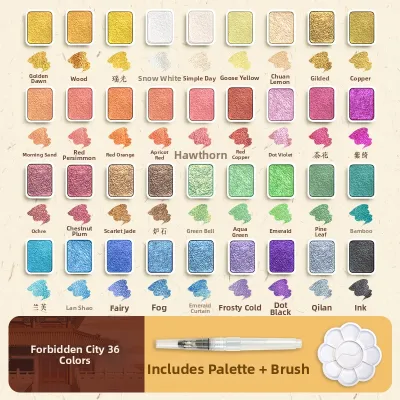
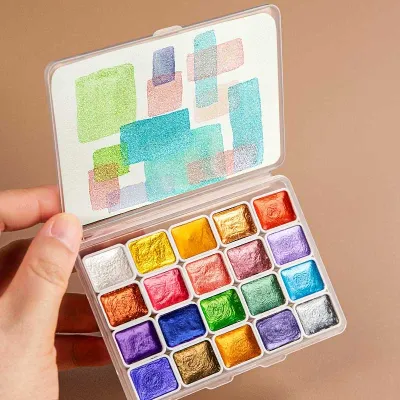
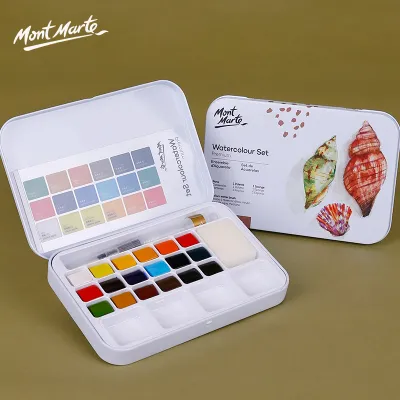
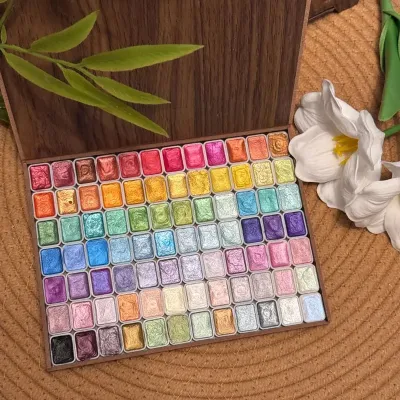
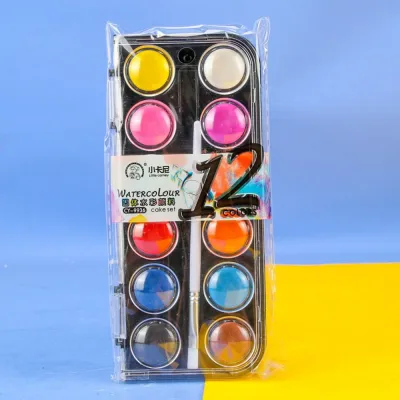
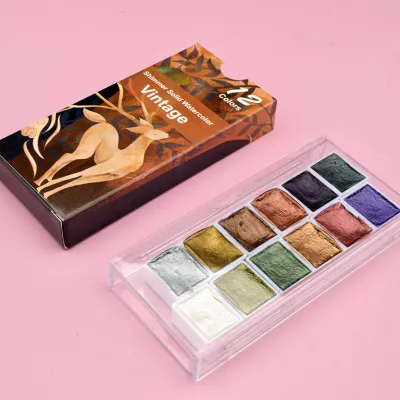
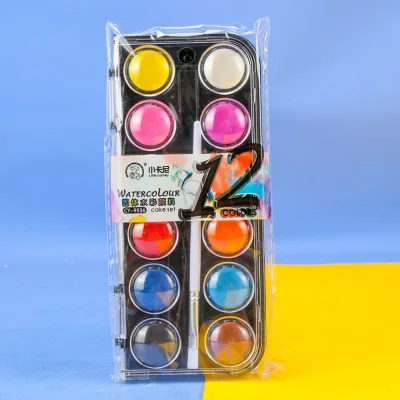
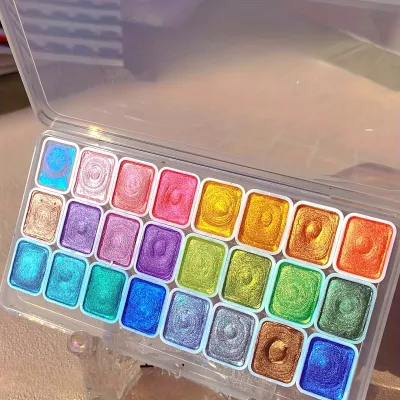
Prices are valid at publication and may change. Please refer to the product page for the latest price.
Standard watercolors are transparent and rely on the white of the paper to reflect light back through the pigment. Metallic watercolors are inherently more opaque due to their mica base. On white paper, some metallic shades can look faint or pastel because the bright background competes with the reflective particles. On black or dark-colored watercolor paper, the dark background absorbs ambient light, making the reflective metallic particles stand out with dramatic, high-contrast intensity.
Core Criteria for Selecting a Beginner-Friendly Set
Metallic watercolors are almost exclusively sold in solid pans—either half-pans or full pans—rather than tubes, as the heavy particles settle and clog tubes easily. For beginners, half-pans are highly practical because they offer a compact footprint, are easy to store, and allow you to try a variety of colors without a massive upfront investment. Look for a palette layout that provides ample mixing space, such as a fold-out metal lid or integrated plastic mixing wells, so you do not contaminate your pure metallic pans with other colors during a painting session.

Because metallic pigments require a generous amount of water to release from their dry state, the palette design should allow you to pool water comfortably. A good beginner set features well-spaced pans so that stray water droplets do not accidentally bleed into neighboring colors. The physical design of the palette should also accommodate the brushes you plan to use, ensuring you can easily sweep the bristles across the pan without damaging them against the plastic edges.
When choosing a set, consider the paper texture you intend to use. Cold-press paper, which has a slight texture or “tooth,” is excellent for general watercolor techniques, but the metallic particles will pool in the texture, creating a glittering, textured effect. Hot-press paper, which is completely smooth, allows the metallic particles to lay flat, resulting in a highly reflective, satin-like finish. Beginners should test both surfaces to see which aesthetic fits their personal style.
It is highly tempting to purchase a massive palette containing dozens of metallic shades. However, a curated palette of six to twelve colors is far more effective for beginners. A smaller, high-quality selection forces you to understand how metallic tones complement one another and prevents the overwhelm of choosing between slightly different shades of gold. Focus on a core set containing a classic gold, silver, bronze, copper, and perhaps two iridescent accent colors to build your foundational skills.
Evaluating Pigment Quality and Lightfastness
Lightfastness refers to a pigment’s resistance to fading or changing color when exposed to light over time. When browsing art supplies in Singapore, look at the back of the packaging or the manufacturer’s color chart. Lightfastness is typically rated using the ASTM international standard, where Category I is excellent and Category II is very good, or a star system where three or four stars indicate high resistance. For metallic paints, high lightfastness ensures your shimmering creations do not turn dull, grey, or transparent after a few months on display.
The binder holds the metallic particles together and adheres them to the paper. Student-grade sets often use synthetic binders or lower-quality dextrin, which can result in a chalky finish that rubs off the paper once dry. Professional-grade sets utilize high-quality gum arabic or specialized synthetic binders that lock the mica particles securely onto the paper surface, ensuring the shimmer remains permanent and does not transfer to your fingers when touched.
If you are sharing your paints with younger family members or working in a small, enclosed home environment, safety is paramount. Look for the AP (Approved Product) seal from the Art and Creative Materials Institute (ACMI) or equivalent European CE markings. These certifications verify that the product has been evaluated by a toxicologist and contains no materials in sufficient quantities to be toxic or injurious to humans, giving you peace of mind during long painting sessions.
Building Your Shortlist: What to Verify Before Buying
Before finalizing your purchase at a local Singapore art store or an online platform, verify the availability of open-stock replacements. Some brands only sell metallics in complete sets, meaning if you run out of your favorite gold pan, you must buy an entirely new set. Choosing a brand that offers individual replacement pans is much more cost-effective in the long run, allowing you to replace only the colors you use most frequently.
To assess the true value of a set, do not just look at the total price tag. Divide the retail price in S$ by the number of pans included to find the price per pan. A set costing S$30 with six pans (S$5 per pan) might actually use higher-quality pigments and binders than a S$40 set with twenty-four pans (S$1.67 per pan), which is likely to be chalky, difficult to reactivate, and frustrating for a beginner to use.
High-quality manufacturers are transparent about what goes into their paints. Check the packaging for the specific pigment codes, such as PW20 for mica-based pigments, and the type of binder used. If a brand does not list its ingredients or pigment codes anywhere on its packaging or website, it is often a sign of lower-quality, student-grade materials that may not perform consistently or offer the brilliant shimmer you expect.
Essential Techniques for Testing Your New Set
The very first thing you should do with a new metallic watercolor set is create a dual swatch card. Take a piece of high-quality watercolor paper and paint a thick black stripe down the middle using black gesso or waterproof black ink. Once dry, swatch each metallic color across both the white paper and the black stripe. This visual reference will show you exactly how opaque each color is and how the shimmer shifts depending on the background value.
Metallic watercolors often require more time to soften than standard watercolors. To test this, place a single drop of clean water onto each pan and let it sit for one to two minutes. Gently swirl a damp brush over the surface. If the paint lifts easily and forms a creamy, ink-like consistency, it has excellent reactivation properties. If it remains hard or requires aggressive scrubbing with your brush, you will need to pre-wet your palette several minutes before every painting session.
Because metallic pigments are heavy, they tend to sink to the bottom of the wet paint pool on your palette or in your brush. When painting, get into the habit of gently stirring the paint mixture with your brush before loading it. Observe how the particles settle on your swatch card as it dries; if you notice the shimmer concentrating only in the areas where water pooled, you may need to adjust your water-to-paint ratio to achieve a more even distribution.
Frequently Asked Questions (FAQ)
Do metallic watercolors require special brushes?
Synthetic brushes are highly recommended for metallic watercolors. Natural hair brushes, such as sable, are soft and designed to hold a large volume of water, but the sharp, heavy edges of mica particles can get trapped in the delicate natural cuticles, making them difficult to clean and causing premature wear. Synthetic bristles are smoother, stiffer, and more resilient, allowing you to easily agitate the paint pan and rinse away the metallic particles completely.
To protect your brushes, never let metallic paint dry in the bristles. Rinse your brush thoroughly in a dedicated water jar that is separate from your standard watercolor water to avoid transferring shimmer to non-metallic paintings. Wash the bristles gently with a mild brush soap, paying close attention to the ferrule—the metal band holding the bristles—where heavy metallic particles love to settle and cause the hairs to splay over time.
Can I mix metallic watercolors with standard colors?
Mixing metallic watercolors directly with standard transparent watercolors can yield beautiful, customized shimmering shades, but it requires caution. Mixing too much standard pigment into a metallic paint can bury the reflective mica particles under a layer of opaque color, dulling the overall shimmer. It is best to mix metallics with highly transparent standard pigments rather than opaque or semi-opaque ones to maintain the reflective quality.
For the most vibrant results, use a layering technique instead of direct mixing. Paint your base layers using standard watercolors first and let them dry completely. Once dry, glaze your metallic watercolors over the top. Because the metallic paint sits on the surface of the dry paper, this layering method preserves the maximum reflective power of the mica particles while allowing the rich colors of the background to show through.

Community discussion
Share your experience or ask a question. Comments are reviewed before publication.