
Selecting the right corrugated cartons is critical to protecting your goods, whether you are shipping retail products, moving houses, or storing documents. When browsing for packaging options, you will quickly encounter technical specifications detailing length, width, height, and terms like ‘3-ply’ or ‘5-ply.’ Selecting the wrong box can lead to structural collapse under weight, damaged contents, and increased shipping costs. To make an accurate choice, you must understand how to read inner versus outer dimensions and how ply ratings translate into physical load-bearing capacity.
The core decision comes down to matching the physical volume of your items with the appropriate structural strength. While dimensions tell you if an item will physically fit inside, the ply rating indicates whether the box can withstand the vertical forces of stacking and the physical impacts of transit. Balancing these two factors ensures your goods arrive intact without paying for unnecessary packaging weight.
Understanding Carton Dimensions: Inner vs. Outer Measurements
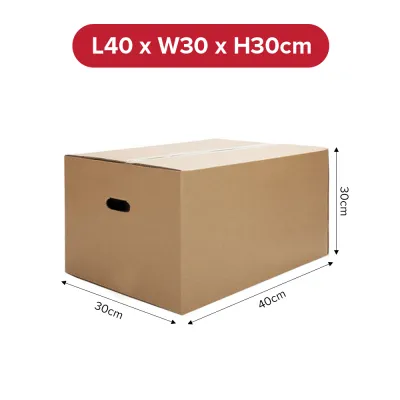
When purchasing cartons, specifications are always presented in a standard three-dimension format: Length x Width x Height (L x W x H). The length is typically the longest side of the opening, the width is the shorter side of the opening, and the height is the vertical depth of the box from the opening to the bottom. However, simply matching these numbers to the size of your items is one of the most common mistakes in packaging selection.
Products mentioned in this guide
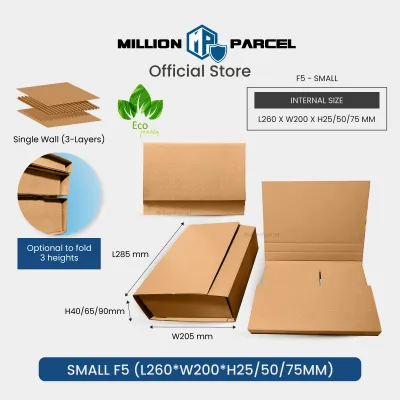
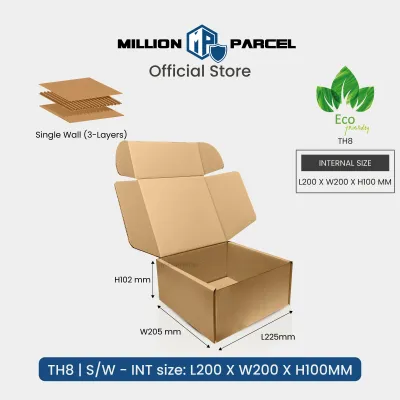
Prices are valid at publication and may change. Please refer to the product page for the latest price.
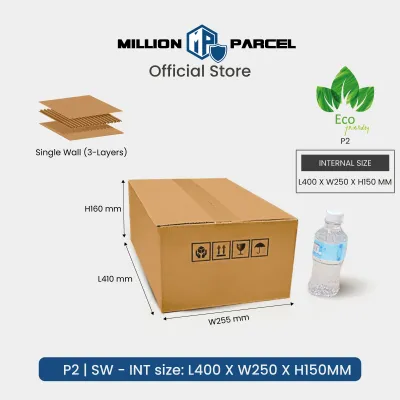
You must distinguish between inner and outer dimensions. Inner dimensions measure the usable space inside the box after it is assembled. Outer dimensions measure the external footprint, including the thickness of the cardboard walls and any folded flaps. For standard shipping and storage, outer dimensions dictate how much physical space the box occupies in a delivery vehicle, on a retail shelf, or on a pallet.
Always base your packing calculations on the inner dimensions. Because the cardboard walls themselves have thickness, the usable interior space is always smaller than the exterior measurements. If you have an item that is exactly 30 cm long, a box with an outer length of 30 cm will be too tight, causing the walls to bulge or preventing the flaps from closing properly.
To ensure a safe fit, subtract a small margin from the inner dimensions to account for protective void fill. A tight fit without cushioning transfers all external shocks directly to your item. Relying solely on outer dimensions often leads to purchasing boxes that are too small for the intended contents, forcing you to compress your protective materials and compromise safety.
Demystifying Ply Ratings: 3-Ply vs. 5-Ply Cartons
The term ‘ply’ in the packaging industry refers to the layers that make up the corrugated fiberboard wall. It is not simply a count of flat paper sheets stacked together. Instead, a ply rating describes an engineered combination of flat paper sheets, known as linerboards, and wavy, arched paper layers, known as the corrugated medium or fluting.

The fluting is the source of the carton’s structural integrity. The arches of the flute act like columns, resisting vertical pressure and providing cushioning against side impacts. The combination of these layers directly impacts the box’s edge crush resistance (ECT), which determines stacking strength, and its puncture resistance, which prevents sharp objects from piercing the walls.
3-Ply (Single Wall) Cartons: Best for Light to Medium Items
A 3-ply carton, commonly referred to as a single-wall box, consists of one layer of wavy fluting sandwiched between two flat outer linerboards. This construction offers a lightweight yet surprisingly rigid structure suitable for everyday shipping and storage needs. Because they use less material, these boxes are highly cost-effective and keep shipping weights low.
These cartons are ideal for packing lightweight household goods, clothing, soft furnishings, books, documents, and standard e-commerce retail shipments. When packed correctly with appropriate void fill, they provide excellent protection for items that are not inherently fragile and do not exert extreme pressure on the box walls.
However, single-wall cartons have clear structural limitations. They are highly susceptible to crushing if they are stacked too high in a warehouse or delivery truck. If you pack dense, heavy objects like metal tools or thick stacks of paper into a 3-ply box, the bottom is prone to sagging, and the corners may buckle under the concentrated weight.
5-Ply (Double Wall) Cartons: Best for Heavy, Fragile, or High-Value Items
A 5-ply carton, or double-wall box, features two layers of wavy fluting separated and enclosed by three flat linerboards. This dual-flute construction significantly increases the overall wall thickness and structural rigidity. The extra layers act as a heavy-duty shield, absorbing severe physical impacts and resisting crushing forces.
These reinforced boxes are the standard choice for heavy appliances, fragile glassware, industrial components, bulk hardware, and high-value electronics. If your items are destined for long-distance sea freight, international air cargo, or rough handling across multiple sorting hubs, 5-ply cartons provide the necessary physical barrier to prevent damage.
The dual-flute design is particularly effective at absorbing kinetic energy from drops and bumps. It prevents the vertical walls of the box from bowing outward or collapsing under their own weight when fully loaded. This makes 5-ply cartons indispensable for heavy-duty applications where structural failure is not an option.
How to Match Box Strength to Your Items and Transit Conditions
Selecting the right box requires looking beyond physical thickness to verified performance metrics. Rather than guessing a box’s strength by squeezing the cardboard, check the manufacturer’s certified weight capacity or Edge Crush Test (ECT) ratings. Many high-quality cartons feature a circular box certificate printed on the bottom flap, detailing the maximum gross weight limit and bursting test results.
Item density plays a critical role in how weight is distributed across the carton. A small, dense item, such as a set of iron weights or a stack of ceramic tiles, concentrates all its force on a tiny surface area. This concentrated pressure can easily rupture a standard 3-ply box. Conversely, a large, lightweight item like a duvet or empty plastic containers distributes minimal force over a wide area, meaning a standard single-wall box is more than sufficient.
Transit conditions also dictate your choice of carton strength. If you are sending parcels through local courier networks or international postal services, your boxes will travel on automated conveyor belts, slide down sorting chutes, and endure multiple drops. These environments require highly rigid walls to prevent puncture and crushing. In contrast, if you are conducting a local house move where boxes are loaded manually into a truck and transported a short distance, standard 3-ply cartons are perfectly adequate, provided they are not overpacked.
Stacking dynamics must be carefully planned, especially for long-term storage or palletized transport. When boxes are stacked on top of one another, the bottom carton bears the cumulative weight of the entire column. If the bottom box lacks sufficient vertical compression strength, it will slowly deform, causing the entire stack to lean and eventually collapse. Always calculate the total weight of the stack and select a ply rating that can support that load over time.
Essential Specs to Verify and Storage Tips for Singapore's Humidity
To ensure your packaging performs as expected, you must verify the specific flute profiles used in the cardboard construction. Common profiles include B-flute, which is thin (around 3mm) and offers excellent puncture resistance and a smooth surface for printing, making it ideal for retail boxes. C-flute is thicker (around 4mm) and provides better cushioning and stacking strength for standard shipping. For heavy-duty 5-ply cartons, manufacturers often combine these profiles into a BC-flute structure, blending the puncture resistance of B-flute with the stacking strength of C-flute.
Do not assume that a thicker-feeling cardboard automatically translates to a higher weight capacity. The grade of the paper used is just as critical as the ply count. Kraft liner, made from virgin wood pulp fibers, is significantly stronger, stiffer, and more moisture-resistant than test liner, which is made from recycled fibers. A high-quality 3-ply kraft carton can easily outperform a low-grade 5-ply recycled carton in demanding conditions.
In Singapore, the tropical climate and high relative humidity present a unique challenge for paper-based packaging. Corrugated cardboard is highly hygroscopic, meaning it naturally absorbs moisture from the surrounding air. When cardboard becomes damp, the fibers soften, and the structural bonds weaken. High humidity can reduce a carton’s stacking strength by up to 50%, leading to unexpected collapses in non-air-conditioned spaces.
To protect your carton inventory, implement strict storage practices. Keep unused, flat-packed cartons in a dry, well-ventilated, or air-conditioned room. Always elevate them off the floor using plastic pallets or wooden shelves to prevent them from drawing ground moisture. Avoid storing cartons in damp, unventilated areas such as basements, open balconies, or near loading bays where they are exposed to rain and outdoor air.
Frequently Asked Questions (FAQ)
Does a higher ply rating always guarantee a stronger carton?
While a 5-ply carton is generally more rigid than a 3-ply carton, ply count alone does not guarantee superior strength. The quality of the paper grade—such as virgin kraft versus recycled test liner—and the specific flute profiles used play a decisive role. A premium 3-ply kraft box with a high Edge Crush Test (ECT) rating can easily outlast a low-grade 5-ply box made from weak, recycled fibers. Always verify the manufacturer’s certified weight limits.
How much extra space should I leave inside the carton for protective packaging?
You should leave a clearance of at least 5 to 7 centimeters on all sides of your item to accommodate protective cushioning like bubble wrap, foam inserts, or crumpled paper. This buffer zone prevents the item from making direct contact with the outer walls of the carton. Without this space, any external impact or pressure on the box during transit will transfer directly to the item inside, increasing the risk of breakage.

Community discussion
Share your experience or ask a question. Comments are reviewed before publication.