
Choosing the right paper shredder is a critical decision for protecting personal data and maintaining office confidentiality. If you are deciding between a cross-cut and a strip-cut shredder, the short answer is that a cross-cut shredder provides significantly better security. While a strip-cut machine simply slices paper into long, parallel ribbons, a cross-cut model cuts vertically and horizontally to turn your documents into tiny, unreadable confetti. This dual-action cutting makes it incredibly difficult for anyone to reconstruct your sensitive information.
However, security is not the only factor to consider when equipping your workspace. Your choice will also impact daily shredding speed, bin capacity, maintenance routines, and overall practicality. Understanding how these two mechanisms operate, how they align with international security standards, and how they fit into your daily workflow will help you select the ideal machine for your specific document disposal needs.
How Cross-Cut and Strip-Cut Shredders Work
To understand why these machines offer such different levels of protection, it helps to look at their internal cutting mechanisms. A strip-cut shredder operates using a single set of rotating, interlocking blades. As you feed a sheet of paper into the slot, these blades slice the page vertically from top to bottom. The result is a series of long, continuous strips that span the entire length of the original document. Typically, a single A4 sheet fed into a standard strip-cut machine is divided into roughly 30 to 40 strips.
Products mentioned in this guide
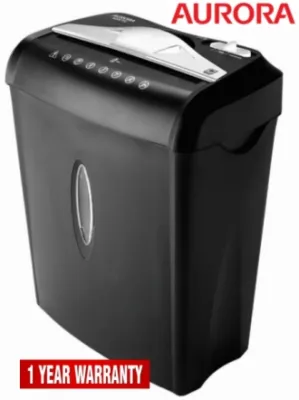
![[SG] Aurora AS875C Cross Cut Shredder [Evergreen Stationery]](https://img.lazcdn.com/g/p/6764cc98d60f0ccee826208f7347c324.jpg_400x400q80.jpg_.webp)
![[SG] Original Aurora AS800CD Plastic Paper Shredder Machine 8 sheet Cross cut (Able to Shred CDs) [Evergreen Stationery]](https://img.lazcdn.com/g/p/0cd07fe2a1ba74eeb42f61baa8c305df.jpg_400x400q80.jpg_.webp)
Prices are valid at publication and may change. Please refer to the product page for the latest price.
In contrast, a cross-cut shredder utilizes a more complex dual-blade mechanism. It features two sets of cutting shafts that rotate in opposite directions. The first set of blades performs the vertical slice, while the second set cuts across the paper horizontally at precise intervals. This coordinated action transforms a single sheet of paper into hundreds of tiny, rectangular or diamond-shaped particles. Instead of long ribbons, you are left with small pieces of confetti that are exceptionally difficult to realign.
These mechanical differences lead to highly visible variations in the resulting waste. Strip-cut waste is bulky, springy, and quickly fills up the collection bin because the long ribbons do not settle flat. The strips tangle together, creating large air pockets that trick the bin’s fill sensors into indicating a full basket prematurely. Cross-cut waste, on the other hand, consists of dense, compact particles that settle flatly at the bottom of the bin. This allows you to fit significantly more shredded material into the same size basket before needing to empty it.
Evaluating Security Levels for Your Documents
When evaluating document security, the primary risk to consider is reconstructability. Strip-cut ribbons present a relatively high security risk because the text on each strip remains largely intact. If a document is fed vertically, entire lines of text, account numbers, or signatures can remain perfectly legible on a single strip. With basic patience, manual sorting, or digital scanning software, an unauthorized individual can piece these strips back together like a simple jigsaw puzzle.

Cross-cut particles eliminate this vulnerability by breaking up both the vertical and horizontal flow of text. Because the cuts occur in two directions, individual words, numbers, and identifiers are sliced into multiple fragments. Reassembling a cross-cut document requires matching thousands of tiny, identical-looking confetti pieces, a task that is practically impossible without specialized forensic equipment and immense amounts of time.
To help consumers verify these security capabilities, manufacturers use the international DIN 66399 standard, which classifies shredder security levels from P-1 to P-7. The “P” stands for paper, and the accompanying number indicates the level of protection, with higher numbers representing smaller particle sizes. You can easily verify these ratings on product labels, packaging, or manufacturer manuals before making a purchase.
Strip-cut shredders generally fall into the lower security categories, typically P-1 or P-2. These levels are suitable only for non-sensitive drafts, general office waste, and documents that contain no personally identifiable information. They are designed for basic clutter reduction rather than data protection.
Cross-cut shredders usually achieve P-3 or P-4 security ratings. A P-4 rating is widely considered the standard for secure business and personal document disposal. It is highly recommended for destroying financial statements, medical records, tax forms, payroll information, and any documents containing personal identification numbers. For most households and standard office environments, a P-4 cross-cut shredder provides the ideal balance of robust security and practical operation.
Comparing Daily Practicality and Maintenance
While security is paramount, the daily operational differences between these two types of shredders will directly affect your productivity and maintenance routine. Strip-cut shredders are generally faster and can handle a higher sheet capacity per pass. Because the motor only has to drive a single set of vertical blades, it encounters less resistance. This allows strip-cut machines to glide through thick stacks of paper quickly, making them highly efficient for high-volume, low-security tasks.
Cross-cut shredders require more mechanical effort to operate. Slicing paper in two directions simultaneously puts a heavier load on the motor and gear system. As a result, cross-cut models typically have lower sheet capacities per pass and slower linear shredding speeds compared to strip-cut models of a similar motor size. If you try to force too many sheets into a cross-cut shredder at once, you risk overloading the motor and causing a jam.
However, cross-cut shredders hold a clear advantage when it comes to bin space efficiency. Because the tiny particles compress tightly under their own weight, a cross-cut bin can hold up to four or five times more shredded paper than a strip-cut bin of the same physical volume. This means you will spend far less time emptying the wastebasket and dealing with messy, overflowing paper strips that spill onto the office floor.
Maintenance requirements also differ significantly between the two mechanisms. The complex, interlocking gears and dual blades of a cross-cut shredder generate more friction and paper dust during operation. To keep the blades sharp and prevent the motor from straining, cross-cut shredders require regular lubrication. You will need to apply specialized shredder oil or use pre-treated oil sheets according to the manufacturer’s instructions, typically every time you empty the waste bin or at least twice a month. Strip-cut shredders, having simpler blade designs, require much less frequent oiling and are generally more forgiving of maintenance neglect.
Noise levels and power consumption are additional factors to observe during continuous operation. Because of the increased resistance of the dual-cutting action, cross-cut shredders often run slightly louder and draw more electrical power than strip-cut models. If you work in a quiet home office or a shared corporate space, checking the decibel rating on the product specification sheet can help you find a model that operates quietly.
Decision Framework: Choosing the Right Shredder
To make the final decision, you should evaluate your specific document handling habits, security requirements, and willingness to perform regular maintenance.
You should choose a strip-cut shredder if your primary goal is to quickly clear out large volumes of non-sensitive paperwork, such as old junk mail, generic business drafts, or packing slips. If you prioritize high sheet capacity, fast processing speeds, and a low-maintenance machine that does not require frequent oiling, a strip-cut model will serve your needs well.
You should choose a cross-cut shredder if you handle any form of sensitive personal, financial, or corporate data. If you regularly dispose of bank statements, utility bills, medical documents, client records, or tax papers, the physical security of a cross-cut machine is indispensable. The peace of mind that comes from knowing your private information cannot be easily reconstructed far outweighs the slightly slower shredding speed and the need for regular oiling.
Before finalizing your purchase, always verify the technical specifications on the manufacturer’s product sheet. Look closely at the maximum sheet capacity per pass, the continuous run time (how long the machine can operate before needing to cool down), and the specific DIN security level. Checking these details ensures you select a machine that matches both your security expectations and your daily workload.
Frequently Asked Questions (FAQ)
Can a cross-cut shredder handle credit cards and staples?
Many modern cross-cut shredders are designed to handle small metal staples and paperclips, as well as plastic credit cards. However, you must always verify this capability in your specific model’s user manual before attempting to shred them. Feeding hard materials into a machine that is not explicitly rated for them can dull or chip the dual-action blades, strain the motor, and void your manufacturer warranty. If your model is rated for credit cards, it will usually feature a dedicated slot or specific instructions on how to feed them safely.
Why does my cross-cut shredder jam more often than a strip-cut model?
Cross-cut shredders are more prone to jamming because their dual-cutting blades create more resistance and generate a higher volume of fine paper dust. Jams typically occur when you exceed the recommended sheet capacity per pass or feed paper at an angle, causing the fibers to bunch up in the cutting shafts. Additionally, if you do not oil the blades regularly, friction increases, making it harder for the motor to pull paper through. To minimize jams, always stay within the rated sheet capacity, feed pages straight, and oil the blades as directed by the manufacturer.
Is a micro-cut shredder necessary if cross-cut is already secure?
For the vast majority of households and standard business offices, a standard P-4 cross-cut shredder provides more than enough security to protect against identity theft and data leaks. A micro-cut shredder is a specialized type of cross-cut machine that reduces paper to even smaller, microscopic particles, typically achieving a P-5 or higher security rating. While micro-cut offers extreme protection, it comes with much slower shredding speeds, lower sheet capacities, and higher maintenance needs. It is generally only necessary for government agencies, legal firms, or corporations handling highly classified, top-secret proprietary data.

Community discussion
Share your experience or ask a question. Comments are reviewed before publication.