
Choosing the right paper shredder depends entirely on the sensitivity of the documents you handle daily. While strip-cut machines offer speed and higher sheet capacity for general waste, cross-cut and micro-cut models provide the necessary particle reduction for confidential data. Rather than automatically opting for the highest security rating, understanding how cut types and standard protection levels align with your specific document sensitivity will help you select a shredder machine that balances security, operational speed, and maintenance effort.
Strip-Cut vs Cross-Cut: How the Cut Type Affects Security
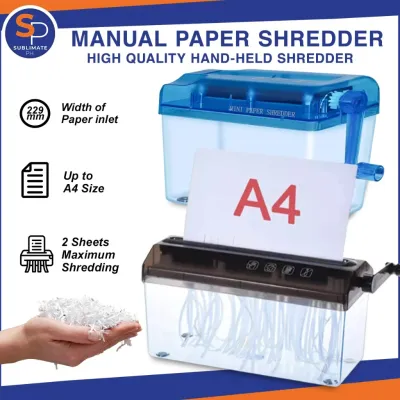
A strip-cut shredder machine operates by slicing paper vertically into continuous, ribbon-like strips. This mechanism is efficient for processing large volumes of non-confidential documents, such as rough drafts, junk mail, or general office scrap paper. Because the blades only cut in one direction, these machines typically offer faster throughput and can handle more sheets of paper in a single pass.
However, strip-cut strips can often be reconstructed with relatively little effort, making them unsuitable for sensitive information. If a document contains personal identification numbers, financial details, or proprietary business strategies, a strip-cut pattern does not offer sufficient protection.
Products mentioned in this guide
![[SG] Aurora AS875C Cross Cut Shredder [Evergreen Stationery]](https://img.lazcdn.com/g/p/6764cc98d60f0ccee826208f7347c324.jpg_400x400q80.jpg_.webp)
![[SG] Original Aurora AS800CD Plastic Paper Shredder Machine 8 sheet Cross cut (Able to Shred CDs) [Evergreen Stationery]](https://img.lazcdn.com/g/p/0cd07fe2a1ba74eeb42f61baa8c305df.jpg_400x400q80.jpg_.webp)
![[SG] A4 Multi-Functional Electric Paper Shredder with Built-in Basket](https://img.lazcdn.com/g/p/e13a5b4a0cd7800074c9a408a1f0b8e7.jpg_400x400q80.jpg_.webp)
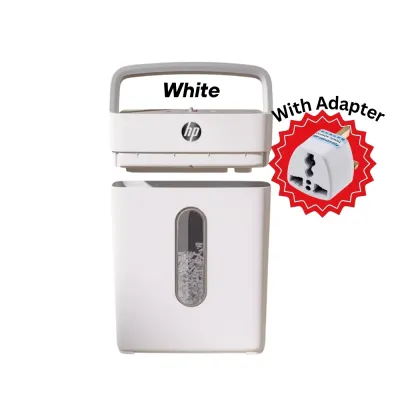
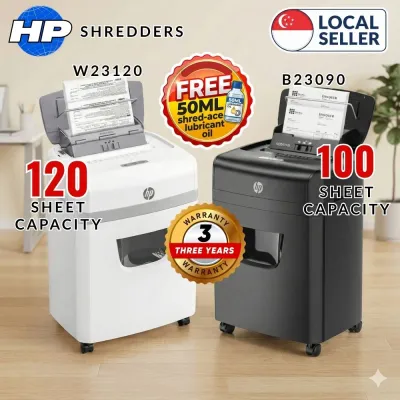
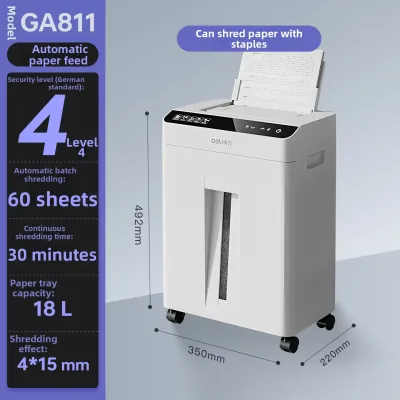
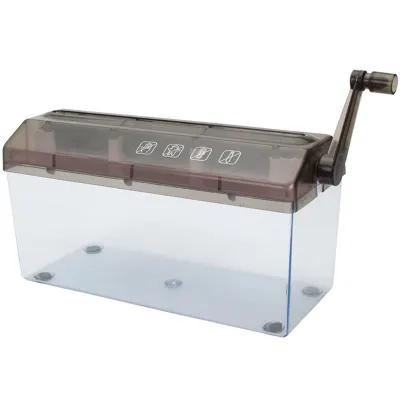
Prices are valid at publication and may change. Please refer to the product page for the latest price.
In contrast, a cross-cut shredder machine uses two opposing rollers to cut paper both vertically and horizontally. This dual-action cutting process transforms a single sheet of paper into hundreds of small, confetti-like diagonal particles. For highly sensitive documents, micro-cut machines—an advanced subset of cross-cut technology—reduce paper to even smaller, unreadable specks.
These security benefits come with specific operational trade-offs. Cross-cut and micro-cut machines generally operate at slower linear speeds because of the complex cutting action. They also tend to generate more noise and heat, which can limit their continuous run time. On the positive side, the smaller paper particles compress more efficiently inside the waste bin, meaning you will need to empty the bin less frequently than you would with bulky, tangled strip-cut ribbons.
Decoding Shredder Security Levels: What the Ratings Actually Mean
To help consumers evaluate protection levels, paper shredder machines are classified using standardized security ratings, commonly referred to as P-levels under the international DIN 66399 standard. You can verify these ratings by checking the physical specification plate on the back of the machine, looking at the product packaging, or consulting the official user manual. The “P” stands for paper-based media, followed by a number from 1 to 7, where a higher number indicates a smaller particle size and greater security.

Low-security tiers, specifically P-1 and P-2, represent basic strip-cut machines. A P-1 rating typically produces strips that are about 12 mm wide, while P-2 produces strips around 6 mm wide. These levels are suitable only for general office documents, non-sensitive internal memos, and basic recycling preparation where privacy is not a primary concern.
Medium-security tiers include P-3 and P-4 ratings, which are the standard for most professional environments. A P-3 shredder produces narrow strips or larger cross-cut particles, making it suitable for general business correspondence. A P-4 rating is the baseline for confidential personal data, including human resources records, medical documents, and financial statements, as it reduces a standard A4 sheet into roughly 400 secure particles.
High-security tiers, ranging from P-5 to P-7, are reserved for highly sensitive government, legal, or proprietary corporate data. A P-5 micro-cut machine turns a single page into over 2,000 particles, while P-7 is the standard used for top-secret government intelligence.
Opting for the highest security rating is not always the most practical decision for every office or home. High-security machines require more precise engineering, which often translates to a higher purchase price, lower sheet capacity per pass, and more frequent maintenance. Matching the security level to your actual data risk ensures you do not overpay for security while sacrificing daily operational efficiency.
How to Match Shredder Specs to Your Document Sensitivity
When selecting a shredder machine, you must balance your security requirements with the physical limits of the hardware. The sheet capacity—the number of pages the machine can shred simultaneously—is a critical specification to check. High-security cross-cut and micro-cut models generally have lower sheet capacities per pass because the motor must drive paper through more complex cutting cylinders.
Continuous run time is another vital metric, representing how long the motor can run before it needs to cool down. Entry-level models may only run for two to five minutes before requiring a 20-minute rest, whereas heavy-duty office shredders can run continuously for 30 minutes or more. If your daily workflow involves shredding large stacks of paper at once, a machine with a longer run time and higher sheet capacity is essential, even if it means choosing a slightly lower, yet still acceptable, security level.
Bin capacity should also influence your decision. Although cross-cut particles compress tightly and fill a bin more slowly than strip-cut ribbons, a small bin will still require frequent emptying in a busy office. Look for a bin capacity that matches your daily volume, and consider models with a transparent viewing window so you can easily monitor the fill level.
Finally, review the secondary operational specifications listed on the product label or manual. Many modern shredders feature an auto-reverse function, which automatically detects paper jams and runs the blades backward to clear the blockage. You should also verify media compatibility; if you regularly need to destroy expired credit cards, CDs, or documents held together by staples and paper clips, ensure the cutting cylinders are rated to handle these materials without sustaining damage.
Frequently Asked Questions (FAQ)
Can I change a strip-cut shredder to cross-cut later?
The cutting mechanism of a paper shredder is a fixed, precision-machined assembly consisting of heavy-duty steel shafts and cutting discs. These components are permanently aligned during manufacturing to ensure safe and reliable operation. Because these internal parts cannot be swapped or upgraded, you cannot convert a strip-cut machine into a cross-cut model. If your security needs increase, you will need to purchase a new machine designed for the higher security level.
Why does my high-security shredder jam more often?
High-security shredders, particularly micro-cut models, are engineered with tighter tolerances and more complex cutting paths to reduce paper to tiny particles. This intricate design makes them more sensitive to overloading, so exceeding the recommended sheet capacity per pass will quickly cause a jam. To prevent motor strain and blockages, always stay within the manufacturer’s specified sheet limits and regularly apply shredder lubricant oil or lubricating sheets as directed in the user manual.

Community discussion
Share your experience or ask a question. Comments are reviewed before publication.