
Quick Answer: Which 70gsm Photocopy Paper Offers the Best Balance?
Selecting the ideal photocopy paper 70g brand in Singapore depends on matching your specific printing volume, hardware configuration, and document destination to the correct product tier. There is no single universal winner. Premium 70gsm papers, distinguished by high whiteness and ultra-smooth finishes, provide the best performance for external client-facing documents and double-sided laser printing. Standard or budget-friendly brands offer the highest cost-efficiency for high-volume internal drafts, daily administrative filing, and single-sided printing.
Choosing a 70gsm paper weight is a highly practical decision. It is approximately 12.5% lighter than standard 80gsm paper, which translates directly to lower shipping costs, reduced storage space, and lower raw material consumption. For businesses and home offices in Singapore looking to balance operational budgets with environmental responsibility, high-quality 70gsm paper serves as an excellent everyday workhorse. The key is identifying which tier of paper aligns with your daily output requirements.
Key Dimensions for Comparing 70gsm Copy Paper
Evaluating photocopy paper 70g requires looking beyond the brand name on the wrapper. To make an objective comparison, you must understand the physical and optical properties that dictate how paper behaves under the heat and pressure of modern office printers.
Products mentioned in this guide
![[SG]Perfect Print A4 Size 70gsm White Copier Paper [Evergreen Stationery] (5 Reams per Carton) | MAX 2 CARTONS/ORDER](https://img.lazcdn.com/g/p/5b68d91431474af3ae7b65825324d08d.png_400x400q80.png_.webp)
![[SG] Fujifilm A4 70gsm Everyday Copier Paper 1 Carton | MAX 2 CARTONS/ORDER [Evergreen Stationery]](https://img.lazcdn.com/g/p/6c0da9aef6095ba243aedb3b797bb59d.png_400x400q80.png_.webp)
![PaperOne™ Copier Paper 70gsm / 75gsm Copy Paper A4 [1 Box]](https://img.lazcdn.com/g/p/62f961291078a3b12171dd45eea2a9a4.jpg_400x400q80.jpg_.webp)
Prices are valid at publication and may change. Please refer to the product page for the latest price.

Print Quality, Brightness, and Opacity
Print quality is heavily influenced by two optical measurements: brightness and whiteness. Whiteness, often measured using the CIE (Commission Internationale de l’Éclairage) index, indicates how white the paper appears to the human eye under standard outdoor lighting conditions. A higher CIE whiteness rating, such as CIE 160 or above, means the paper contains more optical brightening agents (OBAs). These agents reflect ultraviolet light as visible blue light, making the paper look exceptionally bright and crisp. This high contrast makes printed text appear sharper and colors more vibrant.
Opacity is the measure of how much light is prevented from passing through a single sheet of paper. Because 70gsm paper is thinner than 80gsm paper, it naturally has lower fiber density, which can lead to lower opacity. If opacity is too low, ink or toner from one side of the sheet will show through to the other side, rendering double-sided printing difficult or unreadable. When comparing brands, look for opacity ratings on the manufacturer’s technical data sheets. For double-sided printing, aim for an opacity rating of 90% or higher. Do not rely solely on brand names; formulations and mill sources can change, so verifying these technical specifications on the packaging or product datasheet is highly recommended.
Runnability, Smoothness, and Jam Prevention
Runnability refers to the paper’s ability to pass through a printer’s paper path without causing misfeeds, multi-sheet feeding, or physical jams. This property is determined by surface smoothness, edge cutting precision, and moisture control. Smoothness is typically measured in Bendtsen milliliters per minute (ml/min) or Sheffield units; a lower value indicates a smoother surface. A smooth surface ensures consistent contact with the printer’s fuser rollers, allowing for even heat distribution and precise toner transfer.
Precision cutting is another critical mechanical factor. During manufacturing, paper is slit into individual sheets. If the slitting knives are dull, they leave microscopic paper dust and rough edges on the sheets. This dust accumulates on the printer’s rubber feed rollers over time, causing them to lose traction and slip, which leads to chronic paper jams. Furthermore, 70gsm paper is inherently less stiff than 80gsm paper. If the paper’s moisture content is not carefully controlled during packaging, the intense heat of a laser printer’s fuser will cause the paper to curl excessively as moisture rapidly evaporates. To minimize these risks, look for brands that explicitly advertise precision-cut edges, low-dust manufacturing, or specialized moisture-barrier packaging.
Cost Efficiency and Packaging Sizes
To find the true financial value of photocopy paper 70g, you must calculate the cost per sheet rather than comparing simple ream prices. A standard ream contains 500 sheets of paper. Purchasing paper by the single ream is generally the most expensive approach. For businesses and home offices with consistent printing needs, buying paper in full cartons—which typically contain five reams (2,500 sheets)—offers significantly better unit economics.
When ordering paper in Singapore, physical logistics must be factored into your total cost. A single carton of A4 70gsm paper weighs approximately 10.9 kilograms. Because of this weight, delivery fees can quickly erode the savings gained from a low purchase price. When ordering from online marketplaces or local office supply distributors, look for bulk-purchase thresholds that qualify for free delivery. Compare the delivered cost per carton across different suppliers to ensure you are getting the best overall value.
Market Tiers: How Popular Brands Typically Position Themselves
The photocopy paper 70g market in Singapore is populated by several regional and international brands. These products generally fall into three distinct market tiers based on their technical specifications, manufacturing standards, and target use cases.
Premium Tier
Premium 70gsm papers are engineered to mimic the stiffness, brightness, and runnability of heavier 80gsm sheets. These papers typically feature a CIE whiteness rating of 160 or higher and an ultra-smooth surface texture (often below 150 ml/min Bendtsen roughness). They are designed to withstand the high-speed feed mechanisms of enterprise multi-function printers (MFPs) and high-volume copiers without jamming.
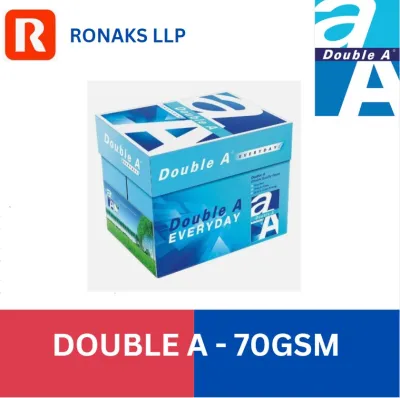
- Double A 70gsm: Highly regarded in Singapore for its exceptional smoothness and high whiteness. This brand utilizes short-fiber eucalyptus pulp, which provides high fiber density and stiffness, allowing the thin 70gsm sheet to feed reliably through high-speed machines.
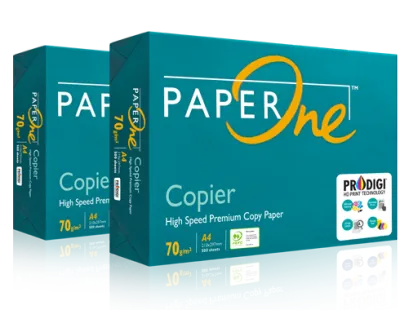
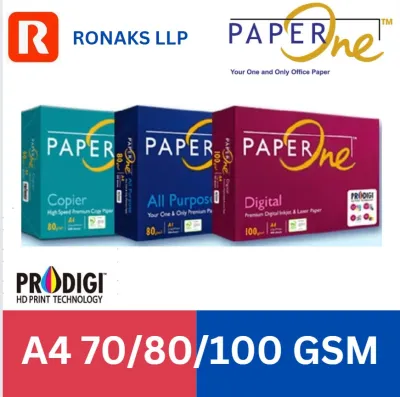
- PaperOne All Purpose 70gsm: Features specialized surface treatments, such as ProDigi HD Print Technology, which helps lock ink pigments near the surface of the paper. This reduces ink bleed and feathering, making it highly suitable for both laser and inkjet systems.
These premium options are ideal for external client presentations, official reports, and double-sided documents where visual quality and a smooth tactile feel are paramount.
Standard Tier
Standard 70gsm papers are the primary workhorses of most Singaporean offices. They offer a highly competitive balance of dependable runnability and moderate optical properties, typically featuring a CIE whiteness rating between 145 and 155.
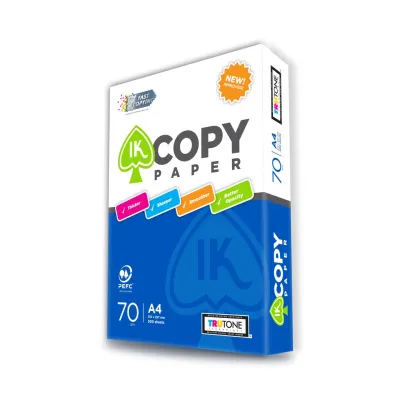
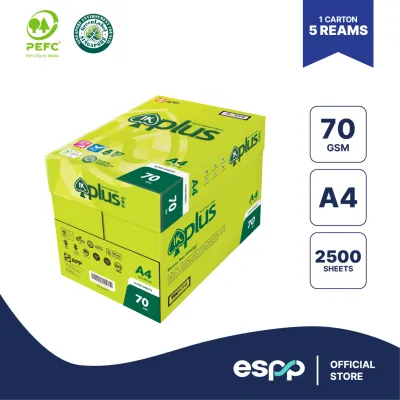
- IK Yellow 70gsm: A widely used regional brand known for reliable daily performance in standard office copiers. It provides adequate contrast for text-heavy documents and maintains good dimensional stability under normal operating conditions.
- PaperOne Everyday 70gsm: Designed specifically for high-volume, daily copying and printing tasks. It offers consistent smoothness and runnability at a lower price point than its premium counterpart.
This tier is best suited for internal memos, shipping documents, standard business correspondence, and everyday high-volume printing where extreme brightness is not required.
Budget/Eco Tier
Budget and eco-friendly papers prioritize lowest-cost-per-sheet metrics or sustainability profiles. These papers may have a lower CIE whiteness rating (often between 135 and 145) and slightly higher surface roughness, which can result in a more muted print contrast.
- Local House Brands: Many major office supply distributors and supermarket chains in Singapore offer their own white-label 70gsm paper. These products are sourced from various regional mills and offer the lowest upfront cost.
- Recycled-Fiber Papers: These papers incorporate post-consumer waste or recycled fibers. While they may have slightly higher opacity variance and lower whiteness, they appeal directly to organizations operating under strict green procurement policies.
When purchasing from this tier, it is essential to look for verifiable environmental certifications, such as the Forest Stewardship Council (FSC) or the Programme for the Endorsement of Forest Certification (PEFC), on the packaging to ensure the wood fibers are responsibly sourced. Always treat brand names as illustrative examples; check the physical label of the specific batch you purchase to verify current technical specifications.
Decision Framework: Matching the Right 70gsm Paper to Your Needs
To simplify your purchasing process, use this structured decision framework to match your specific printing scenarios to the correct paper tier.
- Choose Premium 70gsm if:
- You frequently print high-contrast, double-sided documents.
- Your office uses high-speed enterprise multi-function printers that are sensitive to paper stiffness.
- You are producing external client-facing reports, proposals, or marketing drafts that require a professional, crisp appearance.
- You print documents containing fine lines, detailed charts, or color-coded graphics that require sharp contrast.
- Choose Standard 70gsm if:
- You need a reliable, cost-effective paper for high-volume, single-sided black-and-white printing.
- Your daily output consists of internal administrative records, standard office filing, and daily correspondence.
- You want to minimize paper jams in standard desktop laser printers without paying a premium for high-brightness coatings.
- Choose Budget/Eco 70gsm if:
- Your printing is limited to temporary drafts, internal scratchpads, or single-use packing slips.
- Your organization is bound by corporate sustainability mandates that require certified recycled content or PEFC/FSC-certified materials.
- Minimizing the absolute cost per sheet is your primary operational objective.
- Important Hardware Verification Step:
Before committing to bulk purchases of 70gsm paper, always consult your printer's official user manual. Some high-speed production copiers, older laser printers, or specialized inkjet models specify a minimum paper weight of 75gsm or 80gsm. Attempting to run thinner 70gsm paper through these specific machines can result in chronic feed failures, double-sheet feeding, or internal paper path damage, which may void your hardware service agreements.
Practical Tips for Buying and Storing Copy Paper in Singapore
Singapore’s tropical climate presents unique challenges for paper storage. With average relative humidity levels frequently exceeding 80%, paper—which is naturally hygroscopic—will readily absorb moisture from the surrounding air if left unprotected.
When paper fibers absorb moisture, they expand unevenly. This dimensional instability causes the sheets to wavy-edge or curl, particularly when exposed to the high heat of a laser printer’s fuser unit. The result is a dramatic increase in paper jams and multi-sheet misfeeds. To protect your paper investment, follow these practical storage guidelines:
- Keep Paper Sealed: Leave paper reams inside their original, moisture-resistant wrappers until the exact moment you are ready to load them into the printer tray. These wrappers are typically lined with a thin polyethylene barrier designed to keep moisture out.
- Reseal Opened Reams: If you only use half a ream, fold the open end of the wrapper tightly and secure it with tape, or transfer the remaining sheets to a sealable plastic container.
- Elevate Storage: Never store paper cartons directly on concrete floors, as moisture can easily migrate through the cardboard packaging. Store cartons on shelves, pallets, or inside cabinets.
- Avoid Climate Extremes: Keep your paper storage area away from direct sunlight, open windows, and air-conditioning vents. Rapid temperature and humidity fluctuations from AC units turning on and off can cause rapid paper warping.
When purchasing paper in bulk from online marketplaces, pay close attention to merchant ratings and customer reviews. Look specifically for feedback regarding how the seller packages and transports the cartons. If a carton is dropped or exposed to rain during delivery, the protective moisture seals on the individual reams can rupture, compromising the entire batch of paper before it even arrives at your office.
Frequently Asked Questions (FAQ)
Is 70gsm paper too thin for double-sided printing?
It depends on the paper’s opacity and the type of printer used. High-quality, premium 70gsm paper with an opacity rating of 90% or higher can handle double-sided black-and-white text printing very well. However, if you are printing heavy graphics, dark backgrounds, or using high-saturation inkjet inks, some degree of show-through is likely to occur, making the text on the reverse side harder to read.
Can I use 70gsm paper in all inkjet and laser printers?
While most modern home and office printers are designed to handle a wide range of paper weights, compatibility is not universal. You must check your specific printer’s user manual to verify its supported media weight range. Some older printers or heavy-duty office copiers require a minimum weight of 80gsm to feed reliably through their high-speed rollers without jamming.
What is the difference between 70gsm and 80gsm copy paper?
The primary difference is the weight and thickness of the sheet; 80gsm paper is roughly 14% heavier than 70gsm paper. This extra weight gives 80gsm paper higher opacity, greater stiffness, and a more substantial, premium tactile feel, making it the preferred choice for formal external documents. Photocopy paper 70g is thinner, lighter, and more cost-effective, making it highly suitable for high-volume, everyday office printing where premium thickness is not required.

Community discussion
Share your experience or ask a question. Comments are reviewed before publication.