
Selecting the right school stapler depends on balancing a student’s physical hand strength with their growing academic workload. Lower primary students benefit most from lightweight, low-force mini staplers that fit comfortably in small hands and pencil cases. As students progress to upper primary and secondary school, their assignments grow from simple worksheets to multi-page reports, requiring a transition to standard desktop staplers or compact half-strip models with higher sheet capacities and durable metal components. Matching the tool to the student’s developmental stage ensures frustration-free binding and prevents damage to both the device and school assignments.
How Hand Strength and Assignment Volume Dictate Stapler Choice
A student’s physical development directly impacts their ability to use standard office tools. Mini staplers typically feature shorter levers, which require more concentrated pressing force per sheet but are sized appropriately for smaller hands. Standard desktop staplers offer longer lever arms, distributing the force more efficiently and allowing students to bind thicker stacks with less physical strain. Heavy-duty staplers utilize compound leverage systems designed for substantial paper volumes, though these are generally too bulky and heavy for daily school bags.
Paper volume also shifts dramatically across different academic stages. Daily worksheets in early primary school rarely exceed two to four sheets of paper, a volume easily managed by compact models. By secondary school, term papers, lab reports, and project portfolios can quickly reach fifteen to thirty sheets, demanding a robust mechanism that will not buckle under pressure. Attempting to force a low-capacity stapler through thick stacks often leads to bent staples, jammed cartridges, and torn pages.
Products mentioned in this guide
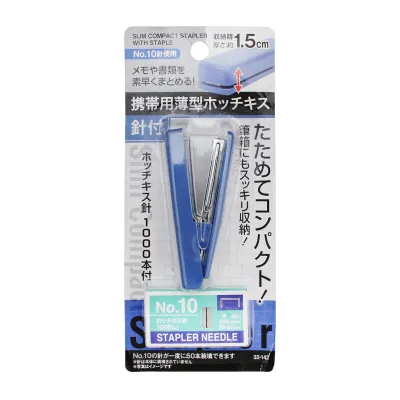
Prices are valid at publication and may change. Please refer to the product page for the latest price.
Ergonomics play a vital role in preventing hand fatigue during busy exam seasons or project deadlines. Low-force mechanisms, which use internal gearing to reduce the required pressing effort by up to fifty percent, are highly beneficial for developing hand muscles. Soft-touch rubber grips on the top cap and base provide a non-slip surface, allowing students to apply pressure safely and comfortably without their fingers slipping off the device.
Recommended Stapler Profiles for Primary School Students
During the lower primary years, students are still developing fine motor skills and hand grip strength. For these younger learners, a mini or compact stapler is a highly practical choice. These models should feature rounded plastic edges to prevent accidental pinches and a lightweight body that fits easily into a standard pencil case. Choosing a model with an integrated low-force mechanism allows younger children to bind their worksheets independently without needing assistance from a teacher or parent.

As students enter upper primary, their academic tasks begin to include short essays, science reports, and multi-page booklets. This stage warrants a transition to standard desktop staplers or mid-sized compact models. These staplers can reliably handle up to twenty sheets of paper at once, accommodating the increased homework volume. Parents should look for models with stable, non-slip rubber bases that stay secure on a study desk, as well as simple, accessible jam-clearing paths.
When choosing a stapler for primary school, parents must weigh the trade-off between portability and stability. A tiny mini stapler is highly portable and fits neatly into a school bag for on-the-go use, but it lacks the stability needed for binding multiple booklets at home. Conversely, a weighted desktop stapler provides excellent leverage and stability on a home desk but is too heavy and bulky to carry to school daily. Many families find success by keeping a durable mini stapler in the pencil case and a standard desktop model at the home study station.
Recommended Stapler Profiles for Secondary School Students
Entering lower secondary school introduces a significant increase in subject variety and assignment lengths. Students at this level require standard desktop staplers with reliable mid-range capacities, typically rated for twenty to twenty-five sheets. Because school bags are often packed tightly with textbooks and files, selecting a stapler with a sturdy metal inner chassis and a durable plastic outer shell ensures the tool can withstand daily transit without cracking or misaligning.
By upper secondary, students are preparing extensive research papers, humanities portfolios, and design project documentation. These lengthy submissions often exceed the capacity of basic school staplers, making high-capacity standard models or compact half-strip heavy-duty staplers highly useful. These advanced models can bind up to thirty or forty sheets cleanly, ensuring that thick reports remain securely fastened without the staple legs folding outward or failing to pierce the back page.
The transition to upper secondary also marks a shift from simple worksheet organization to professional-looking project submissions. A clean, flat-clinch staple—which bends the staple legs completely flat against the back of the paper—creates a neater stack of documents that lies flat without bulky corners. This professional finish is particularly beneficial when submitting portfolios for national examinations or school assessments, where presentation and neatness are highly valued.
Essential Features to Verify Before Purchase
Before purchasing any stapler, parents should verify several practical features to ensure long-term usability and avoid common classroom frustrations. First, check the staple size compatibility printed on the product packaging or the underside of the stapler base. While standard desktop staplers typically use No. 10 or 26/6 staples, mini staplers often require proprietary or smaller sizes that may be harder to source in local stationery shops. Ensuring easy access to the correct refill sizes prevents the device from becoming unusable when the initial supply runs out.
Second, look for user-friendly maintenance features such as built-in jam-release buttons or front-loading staple trays. Staplers with a top-loading design can sometimes be difficult for students to open, leading to spilled staples or pinched fingers. A front-loading mechanism, activated by a simple button press, makes refilling quick and safe. Additionally, models that allow the anvil to rotate can switch between permanent stapling and temporary pinning, offering extra flexibility for art projects or temporary document organization.
Finally, examine the base of the stapler for adequate padding and construction quality. A full rubber or soft foam base pad serves two important purposes: it protects wooden study desks from scratches and significantly dampens the noise of stapling in quiet classroom or library environments. A well-padded base also prevents the stapler from sliding across the desk during rapid use, reducing the risk of misaligned staples or accidental finger slips.
Frequently Asked Questions (FAQ)
Can a standard stapler use mini staples if we run out?
No, standard staplers cannot accommodate mini staples. Standard and mini staples have entirely different crown widths and leg lengths, meaning they will not fit securely in the staple channel or align with the driving blade. Attempting to force mini staples into a standard stapler, or vice versa, will cause immediate jamming and can permanently damage the internal feeding spring. Always check the manufacturer’s label on the bottom of the stapler to verify the exact compatible staple size before loading refills.
Are electric staplers allowed or practical for school use?
Electric staplers are generally impractical and often restricted for school use. These devices rely on batteries or mains power, making them heavy to carry and dependent on constant battery replacements. Furthermore, many schools discourage or prohibit motorized stationery in the classroom to minimize noise distractions and encourage students to develop manual coordination. It is highly practical to reserve electric staplers for high-volume home study spaces and stick to manual, low-force staplers for the school bag.
How do we safely clear a stubborn staple jam?
To safely clear a jam, first slide open the staple tray and remove any loose, undamaged staples to clear your view. If your model has a built-in jam-release button, press it to dislodge the stuck staple. If the staple remains wedged, use a flat, blunt tool like a plastic ruler or the edge of a metal paperclip to gently pry the bent staple out of the mechanism. Avoid using sharp knives or scissors, which can scratch the metal driver or cause injury, and consult the product manual for specific disassembly instructions if the jam persists.

Community discussion
Share your experience or ask a question. Comments are reviewed before publication.