
Carton box sizes are expressed as a series of three numbers representing length, width, and height, always measured in that specific order. Understanding these dimensions ensures that your items fit securely, packaging materials work effectively, and shipping costs remain predictable. Whether you are preparing goods for storage, shipping products, or organizing a move, knowing how to read these measurements and calculate the correct box size prevents packing errors and product damage.
How Standard Carton Box Dimensions Are Named
When browsing packaging supplies, you will see dimensions listed in a standard sequence: Length (L) x Width (W) x Height (H). This industry-standard format ensures consistency across different manufacturers. Reversing these numbers can lead to ordering a box with an opening that is completely different from what you expect, even if the total volume remains identical.
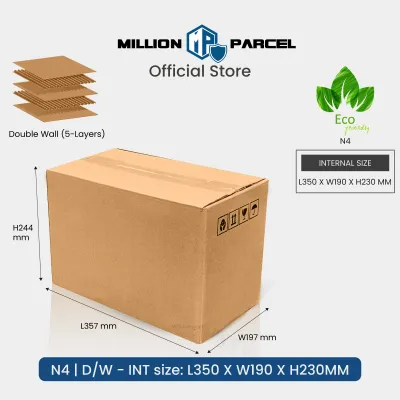
To identify these dimensions on a box, look at its opening. The opening is the top part where the flaps fold over to seal the contents. The longest side of this opening is designated as the Length, while the shorter side is the Width.
Products mentioned in this guide
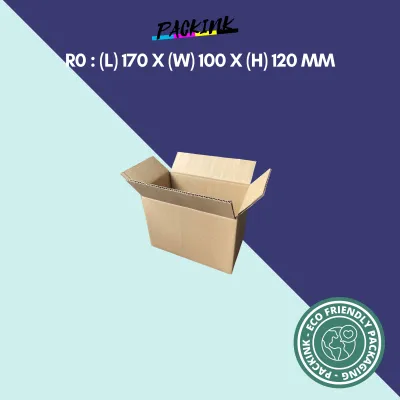
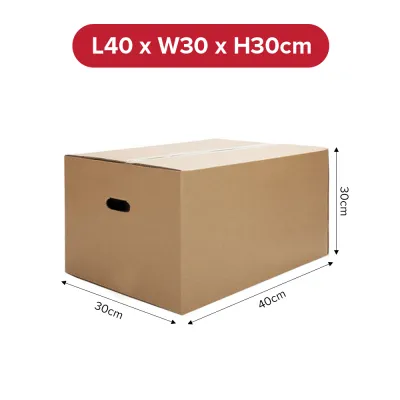
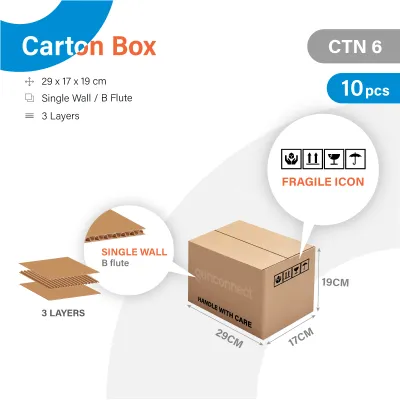
Prices are valid at publication and may change. Please refer to the product page for the latest price.
The third dimension, Height, is sometimes referred to as the depth of the box. This measurement runs perpendicular to the opening, extending from the top edge down to the bottom base. Keeping this sequence in mind helps you visualize the orientation of the box and how your items will sit inside it once assembled.
Inner vs. Outer Dimensions: Which One to Use
A common mistake when purchasing carton boxes is failing to distinguish between internal and external measurements. Manufacturers typically list the inner dimensions of a box because these numbers dictate the actual usable space available for your items. However, the outer dimensions are equally important for logistics and storage planning.

The difference between these two sets of measurements comes down to the thickness of the corrugated cardboard. Corrugated board is constructed with a fluted paper medium sandwiched between flat linerboards. Depending on whether the box is single-wall or double-wall, and the specific flute profile used, the walls can add several millimeters to the overall exterior size.
You should rely on inner dimensions when verifying if your products, along with any protective wrapping, will physically fit inside the box. Relying on outer dimensions for this calculation can result in a box that is too tight, causing the sides to bulge or preventing the top flaps from closing flat.
Conversely, outer dimensions are the critical metric for calculating shipping costs, pallet stacking configurations, and shelf storage space. Courier services use external dimensions to calculate volumetric weight, which directly impacts shipping fees. To ensure accuracy, check the manufacturer’s technical specification sheet to verify both sets of measurements before placing an order.
How to Measure Items and Calculate the Right Box Size
Selecting the ideal carton box requires a systematic approach to measuring your items. Place the object on a flat surface in the orientation it will be shipped. Use a reliable measuring tape to find the maximum length, width, and height of the item, making sure to measure from the outermost points.
Be sure to account for any irregular shapes, protruding handles, or loose parts that extend past the main body of the item. If you are packing multiple items into a single box, arrange them as they would sit inside the carton and measure the overall footprint of the entire group as a single unit.
Once you have the base measurements of your items, factor in the space required for protective packaging. Items should rarely be placed directly against the raw cardboard walls. You need to add a clearance margin to all sides to accommodate bubble wrap, foam inserts, crumpled paper, or air pillows.
To calculate the minimum required inner dimensions of your box, use this straightforward framework:
- Minimum Inner Length = Item Length + (Padding Thickness on Left Side + Padding Thickness on Right Side)
- Minimum Inner Width = Item Width + (Padding Thickness on Front Side + Padding Thickness on Back Side)
- Minimum Inner Height = Item Height + (Padding Thickness on Top + Padding Thickness on Bottom)
Finally, remember that physical dimensions are only one part of the equation. You must also check the manufacturer’s weight capacity rating for the box. A box that is sized perfectly but constructed from a lightweight board may fail structurally if loaded with heavy items, leading to tears or collapsed corners during transit.
Adjusting Your Size Choice for Padding and Shipping
The nature of the items you are shipping should directly influence how you adjust your box size selection. Fragile goods, such as glassware, electronics, or ceramics, require a generous buffer zone. For these items, select a box that allows for uniform padding on all six sides, ensuring the product remains suspended in the center of the carton and does not shift toward the outer walls during rough handling.
For dense, heavy, or non-fragile items like books, metal tools, or flat-packed components, a different strategy is required. These items benefit from a snugger fit with minimal void space. Excessive empty space in a heavy box allows the contents to slide around, generating kinetic energy that can easily burst through the tape or split the seams of the corrugated board.
Additionally, shipping logistics must play a role in your final size decision. Most modern courier services calculate shipping rates based on dimensional weight rather than actual physical weight. This means a large, mostly empty box filled with lightweight packing peanuts can cost significantly more to ship than a smaller, tightly packed box.
To avoid unexpected shipping surcharges, calculate the dimensional weight of your chosen box size using the courier’s specific formula. If the dimensional weight is significantly higher than the actual weight of your package, consider reducing the box size or switching to a more space-efficient protective material to keep your shipping costs manageable.
Frequently Asked Questions (FAQ)
Does the order of Length, Width, and Height matter when ordering?
Yes, the specific sequence of L x W x H is critical when ordering custom or standard boxes. While reversing the numbers does not change the mathematical volume of the box, it completely alters how the box is manufactured and assembled. The dimensions dictate where the opening flaps are cut and where the manufacturer’s joint is glued. Reversing the length and width, for example, will change which way the top flaps fold, potentially making the box difficult to pack or structurally weaker for your specific application.
How much extra space should I leave inside the box for fragile items?
As a general guideline, leave enough clearance on all six sides to accommodate the specific thickness of your chosen cushioning material. For moderately fragile items, a protective layer of bubble wrap or paper padding on all sides is usually sufficient. For highly delicate or heavy items, you may need thicker foam inserts or specialized corner protectors. The key is to ensure that the item cannot migrate through the void fill and make direct contact with the inner walls of the corrugated box during transit.
Why do some boxes list dimensions in millimeters and others in inches?
The unit of measurement used typically depends on the manufacturer’s regional standards, target market, or industry conventions. In Singapore and many international markets, metric measurements like millimeters or centimeters are standard for precision, while some imported packaging materials or regional suppliers may use inches. To avoid costly sizing mistakes, use a reliable conversion tool to double-check the dimensions in your preferred unit before finalizing your purchase.

Community discussion
Share your experience or ask a question. Comments are reviewed before publication.