
Finding the right bubble mailer size is a balance between protecting your items and keeping shipping costs manageable. Standard bubble mailers range from tiny #000 envelopes (ideal for small jewelry) to large #7 mailers (designed for books and clothing). To ensure a secure fit, you must always account for the internal bubble lining, which typically reduces the usable width and length by at least 0.5 to 1.5 inches compared to the listed external dimensions.
Understanding Bubble Mailer Size Labels and Usable Space
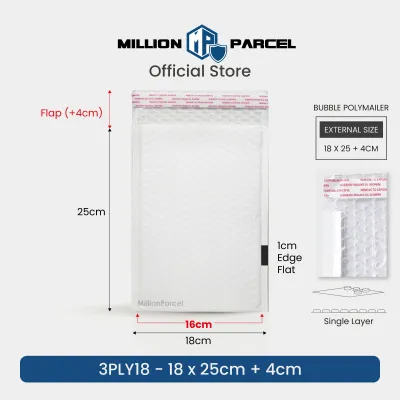
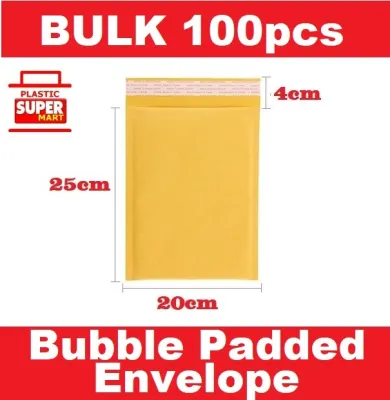
When browsing for shipping supplies, you will encounter two sets of measurements: external dimensions and internal (usable) dimensions. The external dimensions dictate how much space the envelope occupies in a sorting bin, while the internal dimensions determine what actually fits inside. Because the protective air bubbles line the entire interior, they compress the space, meaning a mailer with an external width of 6 inches may only offer 5 inches of usable width.
Standard bubble mailers are flat envelopes without built-in gussets or expandable sides. This flat construction means that as your item increases in thickness, it pulls the front and back panels closer together, effectively shrinking the available width and length even further. If you are shipping a thick item, a standard flat mailer might stretch at the seams, risking a blowout during transit.
Products mentioned in this guide
![[SG] ⭐CHEAPEST BUNDLE⭐ Bubble Polymailer | Bubble Envelope | Bubble Mailer | Padded Envelope | 20pcs/50pcs/100pcs](https://img.lazcdn.com/g/p/bc59e22c194caebccc2d4f06ccb2fc3f.jpg_400x400q80.jpg_.webp)
![[SG] ⭐CHEAPEST BUNDLE⭐ Bubble Polymailer | Bubble Envelope | Bubble Mailer | Padded Envelope | Bulk Purchase](https://img.lazcdn.com/g/p/d1f9b06ebe577dd9b0f70feb1fa794ad.jpg_400x400q80.jpg_.webp)
Prices are valid at publication and may change. Please refer to the product page for the latest price.
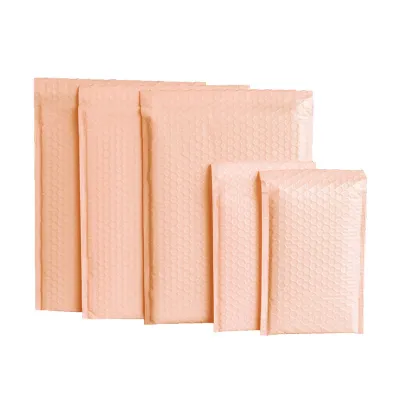
To simplify selection, manufacturers use standard industry numbers ranging from #000 to #7. For example, a #000 mailer typically measures around 4 by 8 inches externally, while a #5 mailer measures approximately 10.5 by 16 inches. However, because different manufacturers may have slight variations in their sizing systems, you should always verify the exact millimeter or inch measurements listed on the product packaging rather than relying solely on the numerical code.
Matching Common Items to Standard Mailer Sizes
Selecting the correct mailer size depends heavily on the physical characteristics of your inventory. Small, flat items such as handmade jewelry, enamel pins, memory cards, and compact cosmetics fit securely in #000 (4″ x 8″) or #00 (5″ x 10″) mailers. These compact envelopes keep lightweight items snug, preventing them from sliding around and getting damaged, while also meeting the minimum size requirements for standard postal sorting.

Medium-sized goods like paperback books, video games, clothing, and small electronic accessories require larger options like #0 (6″ x 10″) up to #4 (9.5″ x 14.5″) mailers. When shipping apparel or soft goods, you must factor in the extra volume created when the fabric is folded. A t-shirt might look flat, but once folded, its thickness will require a larger mailer, such as a #2 or #3, to ensure the self-seal flap can close securely without tension.
For bulky, heavy, or highly irregular items, standard bubble mailers may not provide sufficient structural support. Items with sharp corners, rigid edges, or fragile glass components can easily puncture the paper or plastic film. In these cases, it is safer to transition to a corrugated cardboard box lined with bubble wrap, or to use a heavy-duty padded mailer with reinforced seams to prevent transit damage.
Essential Specs to Verify Beyond Length and Width
Beyond the basic dimensions, the physical composition of the mailer plays a critical role in protecting your shipment. The thickness of the bubble lining itself is a key factor; standard mailers usually feature a 3/16-inch (approx. 4.8 mm) bubble height, which offers moderate shock absorption for non-fragile items. If you are shipping delicate electronics or glassware, look for specialty mailers with high-profile bubbles or double-walled lining for enhanced cushioning.
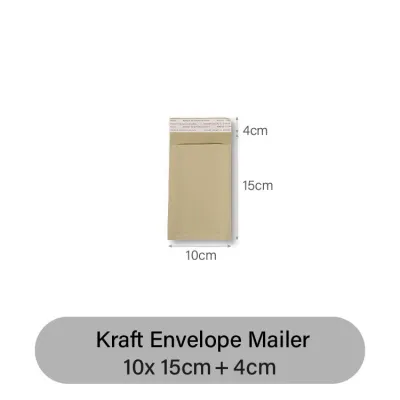
The outer material of the mailer also dictates its performance under different environmental conditions. Kraft paper mailers offer a classic, professional look and are often easier to write on with standard ballpoint pens, but they are highly susceptible to moisture. In humid or rainy climates, such as Singapore, polyethylene (poly) bubble mailers are generally more reliable because their plastic exterior resists water, tears, and punctures during outdoor handling.
Finally, evaluate the closure mechanism of the envelope. Most modern bubble mailers feature a self-seal adhesive strip protected by a peel-off paper backing. To ensure a secure transit, check that the adhesive is high-tack and tamper-evident, meaning the envelope cannot be opened without visibly tearing the material. Keep in mind that adhesive strength can degrade over time if stored in hot, humid environments, so it is wise to inspect older stock before dispatching.
Step-by-Step Guide to Measuring and Testing Your Items
To avoid purchasing the wrong size in bulk, you can use a simple measurement formula to determine the minimum mailer size required for any three-dimensional item. First, use a standard ruler or tape measure to find the exact length, width, and thickness (depth) of your item at its widest points.
Next, calculate the minimum required internal width of the mailer by adding the item’s width to its thickness, plus an additional 0.5-inch buffer to account for the bubble padding. To find the minimum required internal length, add the item’s length to its thickness, plus another 1 inch to ensure the sealing flap can fold over completely without compressing the item. For example, if your item is 5 inches wide, 7 inches long, and 1 inch thick, you will need a mailer with an internal space of at least 6.5 inches wide by 9 inches long.
Before committing to a large shipping run, always perform a physical slide test with a single sample mailer. Gently slide the item into the envelope; it should glide in smoothly without requiring force. If you have to stretch the seams or struggle to pull the adhesive flap down to its designated sealing area, the mailer is too small, and you should step up to the next standard size.
Frequently Asked Questions (FAQ)
How does the thickness of a bubble mailer affect shipping costs?
Postal services often categorize mail based on both weight and thickness. If a bubble mailer exceeds the maximum thickness threshold set by your local postal carrier (often 14mm to 20mm for standard letter or local mail rates), it will be reclassified as a package or parcel. This reclassification can significantly increase your shipping costs, even if the item itself is very lightweight, so it is important to measure the total thickness of your packed mailer before purchasing postage.
Can I reuse a bubble mailer for a second shipment?
You can reuse a bubble mailer if its structural integrity is still intact. Inspect the envelope to ensure the inner bubbles are not popped or deflated, as flattened bubbles will no longer provide adequate cushioning. To reuse the mailer safely, completely cover or cross out all previous shipping labels and barcodes, insert your item, and seal the opening securely using heavy-duty packaging tape, as the original self-seal adhesive cannot be reliably reused.

Community discussion
Share your experience or ask a question. Comments are reviewed before publication.