
Selecting the perfect bubble mailer size is the key to ensuring your products arrive safely at their destination without overpaying for shipping. For e-commerce sellers and stationery enthusiasts in Singapore, shipping efficiency is closely tied to package dimensions. If your mailer is too small, your products will stretch the seams and risk bursting during transit; if it is too large, the items will slide around and potentially incur higher courier rates due to excess volume. To get the perfect fit, you must look beyond flat measurements and understand how the protective internal bubbles reduce the actual space inside the envelope.
Understanding Dimensions: How Internal Bubbles Affect Outer vs. Usable Size
When shopping for packaging materials, you will consistently encounter two sets of measurements: outer dimensions and usable (or inner) dimensions. Outer dimensions represent the total physical footprint of the mailer when it is laid completely flat, measured from one sealed edge to the other. While these numbers are important for calculating shipping tiers with local couriers, they do not tell you what will actually fit inside the envelope.
The usable dimensions represent the true interior space available to hold your product. This space is always smaller than the outer dimensions because of the manufacturing seams on the sides and, more importantly, the thickness of the protective bubbles lining the interior. The air-filled bubbles take up physical space on both sides of the envelope, immediately reducing the width and length by several millimeters even before you insert an item.
Products mentioned in this guide
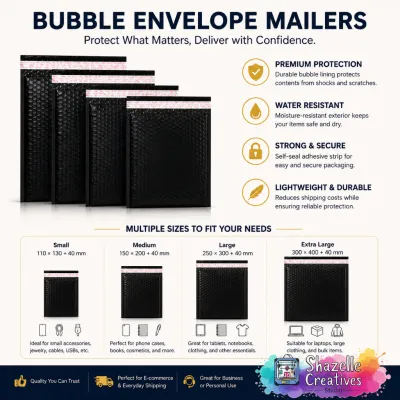
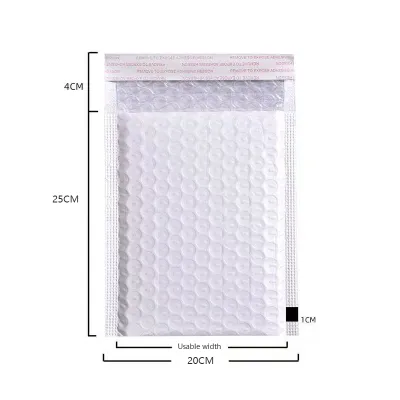
Prices are valid at publication and may change. Please refer to the product page for the latest price.
This leads to the “thickness deduction” rule. When you place a three-dimensional product inside a flat mailer, the envelope must expand outward to accommodate the product’s height. As the mailer stretches to wrap around the thickness of your item, it pulls the front and back faces closer together, which dramatically decreases the usable width and length. For example, a notebook that is 2 cm thick will require a significantly wider mailer than a flat sticker sheet of the same length and width. Minor manufacturing tolerances of a few millimeters are common, but they matter far less than this physical displacement. Always prioritize usable dimensions and round up your calculations to ensure a safe, stress-free fit.
How to Measure and Calculate the Right Fit for Your Items
To avoid wasted materials and prevent transit damage, you can use a simple, reliable mathematical approach to determine the exact mailer size you need.

First, measure your product’s maximum dimensions. Use a rigid ruler or calipers to find the exact length, width, and thickness (height) of the item at its thickest point. If you are shipping multiple items together, stack or arrange them exactly as they will be packaged, then measure the entire bundle as a single unit.
Second, calculate the base wrap-around allowance. To find the minimum usable width your mailer must have, add the product’s thickness to its width, then add an extra 1 cm margin for easy insertion. To find the minimum usable length, add the product’s thickness to its length, then add another 1 cm margin. For example, if your planner measures 15 cm wide, 21 cm long, and 2 cm thick, your minimum usable width is 18 cm (15 + 2 + 1) and your minimum usable length is 24 cm (21 + 2 + 1).
Third, account for the sealing flap. The self-sealing adhesive flap needs to fold over the opening completely to create a secure, tamper-evident seal. Always reserve an extra 2 to 4 cm of length for this flap, depending on the mailer’s design.
If you are shipping fragile stationery items, such as delicate glass ink bottles or ceramic watercolor palettes, you must factor in a fragile item buffer. These items require an initial layer of protective wrap before they go into the mailer. This wrapping increases the product’s overall thickness, which you must use in your calculations. However, avoid choosing a mailer that leaves excessive empty space, as this allows the product to shift during courier handling, reducing the effectiveness of the protective bubbles.
Matching Common Mailer Sizes to Stationery and Small Products
While packaging manufacturers often label their products using numeric size codes like #000, #0, or #2, these standards can vary between brands. Relying on actual centimeter or inch measurements is the safest way to ensure a correct fit. Below is a practical breakdown of how common mailer sizes align with typical stationery and lifestyle products.
Small Mailers (Approx. 10×15 cm / 4×7 in)
These compact envelopes are designed for flat, low-profile items that require minimal structural support. They are ideal for shipping single fountain pens, sticker sheets, small rolls of washi tape, enamel pins, or replacement calligraphy nibs. Because these mailers offer very little wrap-around space, they are best suited for items that are less than 1 cm thick. Attempting to force thicker items into this size will stretch the seams, risking a blowout during transit.
Medium Mailers (Approx. 15×22 cm / 6×9 in)
Mid-sized mailers are the most versatile option for standard stationery and craft supplies. This size comfortably accommodates standard A6 notebooks, planner inserts, small stamp pads, or bundled items like a set of markers. They provide enough interior depth to easily handle items up to 2 to 3 cm thick without severely reducing the usable width, making them an excellent go-to option for daily e-commerce shipments.
Large Mailers (Approx. 25×35 cm / 10×14 in)
When you need to ship larger formats or bulkier items, these generous mailers provide the necessary surface area. They are perfect for A5 journals, large sketchpads, lightweight apparel, or comprehensive stationery gift sets. However, keep in mind that large mailers carry more surface area, which can make them floppy if they are not filled. Additionally, check the weight limits of the adhesive flap, as overloading these mailers with heavy items can put excessive stress on the seams.
Beyond Dimensions: Bubble Thickness and Material Specs
Selecting the right size is only the first step; the physical characteristics of the mailer also play a significant role in protecting your goods.
The thickness of the bubble layer itself determines the level of cushioning. Standard bubbles are typically around 3/16 inch (approximately 5 mm) high, which offers excellent, lightweight protection for most flat stationery items. While larger bubbles provide superior shock absorption for highly fragile items, they also take up significantly more interior space, requiring you to size up your mailer accordingly.
The choice of exterior material—kraft paper versus poly (plastic)—is especially important in Singapore’s tropical climate. Poly bubble mailers are lightweight, highly tear-resistant, and offer outstanding water resistance. This makes them ideal for protecting paper-based stationery from sudden equatorial downpours and high humidity during transit. Kraft paper mailers, on the other hand, provide a classic, premium aesthetic and are often preferred for eco-conscious branding. However, because kraft paper can absorb moisture, you may need to use an additional inner poly bag to protect sensitive paper products if they are exposed to wet weather.
Finally, pay attention to the sealing mechanism. High-quality peel-and-seal adhesive strips speed up the packing process and provide a tamper-evident closure. A strong adhesive ensures the flap remains securely closed even when the mailer is packed to its maximum usable capacity.
Frequently Asked Questions (FAQ)
Can I use a bubble mailer for heavy items like hardcover books?
It is generally not recommended to ship heavy, dense items like thick hardcover books in standard bubble mailers. While the bubbles protect against minor surface scratches, the heavy weight and sharp corners of a hardcover book can easily puncture the outer paper or plastic layer and split the seams during rough handling. For heavy items, corrugated cardboard boxes are much safer, as they offer superior edge-crush resistance and structural integrity.
How do I prevent items from sliding inside a slightly large mailer?
If you must use a mailer that is slightly too large, you can immobilize the product using lightweight void fill such as crumpled tissue paper, clean kraft paper, or custom cardboard inserts. This prevents the item from shifting and absorbing unnecessary impact. Avoid using heavy or bulky fillers, as these can unnecessarily increase the package’s weight and push your shipment into a more expensive shipping tier.

Community discussion
Share your experience or ask a question. Comments are reviewed before publication.