
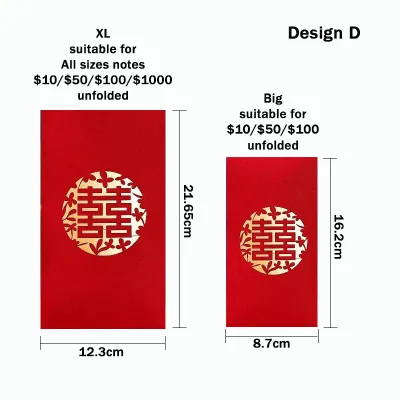
A “big” red packet is defined primarily by its ability to hold standard banknotes completely flat without any folding or creasing. While standard or mini red packets require notes to be folded in half or thirds, a large-format envelope preserves the pristine condition of crisp, new bills. Beyond cash, these larger dimensions are designed to accommodate modern gifting items such as retail vouchers, corporate cheques, and small greeting cards. Selecting the right size depends on the specific dimensions of your contents, the volume of bills you plan to insert, and the structural limits of the paper envelope.
What Qualifies as a 'Big' Red Packet?
To identify a true “big” red packet, look for dimensions that comfortably exceed the length and width of the largest banknote you intend to gift. In many regions, including Singapore, standard banknotes measure up to approximately 162 mm in length and 77 mm in width. Consequently, a red packet must have an internal length of at least 165 mm to 170 mm and an internal width of 80 mm to 90 mm to be considered a flat-lay or “big” envelope. This ensures that the edges of the notes do not catch on the seams or get crushed when the flap is folded down.
In contrast, standard or medium red packets often measure around 115 mm to 130 mm in length, which requires folding banknotes once. Mini red packets are even smaller, typically around 80 mm by 80 mm, requiring notes to be folded into thirds or quarters. The visual and functional differences are distinct: a large red packet presents a sleek, formal, and premium appearance, making it a common choice for formal occasions, weddings, and corporate gifting where presentation is paramount.
Products mentioned in this guide
![[Local SG] Ultra Big Red Packet/ Chinese new year red packet](https://img.lazcdn.com/g/ff/kf/Sea35ef6013e04e71b75212c57febbbcex.jpg_400x400q80.jpg_.webp)
![[Local Stocks] Big Red Packet](https://img.lazcdn.com/g/ff/kf/S4c52daeeb66f44f4ab7bfe93fabede2cn.jpg_400x400q80.jpg_.webp)
![[Local stocks] Interesting Design CNY red packet Ang Bao (Long size) Ang pao](https://img.lazcdn.com/g/ff/kf/S180a0da557ac4c039bc0955398cbd489o.jpg_400x400q80.jpg_.webp)
![[Local stocks] Big Wedding red packet (2 PCs)](https://img.lazcdn.com/g/ff/kf/Scf816f8fa0ae4e2a94c414ff7ee576ebB.jpg_400x400q80.jpg_.webp)
![喜 XI Wedding Ang Bao Red Packet 10pcs / 30pcs [Design C] (Design C Big 10pcs)](https://img.lazcdn.com/g/p/0860a2cc3d7012ed63b42b42789682e4.jpg_400x400q80.jpg_.webp)

Prices are valid at publication and may change. Please refer to the product page for the latest price.
When shopping, it is crucial to check the manufacturer’s printed dimensions on the packaging rather than relying on generic labels like “large,” “L,” or “XL.” Sizing is not standardized across brands, and what one manufacturer labels as “large” might only fit folded notes from certain currencies. Always look for the exact millimetre measurements to ensure the envelope meets your specific requirements.
Matching Red Packet Sizes to Your Contents
When preparing a red packet, the volume and thickness of the contents play a significant role in how the envelope behaves. If you are inserting a single crisp banknote, a standard flat-lay envelope of 165 mm by 85 mm works well. However, if you plan to gift multiple bills—such as ten or more notes—the cumulative thickness will pull the sides of the envelope inward. This reduction in usable width can make it difficult to slide the bills in without crumpling the edges. For thick stacks of cash, look for envelopes with a slightly wider profile, such as 90 mm or more, or those designed with side gussets that expand to accommodate bulk.

Gift vouchers, corporate cheques, and small greeting cards present a different challenge. These items are often longer or wider than standard banknotes. For instance, many retail vouchers measure up to 180 mm in length. Placing these in a standard flat-lay red packet will prevent the flap from closing, or worse, cause the voucher to stick out. For these items, search for oversized red packets that measure at least 190 mm in length and 100 mm in width. This extra space ensures the flap can seal securely without bulging or requiring you to force the contents inside.
Avoiding fit issues is a matter of balancing the envelope’s dimensions with the rigidity of the contents. An overly tight fit creates friction, which can tear the paper seams when the recipient attempts to retrieve the contents. It can also cause the envelope to bend, ruining the presentation. Conversely, an overly loose fit allows the contents to slide around excessively, which can make the presentation feel unstructured and cause thin items to slip out if the flap is not sealed securely. Aim for a clearance of about 5 mm to 10 mm on all sides of your insert for a practical balance of security and ease of access.
How to Verify Dimensions Before Purchasing
Verifying dimensions is straightforward once you know what to look for, especially when navigating online marketplaces. When shopping online, product descriptions should list the exact length and width of the envelopes. However, keep in mind that these listed measurements are almost always the external dimensions. The usable internal space is typically 3 mm to 5 mm smaller due to the glued side seams and the fold of the bottom flap. If the product description does not specify internal dimensions, it is wise to choose a size slightly larger than your minimum requirement to account for this margin.
For in-store verification, you have the advantage of physical inspection. A practical approach is to bring a sample of the item you wish to enclose—such as a voucher or a mock-up paper cut to the exact size of your banknotes—along with a small ruler. You can physically compare the sample against the display models or the packaging. If the packets are sealed, measuring the exterior with a ruler and subtracting a few millimetres for the seams will give you a reliable estimate of the internal capacity.
Material considerations also affect the internal space. Red packets made from thicker paper stocks, heavy cardboards, or those featuring intricate embossed designs, felt textures, or fabric linings have less internal flexibility. A rigid cardboard envelope will not stretch or bulge to accommodate a thick stack of notes the way a standard 120 gsm paper envelope might. If you choose premium, rigid materials, you must be even more precise with your measurements, ensuring the envelope has ample built-in clearance for both the length and the thickness of your contents.
Frequently Asked Questions (FAQ)
Is it advisable to put coins in a big red packet?
It is generally not advisable to place loose coins inside a paper red packet, especially a large-format one. The weight of the coins concentrates at the bottom seam, which can easily split under pressure, causing the coins to fall out. Furthermore, coins slide around inside a large envelope, altering its flat shape, causing unsightly bulges, and potentially tearing the paper from the inside. If you must gift coins, consider placing them in a small, rigid plastic case or a specialized fabric pouch first, or opt for a smaller, thicker card-style packet designed specifically for heavier items.
What paper weight is best for big red packets to prevent tearing?
For big red packets, a sturdier paper weight is essential to maintain structural integrity, especially when holding multiple bills or heavier vouchers. Standard envelopes often use paper weights between 80 gsm and 100 gsm, which can feel flimsy and tear easily under tension. For a premium feel and reliable strength, look for red packets made from paper weights of 120 gsm to 150 gsm. If the envelope features heavy embossing, foil stamping, or is intended to hold a thick stack of bills, a cardstock weight of 180 gsm or higher is recommended to ensure the seams do not give way.

Community discussion
Share your experience or ask a question. Comments are reviewed before publication.