
Selecting the perfect brush is one of the most critical decisions you will make in your Chinese calligraphy journey. In this traditional art form, the brush acts as a direct extension of your hand, translating your inner energy, posture, and wrist movements onto paper. The three primary hair types—wolf hair (langhao), goat hair (yanghao), and mixed hair (jianhao)—each possess distinct physical properties that fundamentally alter how ink flows, how the brush responds to pressure, and how characters take shape. Choosing the wrong material can lead to immense frustration, as a brush that is too soft or too stiff for your current skill level or preferred script style will make it incredibly difficult to control your lines.
For calligraphers practicing in Singapore, this choice is further influenced by the local tropical climate. High humidity levels directly affect how paper absorbs moisture and how quickly calligraphy ink dries. A brush that releases ink too rapidly can cause uncontrollable bleeding on raw Xuan paper, while a brush that is too stiff may scrape or tear damp sheets. By understanding the unique structural characteristics of each hair type, you can make an informed purchase that harmonises with your writing style, skill level, and environmental conditions.
Quick Decision Guide: Match Your Brush to Your Skill and Style
To help you navigate the selection process, use this direct decision framework to identify which brush category aligns with your current practice:
Products mentioned in this guide
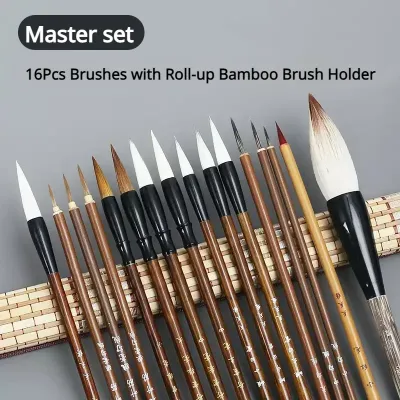
Prices are valid at publication and may change. Please refer to the product page for the latest price.
- **Choose Wolf Hair (Langhao) if** you focus on highly structured, sharp, and precise scripts like Regular Script (Kaishu) or Clerical Script (Lishu). This material is ideal for those who prefer a highly responsive brush that instantly snaps back to its original pointed shape, providing clear feedback with every stroke.
- **Choose Goat Hair (Yanghao) if** you are an intermediate to advanced practitioner specializing in fluid, continuous, and highly expressive scripts like Running Script (Xingshu) or Cursive Script (Caoshu). You must possess strong wrist control, as this soft material does not spring back on its own and relies entirely on your technique to recover the tip.
- **Choose Mixed Hair (Jianhao) if** you are a beginner or intermediate writer looking for a versatile, forgiving, and balanced brush. This hybrid construction is perfect for learning fundamental stroke mechanics across a wide variety of script families without the steep learning curve of pure goat hair.
Your current skill level is the most reliable guide for your initial purchase. Beginners almost always benefit from starting with a mixed hair brush, as the resilient inner core provides a helpful physical guide for lifting and pressing. Advanced calligraphers, on the other hand, often keep a diverse collection of pure wolf and pure goat hair brushes, switching between them to achieve specific artistic textures, line weights, and visual rhythms on the page.
Material Breakdown: Observable Traits of Wolf, Goat, and Mixed Hair
To understand why these brushes perform so differently, we must look at the physical anatomy and structural properties of the animal hairs used to construct them. Each material interacts with water and ink in a unique way, which directly dictates its behavior on paper.

Wolf Hair (Langhao): Elasticity and Precision
Despite its literal translation as “wolf hair,” traditional langhao brushes are actually crafted from the tail hair of the Siberian weasel (Siberian weasel or huángshǔláng), not the grey wolf. This hair is highly prized for its exceptional natural elasticity, stiffness, and structural resilience. When you press a wolf hair brush against paper and then lift it, the hairs naturally spring back into a sharp, unified point. This characteristic is known in calligraphy circles as “bounce” or tánlì.
Because weasel hair is relatively non-porous and smooth, it has a lower ink-holding capacity compared to goat hair. The ink tends to sit on the outer surfaces of the hair bundle rather than soaking deeply into the fibers. Consequently, a wolf hair brush releases its ink quickly and cleanly, producing sharp, crisp edges with minimal bleeding. The trade-off is that you will need to dip the brush into your inkstone more frequently, making it less suitable for long, uninterrupted cursive lines but exceptional for small, highly detailed characters.
Goat Hair (Yanghao): Absorbency and Fluidity
Goat hair, or yanghao, is a soft, highly porous natural fiber harvested from specific regions of China. Unlike weasel hair, goat hair is incredibly fine and lacks any natural spring or stiffness. When wet, a goat hair brush becomes completely soft and flexible. If you bend the brush head, it will remain bent against the paper until you manually rotate your wrist and lift the brush to realign the fibers.
The primary advantage of goat hair is its remarkable ink-holding capacity. The porous nature of the hair allows it to absorb a vast amount of water and ink, acting like a reservoir. This allows you to write large characters or execute long, continuous sequences of cursive writing without dry-out. The softness of the hair also enables a wide range of line variations, from incredibly thick, bold strokes to delicate, whisper-thin lines. However, managing this softness requires exceptional wrist strength, precise finger movements, and a deep understanding of brush angles.
Mixed Hair (Jianhao): Core-and-Edge Balance
Mixed hair brushes, known as jianhao, are engineered to solve the inherent challenges of pure stiff and pure soft brushes. They feature a hybrid “core-and-edge” construction. The inner core of the brush head (the jiàn or pillar) is made from stiff, resilient fibers—typically wolf hair, rabbit hair, or high-grade synthetic nylon. This stiff core is then wrapped in an outer layer (the pī or cloak) of soft, absorbent goat hair.
This clever design balances the high ink retention of goat hair with the reliable elastic rebound of wolf hair. When you press down, the outer goat hair releases a steady flow of ink, while the inner core provides enough structural resistance to help you spring the brush tip back to a point when lifting. Because the exact ratio of stiff to soft hair varies widely by manufacturer (such as 70% wolf to 30% goat, or vice versa), it is important to check the product specifications to find a blend that matches your preferred level of stiffness.
Pairing Brush Types with Calligraphy Scripts
The physical behavior of your brush directly influences how easily you can execute the specific stroke requirements of different Chinese calligraphy scripts. Matching your brush material to your script style is essential for achieving authentic historical aesthetics.
Regular Script (Kaishu) & Clerical Script (Lishu)
Regular Script (Kaishu) is characterized by its strict structure, balanced proportions, and highly defined strokes. Every dot, horizontal line (héng), and downward slash (piě) must have a clear beginning, middle, and end. The high elasticity and precision of a wolf hair brush or a stiff mixed hair brush are perfect for Kaishu. The springy tip allows you to execute the sharp turns (zhézú) and crisp hooks (gōu) with absolute control, ensuring that your stroke endings remain clean and do not splay into messy, rounded shapes.
Clerical Script (Lishu), famous for its flat, horizontal orientation and dramatic, flared horizontal strokes known as “silkworm head and wild goose tail” (cántóu yànwěi), also benefits from a brush with structural integrity. A balanced mixed hair brush provides the necessary resistance to push firmly against the paper, allowing you to create a thick, even body before flaring the stroke upward into a sharp, clean point at the end.
Running Script (Xingshu) & Cursive Script (Caoshu)
Running Script (Xingshu) and Cursive Script (Caoshu) represent the peak of fluid, expressive, and rapid calligraphy. In these styles, characters are often linked together by continuous, flowing lines of ink. The writer rarely lifts the brush from the paper, requiring a tool that can hold a substantial volume of ink without running dry mid-character.
Pure goat hair is the traditional choice for these styles. The high ink capacity of goat hair allows for beautiful, uninterrupted transitions from wet, saturated strokes to dry, textured lines—a highly sought-after aesthetic effect known as “flying white” (fēibái). The complete flexibility of goat hair accommodates the rapid, organic changes in direction required for cursive writing, though it demands a highly trained hand to keep the lines from losing their structural shape.
Seal Script (Zhuanshu)
Seal Script (Zhuanshu) is the oldest form of Chinese writing, characterized by symmetrical, rounded characters and lines of perfectly uniform thickness. Unlike other scripts, Zhuanshu does not feature sharp corners, dramatic flares, or visible brush entry points. Every stroke must be executed with a steady, unhurried movement using the “hidden tip” (cángfēng) technique.
To achieve this level of consistency, you need a brush that releases ink at a perfectly steady rate and bends smoothly around rounded curves. A balanced mixed hair brush or a medium-soft goat hair brush is ideal for this task. The soft outer layer allows you to make smooth, sweeping turns without creating sharp edges, while the stable core ensures that the width of your lines remains perfectly uniform from the start of the stroke to the very end.
Navigating Skill Levels: From Beginner to Advanced
Understanding the learning curve of Chinese calligraphy will save you from unnecessary frustration and help you choose a brush that supports your growth rather than hindering it.
For absolute beginners, starting with a pure goat hair brush is one of the most common mistakes. Because goat hair has no natural spring, a beginner’s untrained wrist will quickly cause the brush head to collapse flat against the paper. Without the muscle memory to rotate the brush and recover the tip, the writer will end up dragging a splayed clump of hair, resulting in shapeless, blotchy lines. This lack of control makes it incredibly difficult to learn the correct structural rules of character construction.
Instead, novices should always start with a mixed hair (jianhao) brush. The stiff inner core acts like training wheels, providing a predictable, forgiving physical feedback. When you lift the brush, the core helps snap the tip back into a point, allowing you to focus on learning the basic eight strokes of the character Yong (Yǒngzì Bāfǎ) without constantly fighting to keep the brush head together.
As you transition to an intermediate level and develop better wrist control, you can begin experimenting with specialized brushes. If you find yourself drawn to the sharp, meticulous details of small Regular Script, upgrading to a pure wolf hair brush will give you the razor-sharp precision you need. Conversely, if you wish to explore the fluid, connected movements of Running Script, transitioning to a soft goat hair brush will challenge you to develop the wrist strength and rotational control required to guide a soft tip.
In-Store and Online Verification: What to Inspect Before Buying
Because material names alone do not guarantee a brush’s performance, you must know how to inspect a brush’s quality before purchasing it. Whether you are shopping at a traditional stationery shop in Singapore or browsing an online marketplace, use these observable checks to evaluate your options:
Tip Alignment (Feng)
A high-quality brush must satisfy the traditional “Four Virtues” of a Chinese brush:
- **Sharpness (Jiān):** The tip must come to a fine, needle-like point when wet.
- **Evenness (Qí):** When the hairs are spread out flat, all the hair tips should align in a perfectly straight, even line.
- **Roundness (Yuán):** The body of the brush head should be perfectly round and plump, indicating that the hairs are packed evenly in all directions.
- **Resilience (Jiàn):** The brush must possess the appropriate spring and flexibility for its material type.
When shopping in-store, ask the seller if you can test the brush with clean water. Once wet, check if the hairs converge naturally into a single, sharp point. If the hairs splay outward, split into two points, or fail to align, the brush is poorly constructed and will produce messy, double-edged strokes.
Proportions and Dimensions
Inspect the ratio of the brush head’s visible hair length (called the fēngcháng) to its diameter at the ferrule (called the kǒujìng).
- **Long-tip brushes (chángfēng)** have a hair length that is more than 5 times the diameter. These are highly flexible and hold a lot of ink, but are very difficult to control.
- **Short-tip brushes (duǎnfēng)** have a hair length that is less than 3 times the diameter. These are highly stable but have very limited ink capacity.
- **Medium-tip brushes (zhōngfēng)** feature a ratio of roughly 4 to 5 times the diameter. This is the standard, highly recommended proportion for general practice.
Ferrule and Handle
Gently brush the dry hair head against your hand. A few loose hairs are normal for a brand-new brush, but excessive shedding indicates a poorly glued ferrule. The handle, typically crafted from natural bamboo or polished wood, should feel balanced and comfortable in your hand. Check the handle carefully to ensure it is perfectly straight; any warping in the wood or bamboo will distort your writing angle and make consistent control impossible.
Price and Material Verification
Authentic wolf hair (langhao) is a premium material due to the scarcity of wild Siberian weasel hair. In Singapore, a genuine, high-quality wolf hair brush of medium size typically costs between S$25 and S$80 or more. If you encounter a brush labeled “pure wolf hair” priced under S$10 on online marketplaces, it is almost certainly made of dyed goat hair or cheap synthetic nylon. Always verify the seller’s reputation and look for explicit material disclosures rather than relying solely on low prices.
Essential Maintenance to Preserve Brush Tips
No matter how high the quality of your brush, poor maintenance will quickly ruin its structural integrity. Traditional calligraphy ink contains binders, such as animal glue (jiāo), which become completely water-insoluble once dry. If ink is allowed to dry inside the brush head, it will harden like cement, locking the hairs in place and causing them to snap off at the base during your next writing session.
To preserve your brushes, follow these low-risk care steps after every single use:
- Washing: Rinse the brush head immediately under a gentle stream of cool or lukewarm tap water. Gently massage the hairs with your fingers from the ferrule down to the tip to release the trapped ink. Never use hot water, as it can melt the adhesive holding the hairs inside the handle. Avoid using dish soap, harsh detergents, or chemical solvents, which strip the natural oils from animal hair, making them brittle and prone to splitting.
- Reshaping: Once the water runs completely clear, gently squeeze out the excess moisture with your fingers or a clean paper towel. Never wring, twist, or pull the hair. Use your thumb and index finger to smooth the wet hairs back into a clean, tapered, needle-sharp point.
- Drying: Never dry a brush standing upright in a cup with the tip pointing up. Gravity will pull the remaining water down into the ferrule, dissolving the glue and causing the handle to split or the hairs to fall out. Instead, hang the brush vertically, tip-down, from a traditional brush hanger (bǐjià), or lay it perfectly flat on an absorbent towel or calligraphy felt mat in a well-ventilated area away from direct sunlight.
Frequently Asked Questions (FAQ)
How can I verify if a brush is genuine wolf hair?
Genuine weasel hair (langhao) features natural color variations, typically displaying a warm, yellowish-brown body with a slightly darker, translucent tip. Synthetic alternatives are often uniformly colored and lack this organic gradient. Additionally, you can perform a physical test: wet the brush and bend it. Genuine wolf hair will spring back to its original shape with a distinct, snappy elasticity and has a slightly coarse texture when rubbed between your fingers. Synthetic fibers often feel plastic-like and overly slippery, while dyed goat hair will feel exceptionally soft but will completely fail to spring back when bent.
Should I buy different brush sizes for large and small characters?
Yes, matching your brush size to your intended character size is essential for both control and brush longevity. Writing large characters (over 10 cm) with a small brush forces you to press the brush down to its ferrule, which bends the hairs at extreme angles, permanently damaging the fibers and causing shedding. Conversely, attempting to write tiny characters (under 2 cm) with a large brush limits your control, making it nearly impossible to execute clean, fine lines. You should invest in a small (xiǎokǎi), medium (zhōngkǎi), and large (dàkǎi) brush to cover different writing scales safely.
Community discussion
Share your experience or ask a question. Comments are reviewed before publication.