
Preparing your child for a new school year in Singapore involves navigating a detailed stationery list that can sometimes feel like decoding a technical manual. Among the various items listed on school booklists, the term “model ruler” frequently causes confusion for parents. Whether your child is transitioning to Primary 3 or entering Secondary 1, knowing whether to purchase a specialized drafting tool or stick to a standard plastic ruler can save you unnecessary expenses and last-minute trips to the bookstore.
In short, primary school students in Singapore do not require specialized model rulers; a standard, transparent 15cm or 30cm ruler is perfectly sufficient for the Ministry of Education (MOE) primary mathematics syllabus. Specialized model rulers—such as isometric, scale, or stencil rulers—are primarily required for secondary school students who are enrolled in Design & Technology (D&T) or specific elective Art modules. To avoid buying the wrong tools, you should always wait for the official school booklist or the subject teacher’s specific instructions before making a purchase.
Quick Diagnostic: Does Your Child Actually Need a Model Ruler?
To help you quickly determine what your child actually needs and prevent impulse purchases at the end of the year, use this quick diagnostic guide based on their current academic level and subject combination:
Products mentioned in this guide
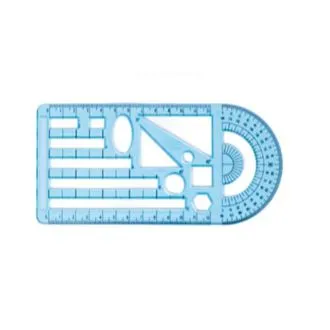
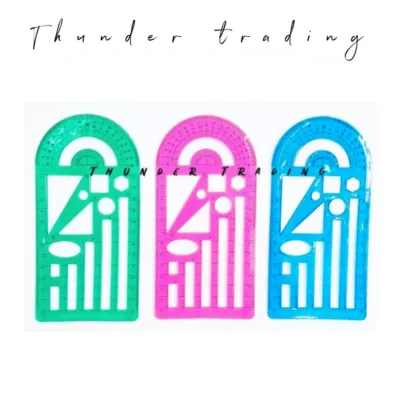
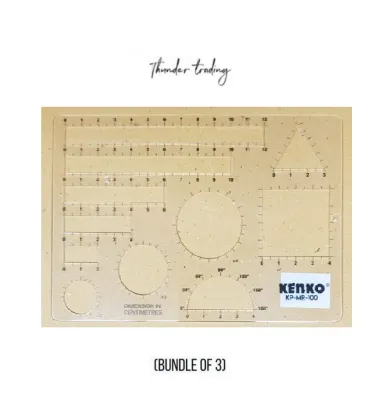
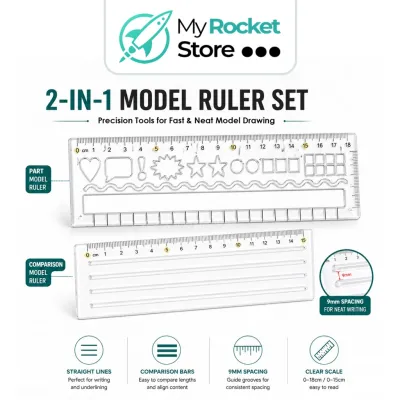
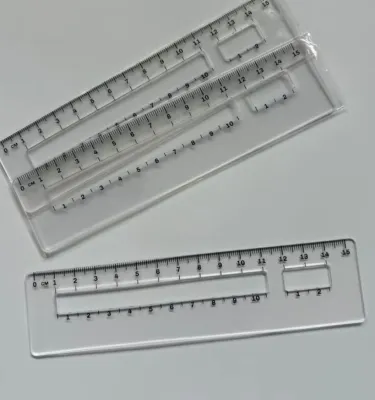
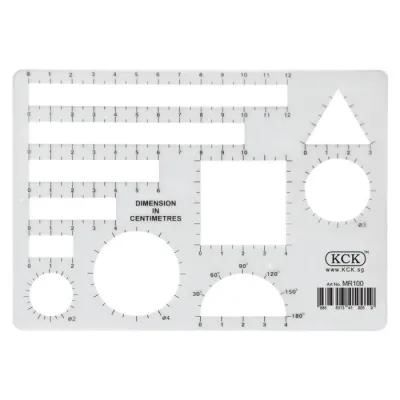
![[Set of 5] [Set of 3] Mini Model Ruler for Math Model Drawing Class Teacher](https://img.lazcdn.com/g/p/807daae11da86f491d6ac99ba82ed320.png_400x400q80.png_.webp)
Prices are valid at publication and may change. Please refer to the product page for the latest price.
- Primary 1 to Primary 6:
- Mathematics: Only standard transparent rulers (15cm and 30cm) are required.
- Art / Science: No specialized tools needed. Standard drawing and measuring tools suffice.
- Verdict: Do not buy any specialized model rulers.
- Secondary 1 to Secondary 2 (Lower Secondary):
- Mathematics: Standard geometry set (containing a ruler, protractor, set squares, and compass) is required.
- Design & Technology (D&T): A specialized isometric template or stencil ruler is highly likely to be required for 3D sketching modules.
- Verdict: Purchase only when listed on the official booklist or requested by the D&T teacher.
- Secondary 3 to Secondary 4/5 (Upper Secondary):
- Elementary & Additional Mathematics: Standard geometry set is required. No specialized 3D or scale rulers are needed.
- D&T Elective (O-Level/N-Level): Specialized scale rulers (triangular or flat) and isometric drawing stencils are mandatory.
- Art Elective: Specialized stencil or drafting rulers may be required depending on the coursework module.
- Verdict: Required for D&T and specific Art students; consult the subject teacher for exact scale specifications.
Clarifying the Term: Standard Geometry Set vs. Specialized Model Rulers
To make an informed purchase, it is essential to clear up the common terminology mix-ups that occur in local stationery shops. Parents often use the term “model ruler” to refer to several completely different items, which can lead to buying the wrong product.

First, some parents associate “model rulers” with the plastic stencils used in primary schools to draw “bar models” for mathematical heuristics. While these stencils exist, they are not official syllabus requirements; primary school teachers actively encourage students to draw bar models freehand using standard clear rulers to develop spatial proportions.
Second, a “model ruler” is frequently confused with a standard mathematical geometry set. A standard geometry set is a metal or plastic tin containing essential mathematical instruments: a compass, a divider, a protractor, set squares, and a short straight ruler. This set is a universal requirement for secondary school mathematics, but it does not contain the specialized drafting rulers used in technical drawing.
In contrast, a true specialized model ruler refers to high-precision drafting instruments used in technical design. These include:
- Isometric Rulers: Stencils featuring built-in 30-degree and 60-degree slots, ellipses, and isometric grids that allow students to sketch three-dimensional objects quickly and accurately.
- Scale Rulers: Triangular or flat rulers marked with multiple proportional ratios (such as 1:50, 1:100, or 1:200) used to translate real-world physical dimensions into scaled technical drawings.
- Stencil Rulers: Templates containing standardized shapes, circles of varying diameters, or electronic symbols, which ensure uniformity in technical diagrams.
Primary School: Do Primary Students Need Specialized Rulers?
If your child is in a Singapore primary school, you can rest assured that specialized technical rulers are not part of their daily academic requirements. The MOE Primary Mathematics syllabus focuses on foundational concepts that do not demand advanced drafting tools.
From Primary 3 to Primary 6, students learn to measure lengths, identify perpendicular and parallel lines, measure and construct angles, and draw basic 2D shapes like squares, rectangles, and triangles. For these tasks, a standard 15cm or 30cm clear plastic ruler is the ideal tool. The transparency is crucial; it allows students to align the ruler accurately with grid lines on their worksheets or exam papers, which is particularly important during the Primary School Leaving Examination (PSLE).
While some third-party retailers market specialized “bar model stencils” to help younger students draw neat block diagrams, these are rarely on official booklists. Relying on stencils can slow a student down during timed assessments. Drawing a block model freehand with a standard clear ruler is faster and helps students internalize mathematical quantities.
The only instances where a primary school student might require a specialized drawing tool or stencil are for specific Co-Curricular Activities (CCAs)—such as the Art Club, Robotics, or Innovation Club—or unique classroom craft projects. In these rare cases, the school will communicate the requirements directly to you, and the tools are often provided in class or sold as a low-cost add-on through the school bookshop.
Secondary School: Which Subjects Require Specialized Drafting Tools?
As students transition into Secondary 1, the academic curriculum branches out into specialized subjects that demand greater technical precision. The general stationery requirements split significantly between standard academic mathematics and technical design electives.
Mathematics (Express, Normal Academic, and O-Level)
Secondary school mathematics, including Elementary Mathematics (E-Math) and Additional Mathematics (A-Math), requires high precision for coordinate geometry, trigonometry, and graphing. Students are frequently required to plot curves, draw tangents, and construct geometric proofs.
For these tasks, a high-quality, standard geometry set is mandatory. A sturdy 30cm clear plastic ruler is essential for drawing axes on graph paper, while set squares are used to construct parallel lines. Specialized 3D model or scale rulers are not part of the secondary math syllabus, and using them in national exams is neither necessary nor permitted under Singapore Examinations and Assessment Board (SEAB) guidelines, which prioritize standard, non-programmable, and transparent drawing aids.
Design & Technology (D&T) and Art
The primary subject where specialized model rulers transition from optional to mandatory is Design & Technology (D&T). D&T is compulsory for Lower Secondary students (Secondary 1 and 2) and remains a key elective for Upper Secondary students (Secondary 3 and 4/5) preparing for N-Level or O-Level examinations.
In Lower Secondary D&T, students learn to sketch design ideas in three dimensions. An isometric ruler, which features pre-angled slots at 30 degrees, is an invaluable tool during this stage. It helps students maintain correct perspective without manually measuring angles for every line, improving the speed and neatness of their design journals.
For Upper Secondary D&T students, the requirements become even more specialized. As they draft technical plans and build physical models from acrylic or wood, they must work with scale. This is where a triangular scale ruler is required, allowing students to easily read and draft measurements at ratios like 1:2, 1:5, or 1:10. Similarly, secondary Art students choosing design-heavy modules, such as architectural layouts, may require specialized stencil or drafting rulers. For these subjects, specialized model rulers are essential tools that are actively used and assessed.
3 Steps to Verify Requirements Before You Buy
To avoid cluttering your home with unused stationery and wasting money on incorrect tools, follow these three practical steps to verify your child’s exact school requirements before purchasing:
Step 1: Check the Official School Booklist Every Singapore school releases a detailed booklist for the upcoming academic year, usually in late November or December. This list is made available online via the school’s portal or distributed physically. Carefully review the “Stationery” and “Subject-Specific Items” sections. If a specialized ruler is required for D&T or Art, it will be listed explicitly under those subjects, often specifying the exact type (e.g., “D&T Isometric Ruler” or “Triangular Scale Ruler”). If you do not see it listed, do not buy it.
Step 2: Wait for the Subject Teacher’s Briefing For highly specialized subjects like D&T, it is highly recommended to hold off on purchasing tools until the first week of school or the start of the subject rotation. D&T teachers often have specific preferences regarding the scale ratios or the material of the tools. In many cases, schools arrange bulk purchases of specialized stencils directly from local suppliers at a discounted rate, or they may provide the necessary drafting tools in the school workshop itself, saving you the hassle of hunting down niche items.
Step 3: Inspect Existing Tools Before buying brand-new stationery, check your home for tools left behind by older siblings. Standard geometry sets, compasses, and scale rulers can last for years. Ensure they are in good condition: verify that edges are straight and free of chips, markings have not faded, and the plastic has not warped in Singapore’s humid climate. If the existing tools are intact and legible, they are perfectly fine to reuse.
What to Look for When Purchasing a Specialized Ruler
If your child’s school booklist or subject teacher confirms that a specialized model ruler is indeed required, you should keep several quality and safety criteria in mind to ensure you buy a durable and compliant tool.
First, consider the material of the ruler. Specialized drafting rulers are typically made of either clear acrylic plastic or anodized aluminum.
- Plastic/Acrylic: Excellent for general sketching and drafting because they are transparent, allowing the student to see the lines and grids underneath their paper. However, plastic rulers are prone to chipping if dropped and can be easily damaged if used as a straight edge for cutting.
- Metal (Aluminum): Highly durable and stable. In D&T workshops, where students frequently use utility cutters or craft knives to cut out physical models from cardboard or plastics, a metal ruler is a vital safety tool. The metal edge resists the blade, preventing the knife from slipping and sliding over the ruler, which could cause serious finger injuries. For safety, ensure any metal ruler used for cutting has a non-slip backing, such as cork or rubber, to keep it firmly in place on the cutting mat.
Second, pay close attention to the markings and units. Ensure the ruler features clear, high-contrast metric markings (millimeters and centimeters), as Singapore’s educational curriculum uses the metric system exclusively. Look for rulers with etched or UV-printed markings; cheap printed markings can quickly rub off due to friction and hand sweat in our warm, tropical climate, rendering the ruler useless for precision work.
Third, double-check the specific scale ratios or grid angles required by the syllabus. A standard architectural scale ruler might feature ratios like 1:50 or 1:100, which are perfect for building models but less useful if your child’s D&T project requires a 1:2 or 1:5 product design scale. Always verify these specifications against the teacher’s instructions before making your final purchase.
Frequently Asked Questions (FAQ)
Can my child use a standard 30cm ruler for Design & Technology?
No, a standard 30cm ruler cannot replace a specialized isometric or scale ruler in Design & Technology. While a standard ruler is perfect for drawing straight lines and measuring basic lengths, it lacks the pre-angled 30-degree guides required for rapid isometric sketching and the proportional ratio markings needed for technical scaling. Using a standard ruler for these tasks is highly inefficient and can lead to inaccurate drawings, which may negatively impact your child’s coursework grades.
Are digital drawing apps replacing physical model rulers in Singapore schools?
While Computer-Aided Design (CAD) software and digital drawing applications are introduced in upper secondary schools to prepare students for modern industry practices, they do not replace physical tools. The lower secondary D&T syllabus continues to place a heavy emphasis on foundational hand-sketching and physical model-making skills. Students are assessed on their ability to draft ideas manually, meaning physical isometric rulers and scale rulers remain essential, mandatory tools in the classroom.
What should I do if the school booklist does not mention a model ruler?
If the school booklist does not explicitly list a model ruler, you should not purchase one. Stick strictly to the standard stationery items listed, such as a basic geometry set and standard clear rulers. If a specialized drawing tool is required later in the semester for a specific project, the D&T or Art teacher will issue a supplementary stationery list or coordinate a bulk purchase during the first week of school.
Community discussion
Share your experience or ask a question. Comments are reviewed before publication.