
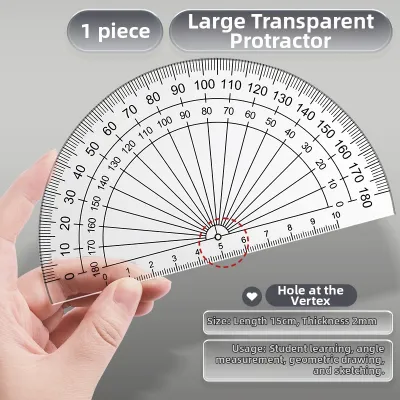
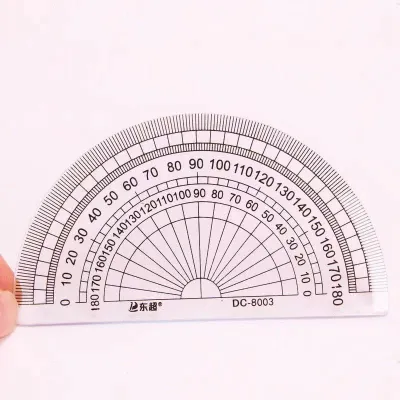
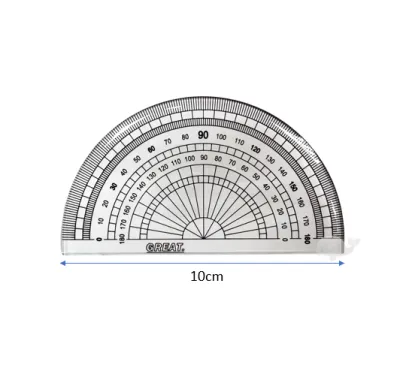
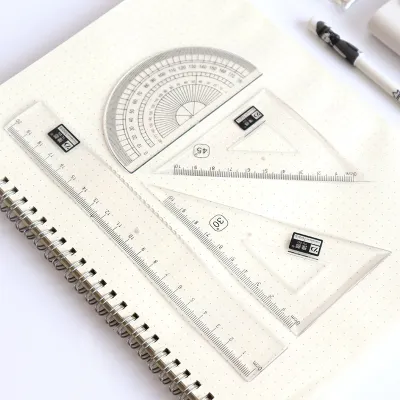
For Singapore primary school students, navigating the transition from basic shapes to formal geometry can be a daunting step. One of the most common questions parents ask when preparing their children for upper primary math is which specific tools they need to buy. The short answer is that your child needs a standard, clear plastic 180-degree semi-circle protractor measuring between 10 cm and 15 cm. This simple, manual tool is a compulsory requirement starting in Primary 4 and remains essential all the way through the Primary School Leaving Examination (PSLE). While digital alternatives and 360-degree circular versions exist, they are not suitable—and often not permitted—for standard schoolwork and national examinations. Choosing the right protractor ensures your child can focus on mastering geometric concepts without being hindered by their stationery.
When Your Child Will Need a Protractor in Primary School
The Singapore primary mathematics syllabus introduces geometric concepts in a carefully structured, step-by-step progression. In the lower primary years, from Primary 1 to Primary 3, students focus on identifying basic shapes, lines, and curves. By Primary 3, they learn to recognize angles conceptually, identifying right angles, acute angles, and obtuse angles purely by sight. No physical measuring tools are required at this stage, as the focus is on developing visual familiarity with spatial orientation.
The major shift occurs in Primary 4, when students are formally introduced to measuring and drawing angles in degrees. This is the exact point in the curriculum where a physical protractor becomes an absolute necessity. Students must learn how to align the tool, read the dual scales, and construct precise angles on paper. These fundamental skills form the basis for more advanced geometric topics in the years that follow.
Products mentioned in this guide
Prices are valid at publication and may change. Please refer to the product page for the latest price.
In Primary 5 and Primary 6, geometry lessons become significantly more demanding. Students apply their angle-measuring skills to complex figures, including triangles, parallelograms, rhombuses, and trapeziums. They must calculate unknown angles using geometric properties and verify their work through precise measurements. Consequently, the protractor remains a permanent fixture in their pencil case throughout their upper primary years and is a critical tool for the PSLE.
Parents should avoid purchasing a protractor too early in their child’s academic journey. Introducing the tool before Primary 4 can cause unnecessary confusion, as the child has not yet developed the mathematical foundation to understand degrees. Conversely, waiting too long can leave them unprepared for early classroom exercises. It is always wise to cross-check your child’s specific school booklist, typically distributed at the end of the academic year, to see exactly when geometry sets are requested.
While the national curriculum set by the Ministry of Education (MOE) is standardized, individual schools may introduce specific topics at slightly different times of the school year. Keeping in touch with your child’s math teacher or monitoring their homework assignments will help you time the purchase perfectly.
Semi-Circle vs. Full-Circle: Which Protractor is Best for Primary Math?
When browsing the stationery aisles in Singapore, you will generally encounter two primary physical formats: the 180-degree semi-circle protractor and the 360-degree full-circle protractor. While both tools measure angles, they serve very different academic purposes. Understanding these differences will help you make the right choice for your child’s daily schoolwork.

The 180-degree semi-circle protractor is the standard, universally recommended tool for primary school students. Its flat baseline makes it incredibly easy to align with lines drawn on standard school worksheets or lined exercise books. Because it only covers a half-circle, it is less visually cluttered than its circular counterpart. This simplicity reduces the cognitive load on young learners who are still trying to grasp how degrees work. Furthermore, this is the exact tool expected and permitted in national exams like the PSLE.
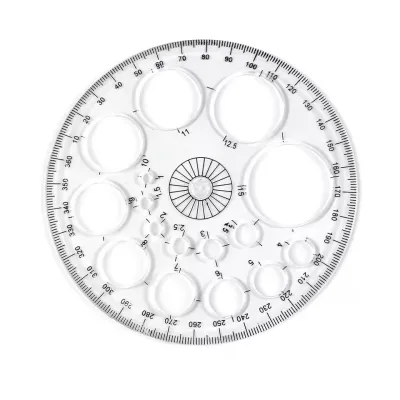
In contrast, the 360-degree full-circle protractor is designed to represent a complete rotation. While these circular tools are excellent for advanced secondary school topics like geography compass bearings, navigation, or technical drawing, they are highly impractical for primary schoolers. The circular layout contains double the amount of numbers and tick marks, which easily overwhelms a ten-year-old student. Aligning a full circle on a small textbook diagram is incredibly difficult, and children frequently read from the wrong quadrant, leading to massive errors in their homework.
Therefore, the clear verdict is to equip your child with a high-quality semi-circle protractor for their daily pencil case. If your child struggles to conceptualize angles greater than 180 degrees (known as reflex angles), you can purchase a 360-degree circular protractor to keep at home as a visual teaching aid. Seeing the full circle can help them understand that a reflex angle is simply 360 degrees minus the interior acute or obtuse angle. However, they should always do their actual schoolwork and exam preparation using the standard semi-circle tool.
4 Must-Have Features for a Frustration-Free Protractor
Not all protractors are created equal, and a poorly designed tool can lead to immense frustration during homework sessions. When shopping at local bookstores or online marketplaces, look for these four essential physical design characteristics to ensure a smooth learning experience for your child.
Clear Center Mark (Crosshair or Target Dot) The most critical step in measuring any angle is placing the protractor’s origin point exactly on the angle’s vertex. Look for a model with a highly visible, precise crosshair, a small circle, or a physical notch at the center of the baseline. Avoid cheap, low-quality models where the center mark is just a faded, thick line. Even a tiny one-millimeter misalignment at the vertex can result in a measurement error of five degrees or more, leading to incorrect answers on assignments.
High-Contrast, Easy-to-Read Scales Standard protractors feature dual scales—an inner scale and an outer scale—running in opposite directions. Distinguishing between these two scales is one of the most common hurdles for young students. To prevent this, choose a design where the two scales are visually distinct. Some student-friendly models print the inner scale in one color (such as blue) and the outer scale in another (such as black), or use different font weights. This visual separation helps your child remember which scale they are reading.
Durable, Non-Slip Material Primary school stationery must withstand daily wear and tear inside a crowded schoolbag. Avoid brittle, thin plastics that snap easily under pressure. Instead, look for flexible, shatter-resistant acrylic or polycarbonate materials. Additionally, some excellent student protractors feature slight textures, raised edges, or tiny non-slip rubber feet on the underside. These subtle features prevent the tool from sliding across smooth paper while your child is trying to hold it steady and draw a line with a pencil.
Appropriate Size Size is a crucial factor when it comes to school geometry. A standard protractor measuring between 10 cm and 12 cm in length is the ideal size for primary school hands and standard school worksheets. Avoid large 15 cm or 20 cm professional drafting protractors, as they will not fit inside standard metal geometry tin cases or pencil pouches, and they will dwarf the diagrams in school workbooks. Conversely, miniature protractors are far too difficult for children to read accurately.
Digital Protractors and Apps: Are They Allowed for School Exams?
With the widespread availability of smart devices, many high-tech measuring tools have emerged, including digital angle finders, laser protractors, and smartphone camera apps. While these digital tools are highly accurate and convenient for adult DIY projects, carpentry, or advanced high school engineering tasks, they have no place in the primary school classroom.
Singapore’s Ministry of Education (MOE) and the Singapore Examinations and Assessment Board (SEAB) maintain strict guidelines regarding permissible materials for school assessments and national examinations. Digital measuring devices, smartwatches, and mobile phones are strictly prohibited in the exam hall. If a student is found using a digital device to measure angles during a test, they face immediate disqualification.
The pedagogical reasoning behind this restriction is fundamental to your child’s cognitive development. The primary school mathematics syllabus is designed to develop manual spatial reasoning, fine motor skills, and the ability to read analog scales. When a child manually aligns a physical protractor, they are building cognitive pathways related to estimation, geometry, and spatial orientation.
Relying on a digital app or tool deprives the child of this essential developmental phase. Parents should restrict digital measuring tools to casual, fun home exploration—such as measuring the tilt of a laptop screen or checking the angle of a ramp—and ensure that all formal schoolwork and exam preparation are done using a traditional physical protractor.
How to Help Your Child Master Protractor Skills at Home
Learning to use a protractor takes practice, and it is common for children to make mistakes initially. As a parent, you can help your child overcome these hurdles by teaching them a few simple techniques and habits during homework sessions.
The “Estimate First” Rule Before your child even touches the protractor to the paper, ask them to look at the angle and estimate its size. Is it smaller than a corner of a piece of paper (a right angle of 90 degrees)? If so, it is acute, and the measurement must be less than 90. If it is wider, it is obtuse, and the number must be between 90 and 180. This simple mental habit completely eliminates the common mistake of reading the wrong scale (such as writing down 130° for a clearly acute 50° angle).
Alignment Checks Create a simple two-step checklist that your child repeats every time they measure. First, place the center origin point directly on the vertex (the corner where the two lines meet). Second, adjust the protractor so that the bottom baseline is perfectly aligned with one of the angle’s arms (the zero-degree line). Only when both points are locked in should they look up at the scale to read the measurement.
Pencil Sharpness A blunt pencil is the enemy of geometric accuracy. A thick pencil lead can easily add two or three degrees of error when drawing or marking an angle. Ensure your child has a sharp 2B pencil, a mechanical pencil with a fine lead (such as 0.5 mm), or a dedicated wooden pencil kept sharp specifically for math class.
Extending Short Lines Many textbook diagrams feature very short lines that do not reach the outer edge of the protractor’s scale, making it impossible to read the angle accurately. Teach your child to use a standard ruler to extend the lines of the angle outward before they begin measuring. This does not change the angle itself but makes reading the scale incredibly easy and accurate.
Frequently Asked Questions (FAQ)
Do I need to buy a specific brand of protractor for the PSLE?
The Singapore Examinations and Assessment Board (SEAB) does not mandate or endorse any specific brand of stationery for national exams. The only requirement is that the tool must be a standard, non-digital, manual mathematical instrument. While many local schools recommend established brands found on their annual booklists, any clear, legible, and durable semi-circle protractor is perfectly acceptable. Focus on readability and durability rather than a specific brand name.
Can my child use a protractor with a built-in magnifying glass?
Yes, protractors with a small built-in magnifying lens over the center origin or the degree scales are generally permitted and can be highly beneficial. They are especially helpful for children with visual impairments or those who struggle to read the tiny tick marks on standard scales. However, to avoid any unexpected issues during formal school examinations or the PSLE, it is always best to have your child’s math teacher or the school’s exam coordinator verify the tool beforehand. For daily homework and classroom practice, they are completely fine and can significantly reduce eye strain.
Community discussion
Share your experience or ask a question. Comments are reviewed before publication.