
When purchasing a Moomin notebook in Singapore, it is easy to assume that the adorable illustrations of Moomintroll, Snufkin, and Little My on the cover guarantee a uniform writing experience inside. However, because the Moomin brand is a licensed intellectual property rather than a paper manufacturer, the paper quality is entirely determined by the specific stationery manufacturer holding the license. There is no single “Moomin paper” standard, meaning your writing experience will vary dramatically depending on who actually manufactured the notebook.
Finding the best Moomin notebook for your needs requires matching the licensee’s proprietary paper characteristics to your preferred writing instrument. If you write with fountain pens or wet rollerballs, you must seek out premium stationery licensees known for high-density, coated, fountain-pen-friendly papers that resist feathering and bleed-through. Conversely, if your daily writing relies on standard ballpoint pens or mechanical pencils, everyday wood-pulp notebooks from standard lifestyle licensees will provide a highly cost-effective and perfectly functional writing surface.
Understanding the "Moomin Brand": Licensed Stationery Makers
To navigate the world of Moomin stationery, you must first understand the licensing model of Moomin Characters Oy Ltd, the company that manages the legacy of Tove Jansson. Instead of producing stationery directly, the parent company licenses the iconic artwork to various global and regional stationery brands. Each of these manufacturers applies its own paper sourcing, binding techniques, and cover designs to the final product. Consequently, a Moomin notebook made by a premium Japanese stationery house will perform completely differently from one produced by a European lifestyle brand or a local souvenir distributor.
Products mentioned in this guide
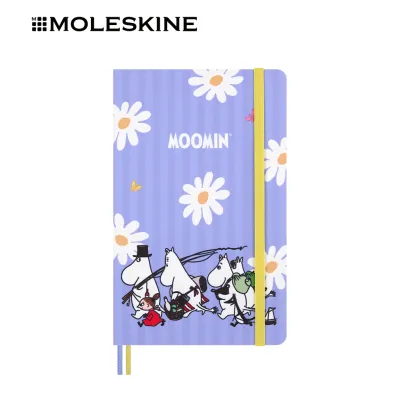
Prices are valid at publication and may change. Please refer to the product page for the latest price.
Several prominent stationery manufacturers regularly secure licensing agreements to produce Moomin-themed notebooks. For example, Japanese giants like Midori, Hobonichi, and Kokuyo occasionally release special-edition Moomin planners and notebooks. These brands are world-renowned for their proprietary paper technologies, such as Midori’s cream-colored MD Paper or Hobonichi’s ultra-thin Tomoe River Paper. On the other hand, brands like Sun-Star Stationery and Lihit Lab produce highly functional, everyday school and office notebooks featuring Moomin designs, while Finnish brands like Putinki focus on eco-friendly, textured Scandinavian paper.
Because the outer cover often prioritizes the character artwork, identifying the actual manufacturer requires a small amount of detective work. Before purchasing, always turn the notebook over and inspect the back cover, paper band (obi), or the adhesive packaging label. Look for the manufacturer’s logo or name printed alongside the official copyright notice (such as “© Moomin Characters™”). Identifying this manufacturer is the single most reliable way to determine the paper technology inside the notebook and predict how it will interact with your pens.
Comparing Paper Performance by Pen Type
Different writing instruments place distinct demands on paper fibers. The interaction between your pen’s ink chemistry and the paper’s surface treatment determines whether your writing remains crisp or degrades into a blurry, illegible mess. When evaluating Moomin notebooks, you must consider key observable performance traits: feathering (ink spreading sideways along paper fibers), bleed-through (ink penetrating completely to the reverse side), ghosting (the shadow of writing visible on the back of the page), and drying speed.

Fountain Pens and Wet Inks
Fountain pens, dip pens, and high-flow rollerballs deposit a significant volume of water-based ink onto the page, making them highly sensitive to paper quality. To prevent feathering and bleed-through, these pens require paper with a high density of tightly packed fibers and specialized surface sizing (coatings that control ink absorption). When wet ink hits untreated, highly absorbent wood-pulp paper, the fibers act like a sponge, pulling the ink outward and creating fuzzy, distorted lines that ruin the aesthetic of fine handwriting.
For the ultimate fountain pen experience, seek out Moomin notebooks manufactured by brands utilizing premium Japanese papers. Hobonichi’s Moomin-themed releases feature Tomoe River Paper, which is celebrated for its ability to handle heavy ink pooling without bleeding, while showcasing complex ink properties like shading and metallic sheen. Midori’s Moomin collaborations utilize MD Paper, which offers a slightly thicker, toothier surface that resists feathering beautifully while providing a satisfying tactile feedback. Be aware that highly absorbent, uncoated, or very thin generic papers found in souvenir-grade Moomin notebooks will almost certainly suffer from severe bleed-through and feathering if paired with a wet fountain pen.
Gel, Rollerball, and Fineliners
Gel pens and standard rollerballs are incredibly popular for daily writing in Singapore, offering a smooth glide and vibrant colors. However, because gel ink consists of pigments suspended in a water-based gel, it sits on the surface of the paper longer than oil-based inks. If you use a notebook with an excessively slick or non-porous coating, the ink will take a long time to dry, making it highly susceptible to smudging under your hand as you write across the page.
For these everyday pens, a smooth, lightly coated, or quick-drying paper is ideal. Kokuyo’s Moomin-themed Campus notebooks are exceptional in this category, utilizing paper designed specifically to balance smooth writing with rapid ink absorption. This ensures that gel ink dries almost instantly, preventing smudges while maintaining crisp, clean lines. If you prefer writing with fineliners, which feature delicate plastic or felt tips, avoid heavily textured or rough papers. A smooth, calendered paper surface prevents the fine tip from catching on rough fibers, preserving the life of your pen tip and ensuring a consistent line width.
Ballpoint Pens and Pencils
Standard ballpoint pens and graphite pencils are the most forgiving writing instruments, requiring very little from paper in terms of chemical resistance. Ballpoint pens use high-viscosity, oil-based inks that dry almost instantly upon contact with the page, meaning they rarely feather or bleed, even on cheap, low-density paper. Pencils rely on physical friction to shear graphite particles off the core and deposit them onto the paper surface, making them entirely immune to wet-ink issues.
If these are your primary writing tools, high-end coated papers are actually counterproductive. Slick, heavily coated papers do not provide enough friction for a ballpoint pen’s rollerball to spin reliably, which can lead to skipping and uneven ink delivery. Similarly, pencils require paper with a slight “tooth” (a micro-textured surface) to grab and hold the graphite. For these instruments, everyday wood-pulp notebooks from standard licensees, such as Sun-Star Stationery or Finnish brand Putinki, are highly suitable and cost-effective. Putinki’s uncoated, FSC-certified Scandinavian papers offer a lovely, organic texture that feels wonderful under a graphite pencil, while standard wood-free papers allow ballpoints to glide effortlessly.
How to Verify Paper Specifications Before You Buy
When shopping for Moomin notebooks, especially in physical retail spaces where you cannot perform an ink test, you must rely on the technical specifications printed on the product packaging. Learning to read these specifications will help you make an accurate purchase decision and avoid the disappointment of incompatible paper.
- Analyze the Paper Weight (GSM): Grams per Square Meter (GSM) indicates the weight and thickness of the paper. Standard notebooks typically range from 70 GSM to 100 GSM. While heavier paper (90 GSM and above) generally offers better resistance to bleed-through, weight is not a guarantee of quality. For example, proprietary papers like Tomoe River Paper are incredibly thin (often 52 GSM) yet resist fountain pen bleed-through better than generic 100 GSM sketch paper due to specialized chemical sizing. Use GSM as a general guide, but prioritize the manufacturer's paper reputation.
- Look for Proprietary Paper Names: Premium manufacturers are proud of their paper and will explicitly name it on the packaging. Look for terms like "MD Paper," "Tomoe River," "Mio Paper," or "FSC-Certified Acid-Free Paper." If the label simply says "paper" without any brand or quality designation, it is highly likely to be standard, non-optimized wood-pulp paper.
- Examine the Binding Style: The binding directly impacts your writing comfort, particularly near the center gutter. Thread-sewn or lay-flat bindings (often found in Midori and Hobonichi notebooks) allow the notebook to open completely flat, ensuring you can write comfortably from edge to edge. Glued or perfect-bound notebooks can be stiff, forcing you to hold the pages down while writing, which can be frustrating when using fountain pens or wet inks that need time to dry.
- Search for Specific User Feedback: If you are buying a specific Moomin notebook online, do not rely solely on generic star ratings. Use the search function within customer reviews to look for terms like "ghosting," "feathering," "bleed," or "dry time." This real-world feedback from other stationery enthusiasts will give you a clear picture of how the paper behaves under different writing conditions.
Finding Authentic Moomin Notebooks in Singapore
Singapore offers several excellent physical and online retail avenues for stationery lovers, but finding authentic Moomin notebooks with high-quality paper requires knowing where to look. Purchasing from authorized retailers ensures you are getting genuine licensed products rather than poor-quality counterfeits that use cheap, highly acidic paper.
For the widest selection of premium Japanese Moomin stationery, Books Kinokuniya (particularly the massive main store at Ngee Ann City on Orchard Road) is unmatched. Their stationery department regularly stocks imported Japanese notebooks from brands like Midori, Sun-Star, and Kokuyo, including limited-edition Moomin collaborations. Another fantastic local option is Hands (formerly known as Tokyu Hands), with branches at Orchard Central, Great World, and Jewel Changi Airport. Hands specializes in high-quality Japanese lifestyle and stationery goods, making it a reliable spot to find functional and beautifully bound Moomin notebooks.
When shopping online, exercise caution. Unverified third-party sellers on general e-commerce platforms often list cheap, unlicensed Moomin notebooks. These counterfeits are typically printed on low-grade, highly acidic paper that will yellow and degrade over time, and they offer terrible resistance to almost all ink types. To protect your writing and your pens, always verify that the online listing explicitly names the manufacturing brand (such as Midori or Putinki) and check for photos of the official packaging. Genuine Moomin notebooks will always feature crisp, high-resolution cover prints, clear licensing text, and a manufacturer’s barcode sticker on the back.
Frequently Asked Questions (FAQ)
Do all Moomin notebooks have bleed-proof paper?
No, there is no such thing as a universally bleed-proof paper, and Moomin notebooks vary wildly in their ink resistance. Because Moomin notebooks are produced by many different licensed manufacturers, the paper quality ranges from cheap, highly absorbent wood-pulp paper to premium, coated, fountain-pen-friendly sheets. If you use wet inks, you must specifically look for notebooks manufactured by high-end brands like Midori or Hobonichi, which utilize specialized coatings to prevent ink from penetrating to the reverse side of the page.
Are Moomin notebooks from different brands the same size?
No, Moomin notebooks come in a wide variety of dimensions depending on the manufacturer’s standard product lines. While some brands adhere to standard international paper sizes like A5 (148 mm x 210 mm) or B6 (125 mm x 176 mm), others use proprietary dimensions designed to fit specific planner covers or traveler’s notebook systems. Always check the exact millimeter or inch measurements printed on the product label rather than assuming a notebook will fit a specific cover based solely on its general size description.
Community discussion
Share your experience or ask a question. Comments are reviewed before publication.