
Selecting the right geometry set for your child in Singapore depends entirely on their current educational stage and the specific demands of the Ministry of Education (MOE) Mathematics syllabus. In the early primary years, students only require basic drawing and measuring tools like clear rulers and simple set squares. As they transition to upper primary and secondary school, the curriculum introduces complex geometric constructions, angle measurements, and circle drawings, which demand high-precision compasses, protractors, and dividers. By aligning your purchase with your child’s current grade level, you can ensure they have the exact tools required for their classroom activities and national examinations without cluttering their pencil cases with unnecessary instruments.
How to Check Your Child's Exact Geometry Set Requirements
Before purchasing any stationery, your primary reference should always be the official annual booklist provided by your child’s school. These booklists are typically distributed at the end of the academic year for the following year, or during orientation periods, and they outline the exact items recommended by the subject teachers. Cross-referencing this list with the specific grade-level requirements ensures you do not buy advanced tools before your child is ready to use them.
It is also important to distinguish between mandatory tools that students must bring to every class and optional items that are either provided by the school during practical sessions or only used occasionally. Some schools have specific uniform policies or classroom guidelines regarding stationery, such as restricting bright, distracting colors or requiring specific safety features like lockable compasses. Checking these details beforehand prevents situations where a child is unable to use their newly purchased tools in class.
Products mentioned in this guide
![[SG Stock] Cox Mathematic Set | Maths Set | Math Set | Geometry Set | compass set squares protractor ruler mechanical pencil and eraser](https://img.lazcdn.com/g/p/7937cfa373155183b306fe034434d280.jpg_400x400q80.jpg_.webp)

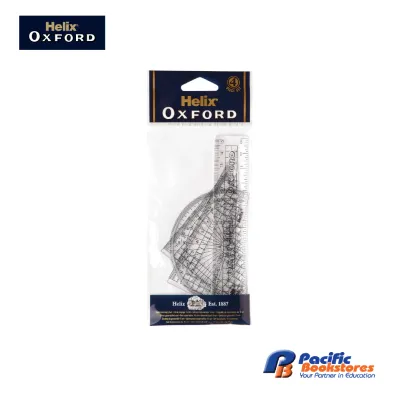
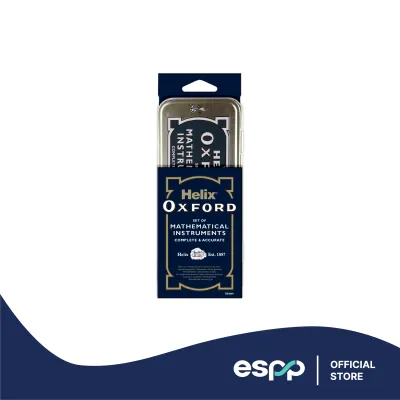
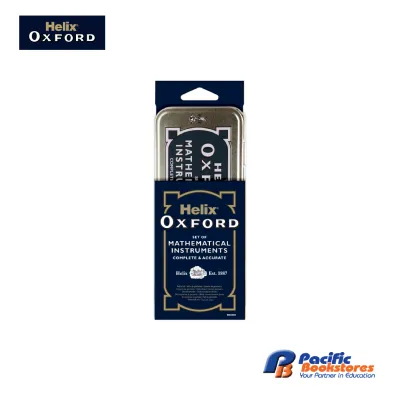
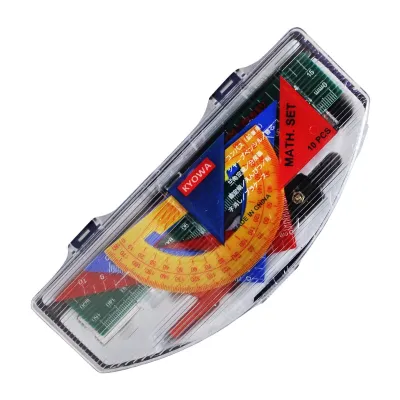
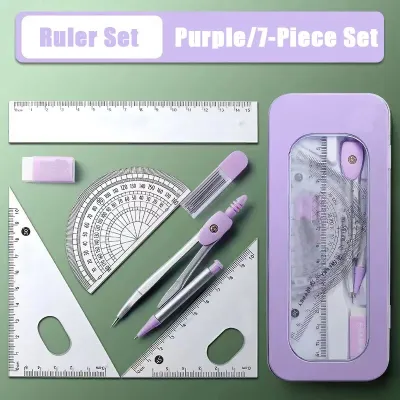
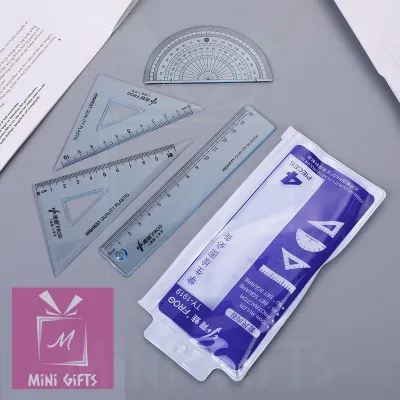
Prices are valid at publication and may change. Please refer to the product page for the latest price.
Additionally, determine whether your child’s teacher prefers a pre-packaged, all-in-one geometry set or individually selected tools. While a pre-packaged tin is highly convenient, some educators prefer students to use specific standalone rulers or high-durability compasses that offer better stability. A quick check of the school’s online portal or a direct query during parent-teacher briefings can clarify these preferences and save you from double-purchasing.
Geometry Tool Progression for Primary School
The introduction of geometry tools in Singapore primary schools is carefully paced to match the cognitive and motor skill development of the students. In Lower Primary (Primary 1 to 3), the mathematics curriculum focuses on foundational concepts of length, straight lines, and basic shapes. During this stage, children primarily need a clear 15cm ruler that fits easily into a standard pencil case. Some schools may also introduce basic set squares to help students identify right angles and draw perpendicular lines, but complex drawing instruments are not yet necessary.

As students enter Upper Primary (Primary 4 to 6), the syllabus expands to include angles, perpendicular and parallel lines, and the properties of symmetrical shapes and circles. This transition requires a significant upgrade in their stationery kit. Students will need a 180-degree protractor to measure and construct angles accurately. They will also be introduced to the compass for drawing circles and arcs. While some schools might suggest a 30cm ruler or a 360-degree protractor, a standard 180-degree semi-circular protractor is usually the core requirement for daily lessons.
Because school-specific pacing and teaching methodologies can vary, the exact grade at which these tools are introduced is not entirely uniform across all Singapore schools. For instance, one school might begin basic compass work in early Primary 4, while another might wait until the latter half of the year. To avoid buying tools that sit unused, always verify the current semester’s topic outline or consult the booklist before making a purchase.
Geometry Set Upgrades for Secondary School
Entering secondary school marks a shift toward more rigorous mathematical proofs, coordinate geometry, and complex geometric constructions. The basic plastic tools used in primary school are often insufficient for the precision required at this level. Lower secondary students typically transition to a comprehensive, standard geometry set that contains a full suite of instruments, including a precision compass, dividers, a 180-degree protractor, a 30cm ruler, and two set squares (45-degree and 60/30-degree variants).
In Upper Secondary and during national examinations like the GCE O-Level or N-Level, the demand for accuracy and durability increases significantly. Students are required to construct complex loci, bisect angles, and draw highly accurate scale diagrams. For these tasks, a metal-bodied compass with a secure tightening screw or a thumbwheel adjustment is highly recommended. These features prevent the compass legs from slipping or widening mid-draw, which can lead to inaccurate measurements and lost marks during high-stakes exams.
Exam compliance is another critical factor when upgrading your child’s geometry set for secondary school. You must verify that the tools comply with the latest Singapore Examinations and Assessment Board (SEAB) guidelines. Generally, protractors and rulers must be clear and free of any unauthorized formulas, stencils, or mathematical templates. Choosing high-quality, transparent, and shatterproof plastics ensures the tools remain compliant and durable throughout the examination period.
Key Features to Check When Buying a Geometry Set
When selecting a geometry set, safety and compliance should be your top priorities, especially for younger students. Look for compasses designed with safety points or blunt needles that minimize the risk of accidental pricks while still maintaining enough grip on the paper. Ensure that all plastic components, such as rulers and protractors, are made from non-toxic, durable materials that do not snap easily, as shattered plastic can pose a safety hazard in a crowded classroom.
Durability and precision are equally vital for long-term usability. Prioritize geometry sets that feature metal components, particularly for the compass and dividers, as metal joints resist wear and tear much better than plastic alternatives. Examine the measurement markings on the rulers and protractors; they should be clearly engraved or printed beneath a protective laminate layer. Markings that are simply printed on the surface tend to rub off quickly with daily use, rendering the tool useless for precise measurements.
Finally, consider the storage and portability of the set. A sturdy, hinged tin case or a hard plastic container with a secure snap-lock mechanism is ideal for protecting the delicate calibration of the instruments. These cases keep the sharp points of the compass and dividers safely contained, preventing them from damaging other items in your child’s school bag. A well-organized case also makes it easy for your child to see if any tools are missing before they pack up at the end of the school day.
Frequently Asked Questions (FAQ)
Can my child use a mechanical pencil inside the geometry compass?
Whether your child can use a mechanical pencil inside a compass depends entirely on the design of the compass lead holder. Standard school compasses are typically designed to hold a short, traditional wooden pencil or a specific thickness of graphite lead (often 2mm) secured by a screw clamp. If your child prefers the consistent line weight of a mechanical pencil, look for a compass that features a universal adapter clamp, which can securely hold various pen and pencil barrels. Always ensure that any modified drawing setup complies with school and national examination guidelines before use.
Is it better to buy a full geometry set or individual tools?
For most students starting a new academic stage, buying a complete, pre-packaged geometry set is the most cost-effective and convenient option, as it provides all the necessary tools in a protective case. However, if your child only needs to replace a single worn-out item, such as a lost protractor or a loose compass, purchasing individual, high-quality replacements is more practical. This approach allows you to invest in a premium, highly durable tool without paying for extra items your child already owns and does not need to replace.
What should I do if my child loses a specific tool from the set?
If your child loses a tool, there is no need to purchase an entirely new geometry set. Most local stationery stores in Singapore sell individual rulers, protractors, and compasses that meet standard school specifications. It is highly practical to keep a small reserve of high-wear items at home, such as spare compass leads, small wooden pencils, and erasers. This ensures your child can quickly replace lost or broken components without disruption to their daily mathematics lessons and homework.
Community discussion
Share your experience or ask a question. Comments are reviewed before publication.