
When sending documents, letters, or event invitations in Singapore, selecting the correct envelopes is crucial to ensure your contents arrive in pristine condition. Using the wrong size can lead to damaged documents, unprofessional creases, or unexpected postage fees. The international standard ISO 269 defines a systematic range of sizes designed to match standard paper dimensions perfectly.
To choose the right size immediately: use a C4 envelope for flat, unfolded A4 sheets; a C5 envelope for A4 sheets folded in half; a DL envelope for A4 sheets folded into thirds; and a C6 envelope for A4 sheets folded into quarters (or flat A6 cards). Matching your document’s folding method to these standard sizes ensures a secure fit and a professional presentation.
Decoding ISO Envelope Sizes: What C-Series and DL Actually Mean
The international standard ISO 269 governs the dimensions of envelopes, creating a logical system that pairs directly with the ISO 216 standard for paper sizes (such as A4 and A5). The fundamental rule of this system is simple: a C-series envelope is designed to hold an A-series sheet of paper of the exact same number without any folding.
Products mentioned in this guide

Prices are valid at publication and may change. Please refer to the product page for the latest price.
This works because C-series dimensions are mathematically scaled to be slightly larger than their A-series counterparts. For example, a standard sheet of A4 paper measures 210 mm by 297 mm. A C4 envelope measures 229 mm by 324 mm. This slight difference provides just enough clearance for the paper to slide in smoothly without bending at the edges.
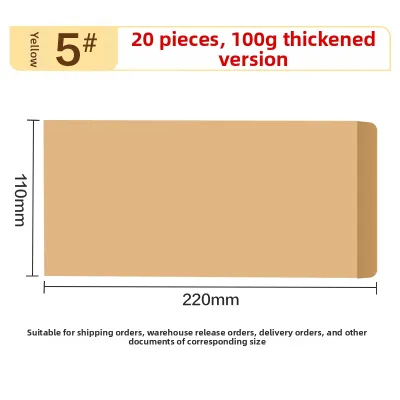
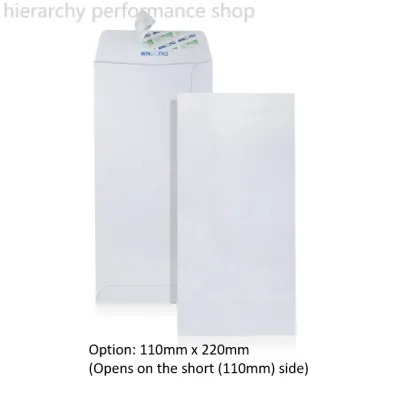
The “DL” format stands for “Dimension Long” (often referred to as “Dimension Lengthwise”). Unlike the C-series, DL is not named after a paper size number. Instead, it measures 110 mm by 220 mm, which is specifically sized to accommodate an A4 sheet folded horizontally into three equal sections.
Understanding these specific designations prevents common mailing errors. Buying envelopes that are too small forces you to make extra folds, which can look unprofessional or damage official documents. Conversely, choosing envelopes that are excessively large allows the contents to slide around during transit. This movement can cause the paper to crumple, tear, or shift away from address windows, potentially leading to delivery failures.
How to Choose the Right Envelopes for A4 Documents Based on Folding
How you prepare your A4 document for mailing dictates the envelope size you must purchase. Balancing the neatness of the document with mailing convenience and postage costs is key to efficient correspondence.

Unfolded A4 (Use C4) When a document must remain completely flat, a C4 envelope (229 mm x 324 mm) is mandatory. This is the standard choice for legal contracts, official certificates, diplomas, high-quality brochures, or fragile photographs that would be ruined by creasing. Because of their flat, rigid, and larger profile, C4 mailers often exceed standard letter dimensions. In Singapore, mailing a C4 envelope typically falls under the “large letter” or “package” rate with SingPost, making it more expensive to post than folded options.
Folded in Half (Use C5) Folding an A4 sheet once across its shortest dimension creates an A5 size (148 mm x 210 mm). This folded sheet fits perfectly inside a C5 envelope (162 mm x 229 mm). This option is highly practical for multi-page reports, corporate newsletters, or greeting cards. It keeps the document relatively flat with only a single, clean crease while keeping the overall envelope dimensions compact enough to qualify for standard postage rates in many scenarios.
Folded in Thirds (Use DL) The DL envelope (110 mm x 220 mm) is the standard for corporate mailings. To use it, fold an A4 sheet into three equal horizontal panels (known as a letter fold or C-fold). This compact format is highly cost-effective, easily fitting into standard automated sorting systems. It is the default choice for invoices, statements, and formal business letters.
Folded in Quarters (Use C6) Folding an A4 sheet in half horizontally and then in half vertically reduces it to an A6 size (105 mm x 148 mm). This fits perfectly into a C6 envelope (114 mm x 162 mm). While not typically used for formal business letters due to the multiple creases, C6 is the classic size for compact personal letters, small greeting cards, or RSVP cards.
Best Envelope Sizes for Standard Letters and Event Invitations
Mailing personal correspondence or formal event invitations requires a focus on presentation, protection, and postal efficiency.
Standard Business Letters For professional correspondence, the DL envelope remains the undisputed industry standard. Many businesses opt for DL window envelopes, which feature a transparent plastic film on the front. This design allows the recipient’s address printed directly on the letter to show through, eliminating the need to print separate labels. When using these, you must align the document’s address block precisely during folding so it remains fully visible within the window boundaries.
Event Invitations Invitations for weddings, galas, or corporate events usually demand a more tactile, premium presentation. These are typically printed on heavy cardstock in A5 or A6 sizes, which should never be folded. Consequently, C5 and C6 envelopes are the preferred choices. Square envelopes (such as 160 mm x 160 mm) are also highly popular for invitations because of their modern, symmetrical aesthetic.
Presentation and Protection The physical weight of the paper, measured in grams per square metre (GSM), plays a major role in how the mail is received. Standard mailing envelopes are usually lightweight, ranging from 80 GSM to 100 GSM. For high-end invitations or heavy multi-page documents, it is best to select envelopes made from 110 GSM to 150 GSM paper. Thicker paper prevents the envelope from tearing under the weight of heavy cardstock and ensures complete opacity so the contents cannot be read through the paper.
Postal Considerations Before sending a large batch of mail, always check local postal guidelines. In Singapore, SingPost charges different rates based on size, weight, and shape. Square envelopes and rigid mailers cannot pass through standard automated sorting machines. They are classified as “non-standard” mail, which requires higher postage fees. To avoid returned mail or unexpected surcharges, verify your final mailpiece dimensions and weight at a local post office.
Quick Reference Chart: Matching Paper Sizes to Envelopes
To make an immediate decision, use the table below to match your paper size and preferred folding method to the correct envelope dimension.
| Initial Paper Size | Folding Method | Resulting Size | Recommended Envelope |
|---|---|---|---|
| A4 | No fold (Flat) | A4 | C4 |
| A4 | Folded in half (1 crease) | A5 | C5 |
| A4 | Folded in thirds (2 creases) | DL | DL |
| A4 | Folded in quarters (2 creases) | A6 | C6 |
Practical Tip for Insertion Always ensure there is a clearance of 2 mm to 5 mm inside the envelope relative to the folded paper size. While a single sheet of paper fits easily, mailing multiple pages or thick cardstock increases the overall volume. This extra thickness pulls the sides of the envelope inward, making insertion difficult and increasing the risk of the paper tearing during sealing or transit.
Frequently Asked Questions (FAQ)
Can I put an unfolded A4 paper into a C5 envelope?
No, an unfolded A4 sheet will not fit inside a C5 envelope. A C5 envelope (162 mm x 229 mm) is physically smaller than an unfolded A4 sheet (210 mm x 297 mm). To use a C5 envelope, you must fold the A4 paper in half once to reduce it to A5 size. If your document must remain completely flat without creases, you must use a C4 envelope.
Do I need to account for extra space if I am mailing multiple pages?
Yes. While the length and width of the envelope remain constant, the thickness of a multi-page document reduces the available internal space. For documents containing more than 10 to 15 pages of standard 80 GSM paper, a flat envelope will bulge, stress the seams, and potentially tear. In these cases, consider using gusseted envelopes, which feature expandable sides designed to accommodate thick document stacks, or step up to a larger size like a C4 envelope to allow the pages to spread out flat.
Community discussion
Share your experience or ask a question. Comments are reviewed before publication.