
As your child progresses through the Singapore education system, their mathematical needs shift from concrete arithmetic to complex calculus. The type of calculator they require depends entirely on their current academic stage: primary school students use basic calculators, secondary school students transition to scientific calculators, and pre-university students often require advanced graphing calculators. Aligning your purchase with the official syllabus ensures your child has the right tool without violating exam guidelines.
Navigating these requirements can feel overwhelming for parents, especially with strict national examination rules. Choosing the wrong device can lead to unnecessary expenses or, worse, a calculator being disallowed in the exam hall. By understanding the specific needs of each grade level, you can make an informed decision that supports your child’s learning journey.
Understanding the Three Main Calculator Types for Students
Before purchasing any device, it is helpful to understand the distinct categories of calculators used in schools. Each type serves a specific pedagogical purpose and is introduced only when students have mastered the corresponding manual mathematical concepts.
Products mentioned in this guide
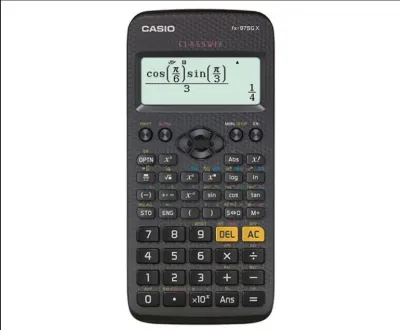
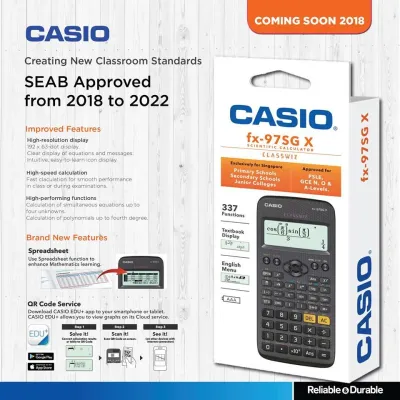
Prices are valid at publication and may change. Please refer to the product page for the latest price.
Basic calculators are designed for standard arithmetic operations, including addition, subtraction, multiplication, and division. They typically feature simple memory functions and large, easy-to-read displays. These devices are intended to speed up calculations once foundational mental math skills are firmly established, ensuring students focus on problem-solving rather than repetitive manual computation.
Scientific calculators introduce advanced mathematical functions necessary for secondary-level education. These devices handle trigonometry, logarithms, fractions, exponents, and basic statistical calculations. They are essential tools for both mathematics and science subjects, allowing students to input complex formulas and receive precise outputs.
Graphing calculators represent the most advanced tier of student calculators, featuring large screens capable of plotting functions and displaying coordinate grids. They support advanced calculus, matrix algebra, and programmable features required for pre-university higher mathematics. These devices function almost like mini-computers, helping students visualize complex mathematical relationships dynamically.
Primary School: Assessing the Need for a Basic Calculator
In Singapore, primary school students do not use calculators in their early years. The curriculum prioritizes mental arithmetic and manual calculation methods to build a strong mathematical foundation. This ensures that children grasp the core concepts of number sense, place value, and basic operations before relying on electronic aids.

Calculators are typically introduced in the upper primary years, specifically at the Primary 5 level. At this stage, the complexity of word problems increases, and the focus shifts from testing basic calculation speed to assessing analytical and problem-solving skills. Students are permitted to use calculators in specific papers of their school examinations and the Primary School Leaving Examination (PSLE).
When selecting a calculator for a primary school student, parents must adhere strictly to the guidelines set by the Singapore Examinations and Assessment Board (SEAB). The permitted devices are basic calculators that do not possess any scientific or programmable functions. Introducing a scientific calculator at this stage is not only against exam regulations but can also confuse a young learner with unnecessary buttons and complex menus.
Look for a basic calculator with large, durable buttons that are easy for small hands to operate. A clear, high-contrast display is essential to prevent reading errors during timed assessments. Ensure the device is robust enough to withstand daily school use and fits comfortably inside a standard school bag or pencil case.
Secondary School: Upgrading to an Approved Scientific Calculator
The transition to secondary school marks a significant shift in mathematical complexity. As students enter Secondary 1, they are introduced to algebraic equations, geometry, and statistical analysis. Consequently, a basic calculator is no longer sufficient, and students must upgrade to an approved scientific calculator.
This transition is usually mandatory from the start of Secondary 1 or Secondary 2, depending on the school’s specific curriculum pacing. Scientific calculators are required not only for Mathematics and Additional Mathematics but also for science subjects such as Physics and Chemistry. Students use them to calculate trigonometric ratios, work with scientific notation, and solve quadratic equations.
When purchasing a scientific calculator, compatibility and compliance are paramount. The calculator must be on the SEAB approved list to be allowed into the national O-Level and N-Level examinations. These approved models are designed to prevent students from storing unauthorized data or formulas, ensuring a fair testing environment for all candidates.
Parents should look for models that offer a natural textbook display, which shows fractions and formulas exactly as they appear in school textbooks. This feature greatly reduces input errors and helps students understand the structure of complex expressions. Additionally, choosing a model with a durable slide-on hard cover protects the screen and keys from damage during transit.
Junior College and Pre-University: Evaluating the Graphing Calculator Requirement
For students progressing to Junior College or equivalent pre-university institutions, the mathematical landscape becomes highly specialized. At this level, the choice of calculator depends heavily on the specific subjects the student elects to study, particularly within the GCE A-Level or International Baccalaureate (IB) curricula.
Students taking H2 Mathematics will almost certainly require a graphing calculator. The H2 syllabus includes topics like correlation and regression, graphing techniques, and complex numbers, which require the visualization and computational power of a graphing device. Conversely, students taking H1 Mathematics may only require a standard scientific calculator, though some still prefer the visualization benefits of a graphing model.
Graphing calculators represent a significant financial investment compared to basic or scientific models. They also come with a steep learning curve, requiring students to navigate complex menus, input variables, and program specific functions. Because of this complexity, schools often dedicate curriculum time specifically to teaching students how to operate these devices effectively.
Before purchasing a graphing calculator independently, parents should consult the school’s booklist or mathematics department. Many junior colleges organize bulk-purchase exercises at the start of the academic year, which can offer better pricing or ensure that all students in a cohort use the exact same model. This uniformity makes it easier for teachers to provide step-by-step instructions during lessons.
How to Verify Approved Models and Time Your Purchase
To avoid purchasing an unsuitable or non-compliant device, parents should follow a systematic verification process. The most reliable reference is the official SEAB website, which publishes an updated list of approved calculator models annually. This list specifies the exact brand and model numbers permitted in national examinations.
It is highly recommended to wait for the school’s official booklist or syllabus briefing before making a purchase. Schools often have preferred models that their teachers are most familiar with. Purchasing the exact model recommended by the school ensures that your child can easily follow along with classroom demonstrations and peer-to-peer troubleshooting.
Avoid the temptation to buy advanced programmable calculators or models featuring a Computer Algebra System (CAS) unless they are explicitly permitted for your child’s specific curriculum. CAS-enabled calculators can perform symbolic algebra, which is strictly prohibited in most standard national examinations. Bringing an unauthorized device into an exam hall can lead to severe consequences, including disqualification.
When buying from local stationery shops or online marketplaces, double-check the exact model number against the approved list. Even a single letter difference in a model name can indicate a different version that may not be approved for exam use. Additionally, ensure the calculator carries the official school approval sticker if required by your child’s institution.
Frequently Asked Questions (FAQ)
Can my child use a scientific calculator in primary school?
No, primary school students are not permitted to use scientific calculators in school or during the PSLE. The primary school mathematics curriculum is designed to build foundational arithmetic skills. Allowing scientific functions would bypass the testing of these core competencies, which is why only approved basic calculators are allowed.
What happens if my child brings an unapproved calculator to a national exam?
If a student brings an unapproved calculator to a national examination, invigilators will confiscate the device before the paper begins. The student will be required to sit the exam without a calculator, which can severely disadvantage them, or they may be issued a basic replacement if one is available. Additionally, the incident will be reported to the examining authority, potentially resulting in disciplinary action.
Community discussion
Share your experience or ask a question. Comments are reviewed before publication.