
In Singapore’s structured education system, specialized physical tools are essential for bridging abstract mathematical theories with concrete, spatial representations. Your child will typically need their first complete geometry set when they enter Primary 4, around the age of ten. This is the precise stage where the Ministry of Education (MOE) Mathematics syllabus introduces formal geometric concepts, such as measuring and drawing angles and identifying the properties of various shapes. The set remains an indispensable tool through Primary 5 and 6, culminating in the Primary School Leaving Examination (PSLE), and becomes even more critical in Secondary school for both Mathematics and Additional Mathematics.
Understanding when and how to acquire this set prevents last-minute purchases and ensures your child is equipped with compliant, high-functioning tools. While it might be tempting to purchase a set early, doing so without understanding the specific school-level requirements can lead to unnecessary expenses or tools that do not comply with exam guidelines. Choosing the right set involves evaluating component quality, safety, and compatibility with standard school paper and exam formats.
How to Confirm Your Child's Exact School Requirements
While the national MOE Mathematics syllabus dictates the overarching learning objectives across all Singapore schools, individual primary and secondary schools retain the autonomy to specify the exact physical tools required for daily classroom activities and assessments. This means that a geometry set that is perfectly acceptable in one school might not meet the specific preferences of a mathematics department in another. To avoid purchasing redundant or non-compliant stationery, parents must consult official school communication channels before making any buying decisions.
Products mentioned in this guide
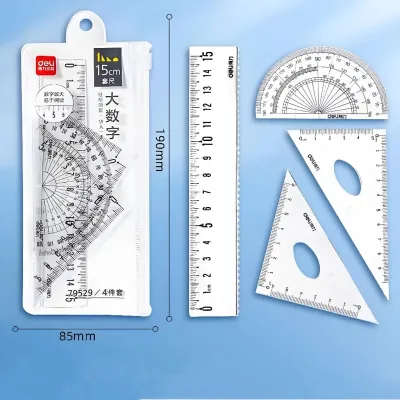
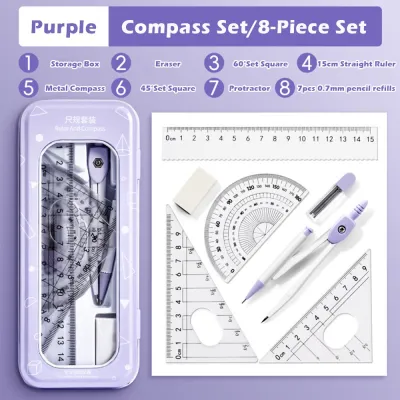
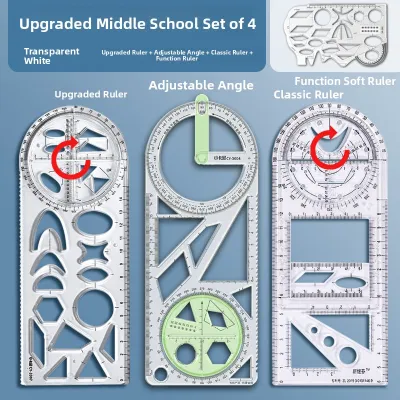
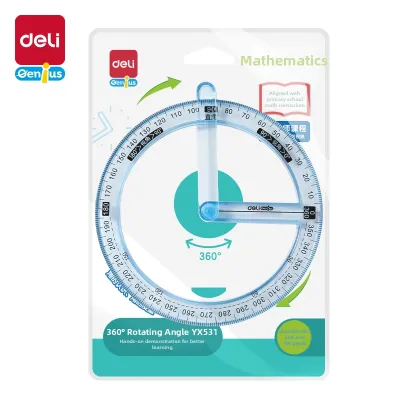
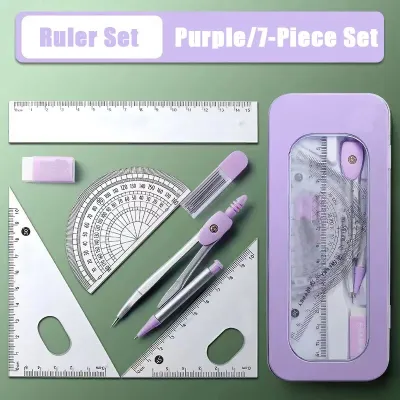
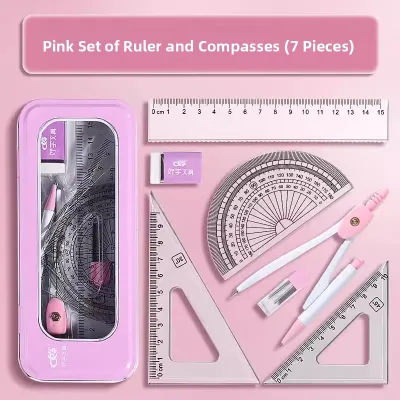
![[SG] 7-Piece Mathematical Compass Set – 3 Colors (Green Blue Pink) [Evergreen Stationery]](https://img.lazcdn.com/g/p/a26676faa26b99e644ff7bcf448e2ebc.png_400x400q80.png_.webp)
Prices are valid at publication and may change. Please refer to the product page for the latest price.
The most reliable and authoritative source of information is the official school booklist, which is typically compiled by the school’s mathematics department and released to parents in late November or early December for the upcoming academic year. This list is usually distributed physically to students or uploaded digitally onto school portals and the Parents Gateway mobile application. The booklist will explicitly state whether a geometry set is required for the student’s specific grade level and will often list a recommended brand or model that is stocked by the school bookshop.
In addition to the booklist, parents should review the teacher’s welcome letters, orientation briefing slides, or parent portal announcements at the start of the school term in January. Subject teachers often use these platforms to share specific preferences regarding stationery. For instance, a teacher might request that students use a compass that accommodates a standard wooden pencil rather than a technical compass that requires fragile mechanical lead refills, especially for younger primary school students who may struggle with fine-motor coordination.
Waiting for these official confirmations is highly recommended, particularly when your child is transitioning to a new educational stage, such as moving from Primary 3 to Primary 4, or from Primary 6 to Secondary 1. Purchasing a geometry set prematurely during the year-end holidays can result in buying tools that are either too advanced or too basic for the school’s specific curriculum delivery. By aligning your purchase with the school’s official recommendations, you ensure that your child has the exact tools needed to follow along with classroom instructions from day one.
General Timeline: When Geometry Sets Are Typically Introduced
The requirement for geometry tools in Singapore schools follows a progressive timeline that aligns with the cognitive development of the child and the increasing complexity of the MOE Mathematics syllabus. Understanding this timeline helps parents plan their stationery purchases over the long term, ensuring that children are neither under-equipped nor overwhelmed by complex instruments before they are ready to use them.

Lower Primary (Primary 1 to 3)
During the lower primary years, the mathematical focus is on basic numeracy, simple spatial awareness, and identifying basic shapes like squares, rectangles, and triangles. At this stage, a full geometry set is not required. Students only need a clear, shatter-resistant 15cm ruler. This basic tool is sufficient for drawing straight lines, measuring short lengths in centimeters, and completing simple worksheet exercises. Introducing complex tools like compasses or protractors at this stage is unnecessary and can pose safety risks due to the sharp metal points on compasses, which require mature handling.
Upper Primary (Primary 4 to 6)
Primary 4 marks the formal introduction of geometry into the syllabus. Students are taught to measure and draw angles in degrees, which makes a protractor a compulsory tool. By Primary 5 and 6, the syllabus expands to include circles, triangles, quadrilaterals, and symmetric figures. Students must use a compass to draw precise circles and set squares to construct perpendicular and parallel lines. These tools are heavily utilized in daily schoolwork, topical tests, and ultimately, the PSLE Mathematics examinations. Having a reliable, easy-to-use set during these years directly impacts a student’s confidence and speed during timed assessments.
Secondary School (Secondary 1 to 5)
Upon entering secondary school, the complexity of geometric construction increases significantly. Whether taking G3, G2, or G1 Mathematics, or opting for Additional Mathematics, students must perform highly precise constructions, such as finding angle bisectors, perpendicular bisectors, and constructing scale drawings or loci. The basic plastic sets used in primary school may no longer suffice. Secondary students require professional-grade, high-precision geometry sets that allow for micro-adjustments, ensuring their drawings meet the strict accuracy tolerances required by Cambridge examiners for the GCE O-Level and N-Level examinations.
While this timeline represents the standard academic progression across most schools in Singapore, parents must always cross-reference these general stages with their child’s specific school booklist. Some schools may introduce basic angle measurement slightly earlier or require specific tools for enrichment programs, making direct confirmation with the school essential.
Choosing a Practical Geometry Set for School and Exams
Selecting a geometry set requires looking beyond attractive packaging or low prices to evaluate the practical utility, durability, and exam compliance of the tools. A practical geometry set should support the student’s learning without causing frustration during daily practice or high-stakes examinations.
Essential Components and Paper Fit A standard, school-compliant geometry set must contain a specific array of tools. This includes a clear 15cm ruler (or a 30cm ruler for secondary students), a 180-degree protractor with a distinct, transparent center point, a pair of set squares (one 45-degree and one 60-degree), and a reliable compass. The transparency of these tools is vital; opaque or heavily colored plastics block the student’s view of the underlying lines on their exam paper, leading to measurement errors. Furthermore, the markings on all tools should be in metric units (centimeters and millimeters), as imperial measurements (inches) are not used in the Singapore syllabus. The tools must also fit standard A4 school worksheets and examination foolscap paper without overlapping the page margins excessively.
Compass Stability and Pencil Compatibility The compass is the most technically demanding tool in the set. A cheap, loose compass is a major source of frustration for students. Look for a compass featuring a robust hinge mechanism, a secure screw lock, or a center-wheel adjustment. The center-wheel design is highly recommended for secondary students, as it locks the legs of the compass in place, preventing them from spreading or collapsing under the pressure of drawing on paper. Additionally, verify if the compass uses a universal pencil holder (which accepts standard wooden pencils) or a dedicated lead-refill mechanism. For younger primary students, a universal holder is often easier to manage as they do not have to worry about replacing fragile lead refills during an exam.
Material Quality and Markings Standard school geometry tools are subjected to rough handling inside school bags. Opt for shatter-resistant plastics that can withstand accidental drops onto hard classroom floors. Examine the markings closely: the millimeter and degree graduations should be deeply engraved or printed with high-contrast, scratch-resistant ink. Cheaply printed markings can wear off within a few weeks of active use, rendering the protractor or ruler entirely useless during a critical assessment.
Erasability and Safety Verification The erasability of the pencil lines drawn with your compass depends on the paper texture and the pencil lead hardness. To avoid tearing standard school worksheets, perform a quick trial at home: draw a circle on a spare sheet of school paper and test if the lines can be cleanly erased without leaving dark smudges or thinning the paper. In Singapore, using a 2B pencil or lead is standard as it provides a dark, legible line that can be read clearly by examiners, yet remains highly erasable. Because the compass features a sharp needle tip to grip the paper securely, teach your child how to handle it safely to prevent accidental punctures. Check that the needle is sharp enough to hold its position on the paper without slipping, but not so long that it pierces through multiple sheets of paper.
Avoiding Impractical Extras Finally, avoid the temptation to purchase novelty, oversized, or highly decorative geometry sets. While a set featuring cartoon characters or neon-colored, flexible materials might look appealing, it is often impractical. Flexible rulers can warp over time, leading to inaccurate measurements. Furthermore, strict examination invigilators during national exams like the PSLE or O-Levels may reject non-standard, distracting, or overly bulky stationery to maintain exam integrity. A clean, simple, transparent case containing standard, professional tools is always the safest and most practical choice.
Signs It Is Time to Replace or Upgrade the Current Set
Many parents assume that a geometry set purchased in Primary 4 will last until the end of primary school. However, because these tools are used frequently, they are prone to wear and tear that can silently compromise a student’s academic performance. Before the start of each school term, conduct a quick inspection of the current set.
Worn Markings The first warning sign is worn or faded markings. If the numbers on the protractor or ruler are scratched, faded, or chipped, your child will struggle to read exact angles or measurements, which can easily result in lost marks for accuracy in competitive exams.
Loose Hinges Next, test the structural integrity of the compass. Hold the compass by its top handle and gently press the legs against a flat surface. If the legs widen or slip easily without turning the adjustment wheel or screw, the hinge has become too loose. A loose compass makes it nearly impossible to draw a perfect circle with a consistent radius, leading to messy, inaccurate constructions. While some compasses allow you to tighten the hinge screw with a small screwdriver, a severely worn joint requires a complete replacement.
Damaged Edges Inspect the edges of the rulers, protractors, and set squares. Run your finger along the straight edges to check for chips, nicks, or warping. Even a tiny chip in a plastic edge will cause the pencil tip to jump, resulting in crooked lines or inaccurate geometric constructions. In geometry, a line that deviates by even a millimeter can throw off subsequent calculations, such as finding the area of a composite shape or locating an intersection point.
Academic Transitions Lastly, consider the natural progression of academic levels. Transitioning from primary to secondary school is a major milestone that almost always necessitates an upgrade. The basic, compact tools designed for a primary schooler’s smaller hands and simpler tasks are inadequate for the rigorous, high-precision demands of secondary-level geometry. Upgrading to a set that includes a 30cm ruler, a more robust metal compass, and finer lead attachments ensures your teenager is fully prepared for the complex mathematical challenges ahead.
Frequently Asked Questions (FAQ)
Can my child use a digital geometry app instead of a physical set?
While digital geometry applications and graphing software are excellent supplementary tools for home learning, interactive visualization, and conceptual understanding, they cannot replace physical stationery in the Singapore school system. All major written assessments, school-based exams, and national examinations—including the PSLE, GCE N-Levels, and GCE O-Levels—are strictly pen-and-paper examinations. Students must physically draw and measure on paper. Relying solely on digital tools at home can leave a child unprepared for the tactile coordination required to use a physical compass and protractor accurately under exam time constraints. Therefore, maintaining a physical set is mandatory.
Do I need to buy a specific brand recommended by the school?
In most cases, Singapore schools do not mandate a specific brand of geometry set, and any standard, high-quality set that meets the syllabus requirements is perfectly acceptable. The school booklist may list a specific brand (such as Helix, Maped, or Staedtler) as a convenient option available at the school bookshop, but this is rarely a strict requirement. Unless the booklist or the subject teacher explicitly states that a particular model is mandatory for uniformity or specific exam compliance, parents are free to choose any reliable alternative. The key is to prioritize the quality, clarity, and stability of the tools over the brand name, ensuring they meet the standard dimensions and safety guidelines of the school.
Community discussion
Share your experience or ask a question. Comments are reviewed before publication.