
Starting your crochet journey is an exciting step into a tactile, creative craft, but the sheer volume of starter options can make choosing your first setup overwhelming. A well-designed beginner kit should serve as a complete, self-contained gateway to the craft, providing everything you need to complete a project from start to finish without requiring immediate trips to a craft store. Unfortunately, many kits on the market are poorly assembled, featuring splitting yarn, rough tools, or confusing instructions that can quickly lead to frustration and abandoned projects.
To make an informed purchase, you must understand how to evaluate the tools, yarn quality, and instructional support included in any prospective set. By focusing on material compatibility and physical comfort, you can select a kit that supports your learning curve rather than hindering it.
Essential Components Every Beginner Crochet Kit Must Include
Verify that a prospective crochet yarn set kit contains all the fundamental tools required to start and finish a basic project without immediate extra purchases. A complete kit saves you the hassle of sourcing individual items and ensures all components are scaled to work together.
Products mentioned in this guide
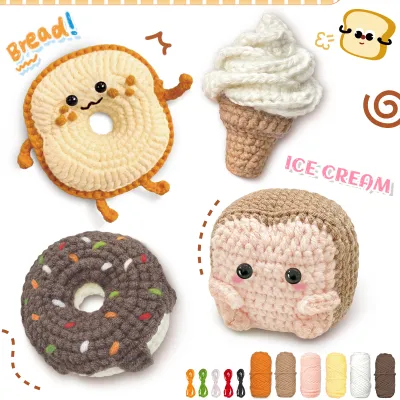
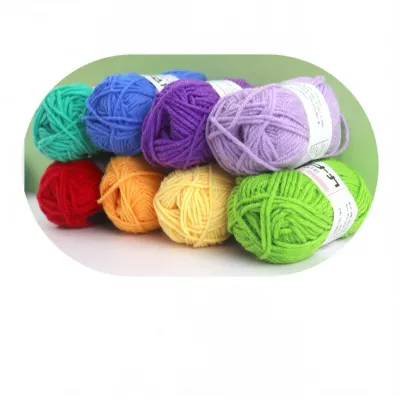
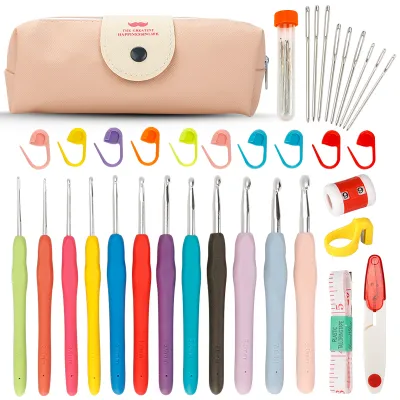
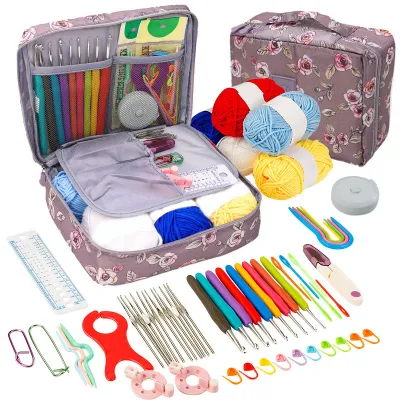
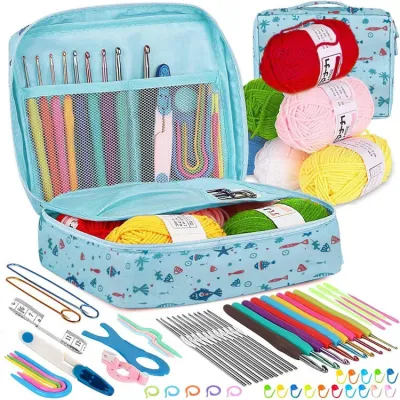
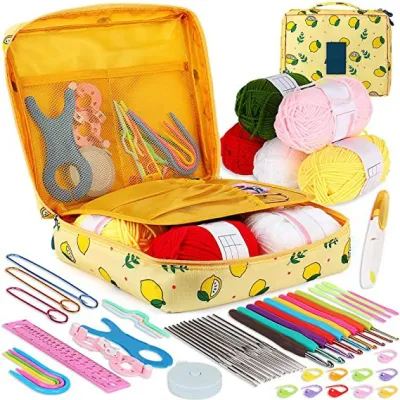
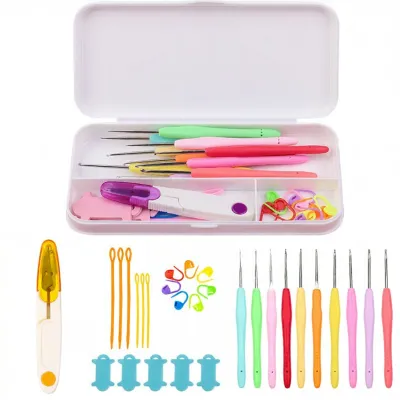
Prices are valid at publication and may change. Please refer to the product page for the latest price.
- Hook Variety and Ergonomics: The crochet hook is your primary tool, and its design directly impacts your physical comfort and learning speed. Look for kits that include hooks with ergonomic, soft-grip handles made of elastomer or rubber rather than basic, flat aluminum hooks. Ergonomic handles reduce hand fatigue and cramping, which is especially important when you are still learning to control your tension. Additionally, ensure the hooks feature clear metric sizing (such as 4.0 mm or 5.0 mm) engraved or printed permanently on the handle. Avoid kits with unmarked hooks or those that only use arbitrary lettering systems, as standard metric measurements are crucial for matching your tools to international pattern instructions.
- Yarn Supply: A common disappointment for beginners is opening a kit only to find tiny sample skeins, often called yarn bonbons, which contain barely enough material to practice a few rows. A reliable crochet yarn set kit must provide sufficient yardage to complete at least one full, functional project, such as a scarf, a dishcloth, or a simple amigurumi character. Before purchasing, check the product specifications for the total weight in grams or length in meters. A beginner-friendly project typically requires at least 100 to 150 meters of continuous yarn; anything less will leave you stranded mid-project, forcing you to hunt for matching dye lots online.
- Notions and Accessories: Beyond the hook and yarn, several small accessories are vital for a smooth crafting experience. Your kit should include locking plastic stitch markers, which are essential for marking the beginning of rounds or specific stitch repeats. Unlike knitting, where simple ring markers slide along the needles, crochet requires locking markers that clip directly into the active loops. Additionally, look for a blunt-tipped metal tapestry needle with a large eye for weaving in loose yarn ends, a manual row counter to track your progress, and a pair of compact, sharp thread snips. Avoid kits that substitute these essentials with low-quality plastic sewing needles, which easily bend and snag yarn fibers.
- Instructional Materials: Even the highest-quality tools are useless without clear guidance. Verify that the kit includes comprehensive, step-by-step instructional materials tailored specifically for absolute beginners. This should go beyond a single sheet of paper with printed text. Look for kits that provide access to high-definition video tutorials with clear voiceovers, slow-motion demonstrations, and close-up angles showing exactly where to insert the hook. The written guides should feature clear, colorful diagrams illustrating basic stitches, such as the chain stitch, single crochet, and double crochet, alongside a glossary of standard abbreviations.
Quality Indicators: How to Spot a Poorly Assembled Kit
Identify red flags in product descriptions and reviews that indicate a kit uses frustrating, low-quality materials that hinder the learning process. Recognizing these warning signs beforehand will save you from purchasing a kit that ends up stored away in a drawer.

- Yarn Construction: The physical structure of the yarn determines how easily your hook will glide through the loops. Beginners should strictly avoid highly textured, novelty, or excessively slippery yarns, such as chenille, velvet, bouclé, or eyelash yarn. While these textures look appealing in the packaging, they obscure the shape of your stitches, making it incredibly difficult to count your rows or identify where to insert your hook. Furthermore, poorly spun yarns with loose plies will split constantly as you work, catching on your hook tip and creating messy, uneven stitches. Opt instead for smooth, tightly spun, multi-ply yarns that maintain their structural integrity under tension.
- Tool Finish: The manufacturing quality of the included tools directly affects your stitching rhythm. Inspect product photos and customer reviews closely for any mention of rough seams on plastic hooks or sharp burrs in the throats of metal hooks. These minor manufacturing defects act like tiny saws, snagging the delicate fibers of your yarn, causing it to fray, split, or snap entirely. A high-quality hook should have a perfectly smooth, polished finish across the entire head, throat, and shaft, allowing the yarn loops to slide effortlessly back and forth as you work.
- Pattern Clarity: Many budget-friendly kits sourced from generic online marketplaces rely on poorly translated patterns that lack standard crochet terminology. This can be highly confusing for beginners, especially if the pattern mixes up United States (US) and United Kingdom (UK) terminology without clarification—for example, a US single crochet is equivalent to a UK double crochet. Ensure the kit's documentation explicitly states which terminology system is used and provides a clear stitch key. If the pattern consists solely of dense blocks of text without visual charts or row-by-row breakdowns, it is likely to cause unnecessary confusion.
- Deceptive Packaging: Be wary of mega kits that advertise high piece counts, such as 150-piece crochet sets. Sellers often pad these numbers by packing the box with dozens of cheap, redundant plastic accessories—such as plastic safety pins, point protectors (which are actually for knitting), paper tape measures, and tiny plastic clips—while providing only a minimal amount of low-grade yarn. When evaluating a kit, ignore the total piece count and focus strictly on the quantity and quality of the core components: the yarn yardage, the ergonomic hooks, and the clarity of the instructional guides.
Yarn and Hook Compatibility: Matching Materials for Easy Learning
Understand how the physical properties of the included yarn and hooks must align to prevent tension issues and beginner frustration. When your materials are perfectly matched, you can focus entirely on mastering the physical movements of the craft.
- Yarn Weight Selection: Yarn thickness is categorized by standard weight numbers, ranging from 0 (lace) to 7 (jumbo). For your first project, prioritize kits that feature Medium (Size 4, often called worsted or Aran weight) or Bulky (Size 5) yarns. These weights are thick enough to hold comfortably in your hands and allow you to clearly see the anatomy of each stitch as you form it. Avoid kits that feature fine, lightweight yarns (such as Size 2 sport or Size 3 DK), as they require highly precise motor control and can quickly strain your eyes, leading to physical fatigue during long practice sessions.
- Color Contrast: The color of your practice yarn plays a critical role in your learning curve. Dark colors, such as black, navy blue, deep charcoal, or dark forest green, absorb light and make it nearly impossible to distinguish individual stitch loops, even in well-lit rooms. Similarly, highly busy, multi-colored variegated yarns can camouflage your stitch structure. Choose kits that provide solid, light-colored yarns in shades like cream, pastel pink, mint green, soft yellow, or light blue. These high-contrast shades make every loop, post, and chain highly visible, allowing you to easily spot and correct mistakes.
- Fiber Content: Different fibers behave differently on the hook. Pure cotton yarn is highly durable and stitch-defining, but it lacks elasticity, which can make it tough on beginner hands and lead to tight, rigid stitches. Conversely, pure wool can be highly elastic but may split easily or feel uncomfortably warm to handle in humid climates, such as Singapore's tropical weather. For the best learning experience, look for kits containing 100% premium acrylic or cotton-acrylic blends (such as a 60% cotton and 40% acrylic mix). These blends offer a comfortable balance of gentle stretch, smooth hook glide, excellent stitch definition, and easy washability.
- Hook-to-Yarn Ratio: Every yarn weight requires a corresponding hook size to achieve the proper tension and drape. If a kit pairs a thick yarn with a hook that is too small, your stitches will be incredibly tight, stiff, and difficult to work into. If the hook is too large, your fabric will be loose, holy, and structurally weak. Check the yarn labels included in the kit to verify that the recommended hook size matches the actual hooks provided. For example, a standard Medium (Size 4) worsted weight yarn typically pairs best with a 5.0 mm or 5.5 mm hook. A well-matched kit ensures your stitches are neither too tight nor too loose.
Building Your Shortlist: Evaluation Checklist Before You Buy
Apply a structured evaluation process to compare different crochet yarn set kits and select the most reliable option for your specific learning style. Taking a systematic approach prevents impulse purchases that might not suit your physical needs.
- Review Analysis: Before committing to a purchase on any online marketplace, conduct a targeted analysis of customer reviews. Instead of focusing solely on five-star ratings, filter specifically for two-star and three-star reviews. These middle-tier reviews often provide the most objective feedback regarding the actual usability of the kit. Look for recurring complaints about yarn that splits easily, missing components, broken links to video tutorials, or instructions that are too fast or difficult to follow. If multiple buyers highlight the same issue, it is a strong indicator of a poorly assembled kit.
- Left-Handed Support: If you are a left-handed crafter, you face a unique challenge when learning to crochet, as the craft is highly directional. Standard right-handed tutorials will show movements that are the exact mirror image of what you need to do. Before buying a kit, verify whether the instructional materials or online video links offer dedicated left-handed tutorials or mirrored video options. Learning from a guide that accommodates your dominant hand will save you hours of cognitive fatigue and prevent you from accidentally working your stitches backward.
- Value Assessment: To determine if a kit is genuinely worth the price, perform a simple value calculation. Take the total price of the kit in S$ and subtract the estimated value of the basic reusable tools (such as a set of ergonomic hooks and basic notions, which typically cost around S$10 to S$15 when purchased individually). Divide the remaining amount by the total weight of the yarn to find the cost per 100 grams. If the resulting cost per 100g is significantly higher than the retail price of standard, high-quality beginner yarn, you are paying an unjustified premium for the convenience of the packaging.
- Retailer Policies: Because crochet is a highly tactile craft, the physical comfort of the tools and the texture of the yarn are entirely subjective. What feels comfortable to one crafter might cause hand strain or skin irritation for another. Before finalizing your purchase, review the retailer's return and exchange policies. Confirm whether you can return the kit if you find the hook ergonomics uncomfortable or if the yarn quality does not meet your expectations. Keep in mind that many craft suppliers do not accept returns on opened yarn skeins or kits once the protective seal has been broken, making it even more critical to verify these details beforehand.
Frequently Asked Questions (FAQ)
Can I use a knitting yarn set for crochet?
While the yarn itself is interchangeable between the two crafts, a dedicated knitting yarn set is not a suitable substitute for a crochet kit. Knitting kits are designed around two long needles and often include specific notions like point protectors and ring stitch markers that do not function well for crochet. Most importantly, knitting kits do not include crochet hooks, which are the single most critical tool you need to form crochet stitches. To avoid having to make immediate secondary purchases, always ensure you buy a kit specifically labeled for crochet.
Is it better to buy a complete kit or purchase yarn and hooks separately?
For absolute beginners, a complete crochet yarn set kit offers unmatched convenience and cost-effectiveness, as it eliminates the guesswork of matching hook sizes to yarn weights and provides a curated project to start immediately. However, if you are committed to the craft long-term, purchasing your tools and yarn separately allows you to invest in premium, highly ergonomic hooks and select your preferred yarn fibers and colors from the start. If you want to test your interest with minimal upfront investment, start with a well-reviewed complete kit; if you plan to make crochet a long-term hobby, building your own custom starter set is often the more satisfying route.

Community discussion
Share your experience or ask a question. Comments are reviewed before publication.