
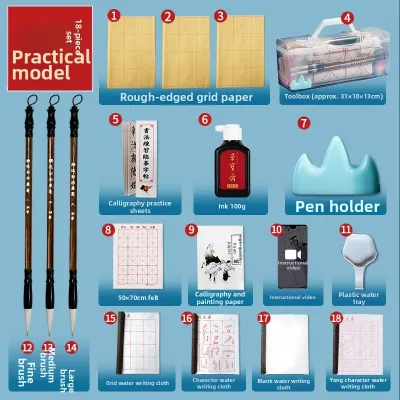
A complete Chinese calligraphy set for beginners must provide a balanced foundation of tools that cooperate to control ink flow, paper absorption, and brush movement. Traditionally centered around the “Four Treasures of the Study”—the brush, ink, paper, and inkstone—a modern beginner’s kit is only truly complete when paired with practical accessories like a felt mat, paperweights, and a brush rest. Selecting these items with the correct specifications prevents the common frustrations of excessive ink bleeding, limp brush bristles, and ruined work surfaces.
By focusing on tools that offer predictable feedback, novices can master the physical mechanics of brush control without fighting their materials. Understanding the role of each component ensures you purchase a set that supports your learning journey rather than hindering it with low-quality or mismatched items.
The 4 Essential Components of a Beginner Calligraphy Set
The foundation of any Chinese calligraphy practice rests upon the “Four Treasures of the Study” (Wenfang Sibao). These four tools have been used for centuries to create expressive brushwork, and each must be selected with a beginner’s specific learning curve in mind.
Products mentioned in this guide
![Chinese Calligraphy Study Kit Brush Pen/Ink/Rice Paper/Inkstone中文书法学习套装文房四宝 Four Treasures of Study Kit[SG Ready Stock]](https://img.lazcdn.com/g/p/e425e131997c6f3c4f0a1a435ad6315f.jpg_400x400q80.jpg_.webp)
![[frthrthrt]No Ink Chinese Calligraphy Practice Set Water Writing Cloth Scrolls Chinese Traditional for Beginners Practice](https://img.lazcdn.com/g/p/49d2db6869290ec5d4d7ba3e49e7f793.jpg_400x400q80.jpg_.webp)
Prices are valid at publication and may change. Please refer to the product page for the latest price.
For the brush, a medium-sized mixed-hair brush (Jianhao) is highly recommended for novices. Mixed-hair brushes typically combine stiff Siberian weasel hair (Langhao) in the core for structural resilience and soft goat hair (Yanghao) on the outer layer for water retention. This combination provides a forgiving balance, offering enough “snap” to help the brush return to a sharp point while holding a generous amount of ink for continuous strokes.
When it comes to ink, beginners should opt for bottled liquid ink rather than traditional solid ink sticks. While grinding a solid ink stick on an inkstone is a meditative and traditional practice, it requires fifteen to twenty minutes of physical preparation before every session. Bottled liquid ink, formulated with finely ground soot and water-soluble binders, is highly practical, consistent in viscosity, and allows you to begin practicing immediately.
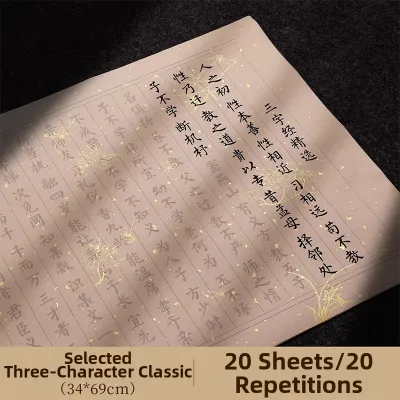
Paper selection is critical because it dictates how the ink behaves upon contact. Beginners should use semi-absorbent practice paper, such as yellow bamboo Maobian paper, rather than highly absorbent raw Xuan paper. Semi-absorbent paper slows down the spread of ink, giving untrained hands the time they need to complete a stroke without creating large, blurry blots on the page.
Finally, the traditional grinding inkstone can be replaced by a simple, smooth ceramic or stone inkwell. Because you will be using pre-made liquid ink, you do not need the abrasive surface of a high-end slate grinding stone. A basic well serves as a reservoir for your liquid ink and provides a flat, sturdy edge to scrape off excess ink, which is essential for maintaining a sharp brush tip.
Additional Tools That Improve the Learning Experience
While the Four Treasures form the core of your set, several supplementary accessories are necessary to maintain a clean, organized, and effective practice space. These tools protect your furniture and help you maintain physical control over your materials.

A calligraphy felt mat (Huanzidian) is an absolute necessity that is placed directly beneath your practice paper. Because calligraphy paper is thin and porous, ink will naturally bleed through the sheet. The felt mat absorbs this excess moisture without letting it pool, preventing the paper from sticking to the desk and protecting your workspace from permanent ink stains.
Paperweights (Zhenzhi) are equally important for keeping your writing surface flat and stable. Calligraphy paper is lightweight and often sold in rolls or folded sheets that naturally curl at the edges. Placing heavy wood, metal, or stone paperweights at the top of your sheet ensures the paper remains perfectly flat, preventing the brush from catching on ripples during dynamic movements.
A brush rest (Bishan) and a washing bowl (Bixi) keep your workspace orderly and protect your brushes. A wet brush should never be laid flat on a table, as the ink will stain the surface and the bristles will flatten out of shape. A brush rest keeps the wet tip elevated, while a dedicated washing bowl allows you to rinse out ink immediately after practice before it can dry and ruin the bristles.
For a completely mess-free alternative, many modern beginner sets include a water writing cloth (Shuixiezhi). This synthetic fabric features a special coating that turns dark black when wet with clean water and fades back to white as the water evaporates. It is an excellent, highly reusable tool for practicing basic stroke mechanics and muscle memory without wasting paper or ink.
Pre-Packaged Sets vs. Sourcing Individual Tools
Deciding whether to buy a pre-packaged calligraphy kit or assemble your own set depends on your budget, convenience needs, and level of commitment. Both approaches have distinct advantages and trade-offs that you should consider before making a purchase.
Pre-packaged kits offer immediate convenience and are often highly cost-effective, with basic beginner sets typically ranging from S$20 to S$50 on online marketplaces. These kits usually come in a decorative box, making them excellent gifts. However, manufacturers of budget kits often compromise on individual tool quality, sometimes bundling stiff, low-grade synthetic brushes or highly absorbent paper that is difficult for a beginner to use.
Sourcing your tools individually allows you to allocate your budget where it matters most. For example, you can invest in a high-quality mixed-hair brush and a generous pack of grid-printed Maobian paper, while keeping your inkwell, paperweights, and felt mat simple and inexpensive. This custom approach ensures that the tools directly touching the paper are of sufficient quality to support your skill development.
If you decide to purchase a pre-packaged commercial set, use this checklist to verify its completeness before checkout:
- Brush Composition: Ensure the brush is explicitly labeled as mixed hair (Jianhao) or soft goat hair (Yanghao), rather than pure stiff synthetic nylon.
- Ink Type: Confirm the set includes a bottle of liquid ink, not just a solid ink stick that requires grinding.
- Felt Mat Included: Verify that a protective felt mat is included in the package, as many budget sets omit this critical accessory.
- Paper Style: Check that the included paper is semi-absorbent practice paper (such as Maobian paper) rather than raw, highly absorbent Xuan paper.
Key Specifications to Check Before Purchasing
To ensure the tools in your calligraphy set are functional and suitable for learning, you must look past aesthetic packaging and verify specific material and dimensional details.
First, examine the brush hair material. Avoid cheap brushes made entirely of stiff synthetic nylon, as they lack the capillary structure required to hold liquid ink properly and tend to flick ink unpredictably. Look for natural mixed-hair brushes, which provide a smooth, continuous flow of ink and offer a gentle resistance that helps you feel the paper’s texture.
Second, check the ink formulation. High-quality beginner liquid ink should be soot-based (either pine soot or oil soot) and labeled as low-odor or lightly scented with traditional herbs. Avoid ultra-cheap inks that have a strong chemical ammonia smell, as these often contain harsh binders that can dry out and damage natural brush hairs over time.
Third, ensure your practice paper features printed grid lines. Beginners should look for paper printed with “Mi-zi-ge” (an eight-directional star grid resembling the Chinese character for rice) or “Hui-gong-ge” (a double-square grid). These lines provide essential visual reference points, helping you master character proportions, spacing, and stroke alignment.
Finally, verify the physical dimensions of the tools. For standard script practice (Kaishu), the brush tip should have a visible hair length (Chu-feng) of approximately 3.5cm to 4.5cm and a diameter at the base (Kou-jing) of 0.8cm to 1.0cm. The practice paper sheets should be large enough to accommodate characters of about 8cm to 10cm in size, giving you ample room to observe your stroke transitions.
Common Mistakes to Avoid When Buying Your First Set
Many beginners abandon their calligraphy practice early simply because they are fighting poorly configured tools. Avoiding a few common purchasing traps will save you frustration and money.
One of the most common mistakes is buying a set with brushes that are either too large or too small. Oversized brushes require whole-arm movement from the shoulder, which is incredibly difficult to control without established muscle memory. Conversely, tiny detail brushes encourage tight, finger-driven movements that prevent you from learning proper wrist and elbow coordination.
Another frequent error is practicing on raw Xuan paper. Because raw paper absorbs moisture instantly, any hesitation in your brush movement will result in a large, bleeding ink blot. This rapid absorption makes it impossible for a beginner to analyze their stroke shapes and transitions, leading to immediate discouragement.
Lastly, do not buy ultra-cheap sets that omit a proper felt mat. Attempting to practice calligraphy directly on a hard desk surface without a cushion causes the paper to slide, reduces stroke feedback, and inevitably leads to ink bleeding through and staining your furniture. Investing in a set that includes a thick, stable felt mat is essential for a clean and comfortable practice environment.
Frequently Asked Questions (FAQ)
How do I clean and store the calligraphy brush after practice?
To clean your brush, rinse the bristles under a gentle stream of cool or room-temperature water. Gently massage the brush head from the base (near the handle) down to the tip to release trapped ink, avoiding hot water as it can melt the glue holding the bristles. Once the water runs clear, gently squeeze out excess moisture, reshape the brush head into a sharp point with your fingers, and hang it vertically by its hanging loop on a brush hanger to dry. Never store a wet brush flat or upright in a cup, as moisture will pool in the wooden handle, causing the wood to split and the bristles to rot.
Can I use regular printer paper for calligraphy practice?
Regular printer paper is highly unsuitable for Chinese calligraphy practice. It has a slick, non-porous surface that does not absorb liquid ink, causing the ink to pool on top of the page and smear easily. Additionally, printer paper lacks the natural surface friction of bamboo or mulberry fibers, which is necessary for controlling the speed and drag of the brush. Without printed grid guides and proper paper texture, it is incredibly difficult to evaluate your stroke weight, ink distribution, and character structure.
Community discussion
Share your experience or ask a question. Comments are reviewed before publication.