
Choosing the right paper shredder requires understanding how document destruction is measured and standardized. If you select a model with too low a security rating, you risk exposing sensitive personal or business data to identity thieves and corporate competitors. Conversely, buying an ultra-secure military-grade machine for basic household junk mail leads to unnecessary expenses, slower shredding speeds, and more frequent maintenance.
To make an informed decision, you must decode the international rating system used by manufacturers to classify shredder performance. This system dictates how small your documents are cut, directly impacting both data security and the operational efficiency of the machine.
What the DIN Security Levels Actually Mean
When shopping for a paper shredder, you will consistently see ratings like P-3, P-4, or P-5. These ratings are part of the DIN 66399 standard, which is the internationally recognized framework for evaluating the security levels of data destruction equipment. Developed by the German Institute for Standardization (Deutsches Institut für Normung), this standard ensures that consumers and organizations worldwide have a consistent benchmark for comparing different machines.
Products mentioned in this guide
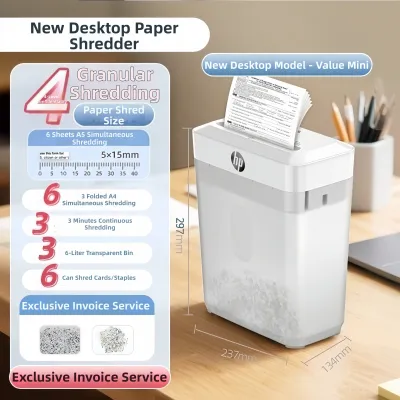
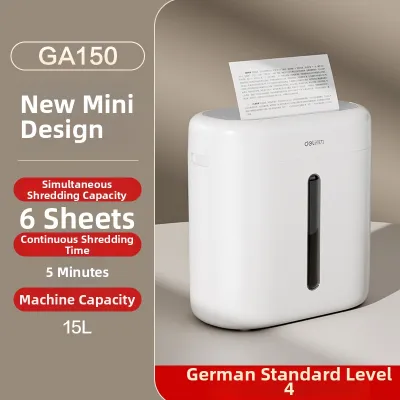
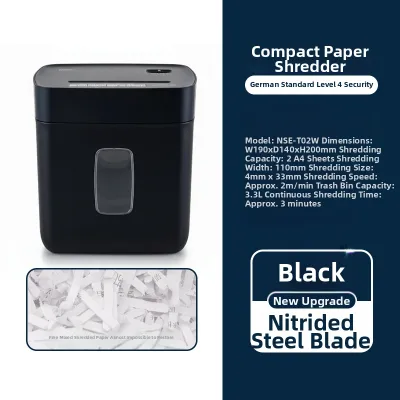
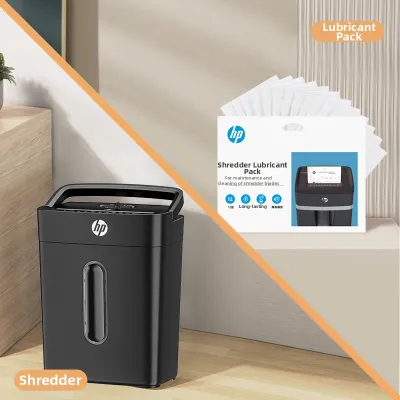
![[SG] A4 Multi-Functional Electric Paper Shredder with Built-in Basket](https://img.lazcdn.com/g/p/e13a5b4a0cd7800074c9a408a1f0b8e7.jpg_400x400q80.jpg_.webp)
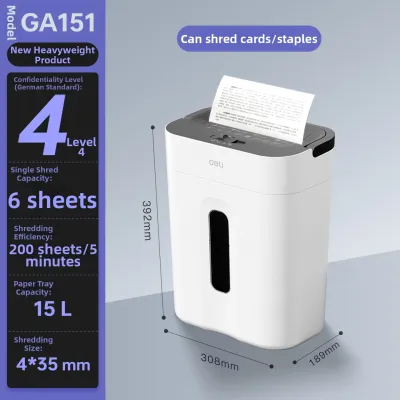
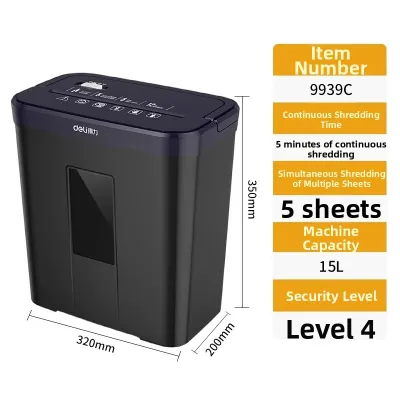
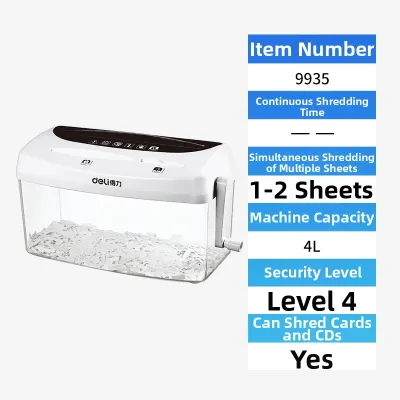
Prices are valid at publication and may change. Please refer to the product page for the latest price.
In this classification system, the letter “P” specifically stands for paper-based media. The DIN 66399 standard actually covers six other media categories, including optical discs (O), magnetic tape (T), and electronic data media (E). However, for standard office and home document destruction, the “P” rating is the only metric you need to evaluate.
Crucially, a shredder’s DIN rating is determined by the maximum surface area and the specific shape of the shredded particles, rather than just the mechanical design of the cutting blades. The standard defines precise limits for particle width and total surface area in square millimetres. This means two machines with different cutting mechanisms can share the same security level as long as their final shredded output falls within the same dimensional boundaries.
As you move up the DIN scale from P-1 to P-7, the shredded output progresses from long, continuous strips to short cross-cut confetti, and finally to microscopic particles. Each step up the scale exponentially increases the number of pieces a single sheet of paper is divided into. This progression makes document reconstruction virtually impossible at the higher tiers, providing peace of mind for highly sensitive data.
A Practical Guide to P-1 Through P-7 Ratings
To choose the right machine, it helps to visualize the physical output of each security tier and understand the specific scenarios they are designed to handle.

Low Security (P-1 and P-2): Basic Privacy
Low-security shredders utilize a strip-cut mechanism that slices paper vertically into long, continuous ribbons. A single A4 sheet fed into a P-1 shredder is typically cut into roughly 30 strips, while a P-2 model cuts it into approximately 40 strips. Because these strips run the entire length of the page, they do not offer robust protection for confidential information.
These entry-level ratings are best suited for destroying non-sensitive materials. If you are looking to clear out public flyers, non-personalized junk mail, or general household clutter where identity theft is not a concern, a P-1 or P-2 model is sufficient.
However, you should avoid using these levels for any document containing personal details. Because the paper is only cut in one direction, a determined individual can reassemble the strips relatively quickly using basic adhesive tape or digital scanning software.
Medium Security (P-3 and P-4): Everyday Confidentiality
Medium-security shredders employ a cross-cut mechanism that slices paper both vertically and horizontally. This dual-action cutting process turns a single sheet of paper into short, diamond-shaped or rectangular confetti-like pieces, making manual reconstruction incredibly difficult and time-consuming.
A P-3 shredder typically cuts an A4 page into about 200 pieces, which is suitable for standard business documents that do not contain highly sensitive personal data. For most small businesses, home offices, and residential users handling standard confidential data, P-4 is the industry-standard recommendation. A P-4 shredder reduces a single A4 sheet into roughly 400 tiny particles, offering an excellent balance between security and processing speed.
These medium-security levels are ideal for destroying everyday confidential documents. You should use a P-4 shredder for disposing of standard bank statements, utility bills, personal correspondence, internal business memos, and basic tax documents.
High Security (P-5 to P-7): Maximum Protection
High-security shredders use micro-cut and highly engineered cutting cylinders to reduce paper to tiny, granular particles or dust-like fragments. These machines are designed for environments where data leaks could result in severe financial, legal, or national security consequences.
The upper tiers of the DIN standard represent extreme levels of destruction. A P-5 micro-cut shredder turns an A4 sheet into more than 2,000 tiny particles, making it ideal for sensitive corporate strategy documents, human resource records, and medical files. P-6 models reduce a sheet to roughly 6,000 particles, which is the standard for highly confidential legal and financial data. P-7 is the highest possible rating, reducing a single sheet of paper into over 12,000 microscopic particles, which is reserved for military, intelligence, and government-classified operations.
Before purchasing a high-security model, you should check the specific industry compliance requirements that apply to your organization. In Singapore, businesses handling personal data must comply with the Personal Data Protection Act (PDPA). If your organization processes highly sensitive financial accounts, medical histories, or proprietary intellectual property, utilizing a P-5 or higher shredder may be legally mandated to prevent data breaches and avoid substantial regulatory fines.
Matching Your Documents to the Right Security Level
Selecting the right shredder requires mapping your typical document waste to the appropriate security level. The table below outlines the recommended DIN ratings for common document types:
| Security Level | Cut Type | Typical Particle Count (A4 Sheet) | Recommended Document Types | Target Users |
|---|---|---|---|---|
| P-1 / P-2 | Strip-cut | 30 to 40 strips | Public flyers, junk mail, non-sensitive clutter | General household use |
| P-3 | Cross-cut | ~200 particles | Internal business memos, non-confidential files | General office use |
| P-4 | Cross-cut | ~400 particles | Bank statements, tax forms, customer PII, payroll | Home offices, SMEs |
| P-5 | Micro-cut | ~2,000 particles | Medical records, proprietary research, HR files | Healthcare, corporate HR |
| P-6 | Micro-cut | ~6,000 particles | Highly sensitive financial data, legal contracts | Legal firms, financial institutions |
| P-7 | Micro-cut | ~12,000 particles | Government classified, military intelligence | Government agencies, defense |
When choosing a level, you must weigh the risk of under-shredding against the operational costs of over-shredding. Under-shredding leaves you vulnerable to identity theft, corporate espionage, and regulatory penalties under local laws like the PDPA. Over-shredding, on the other hand, requires a larger financial investment up front, as high-security micro-cut machines are more expensive to manufacture and maintain.
To find the right balance, audit your typical weekly paper waste. Identify the highest sensitivity level of the documents you regularly handle. If the vast majority of your waste is non-sensitive but you regularly destroy even a small volume of customer invoices or payroll slips, your baseline purchase must match that higher security requirement (typically P-4).
Balancing Security with Performance and Maintenance
As you move to higher security ratings, you will encounter mechanical trade-offs that affect how the machine operates. There is an inverse relationship between a shredder’s security level and its sheet capacity. Because cutting paper into thousands of tiny micro-particles requires immense motor torque, high-security models typically shred fewer sheets per pass than lower-security models with similar motor sizes.
Run-time limitations and cool-down periods are also more pronounced in high-security micro-cut models. The friction generated by processing paper through complex, interlocking cutting cylinders causes the motor to heat up quickly. While a budget strip-cut shredder might run for 10 minutes continuously, a high-security micro-cut model in the same price class might require a 30-minute cool-down period after just 3 to 5 minutes of continuous use.
Bin capacity and maintenance routines also differ significantly across security levels. Strip-cut ribbons do not compress well, meaning the waste bin fills up quickly and requires frequent emptying. Micro-cut particles compress tightly, allowing you to fit significantly more shredded paper into the same bin volume. However, micro-cut cylinders generate more paper dust and require regular lubrication with specialized shredder oil or oil sheets to prevent jams and maintain cutting efficiency.
Before making a final purchase, always verify the manufacturer’s specification label on the machine or in the product manual. Pay close attention to the rated sheet capacity, the continuous duty cycle, and the list of acceptable materials. This ensures you choose a machine that fits your daily workflow without risking premature motor failure.
Frequently Asked Questions (FAQ)
Can I shred credit cards and staples in a high-security shredder?
While many standard cross-cut (P-3 and P-4) shredders can easily process standard office staples and plastic credit cards, high-security micro-cut (P-5 to P-7) blades are highly precise and can be easily damaged or dulled by hard plastics and metals. You must check your product manual before feeding these materials into the machine. Many high-security models feature a dedicated media slot or require you to remove all staples and paperclips prior to shredding to protect the delicate cutting cylinders.
Why does my shredder overheat or jam when using higher security levels?
Reducing paper to thousands of microscopic particles generates significant friction and requires sustained motor power. If you exceed the manufacturer’s stated sheet capacity or run the machine past its continuous run-time limit, the motor will overheat, triggering the thermal overload protector to prevent permanent damage. To avoid jams and overheating, always shred in smaller batches, respect the duty cycle, and oil the cutting blades regularly as directed by the manufacturer.
Community discussion
Share your experience or ask a question. Comments are reviewed before publication.