
Selecting your ideal planner for the year 2027 requires looking beyond outer cover designs and calendar layouts; the true foundation of your daily planning is the paper itself. There is no single brand that offers a universally perfect paper for the year 2027. Instead, the right choice depends entirely on your writing instruments, planning style, and portability needs.
The primary trade-off in planner paper lies between paper weight and opacity. Ultra-thin papers maximize portability and show off fountain pen ink properties beautifully, but they naturally exhibit more ghosting (show-through) on the reverse side. Conversely, thicker papers prevent bleed-through from heavy gel pens and artistic markers, but they add significant physical bulk and weight to your daily carry.
As you prepare for the year 2027, remember that paper manufacturers occasionally alter their sourcing, chemical coatings, or mill partnerships. Always verify the specific paper specifications, such as grams per square meter (GSM) and surface treatments, rather than relying solely on a brand’s historical reputation.
Products mentioned in this guide
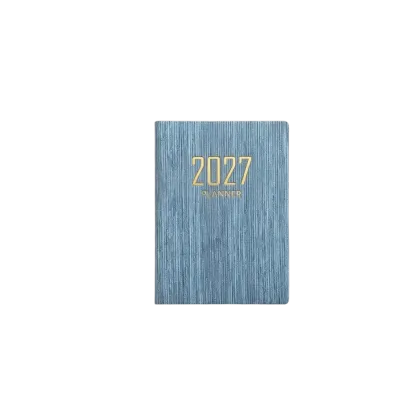
Prices are valid at publication and may change. Please refer to the product page for the latest price.
Core Paper Dimensions to Check Before Buying
To make an informed decision, you must look past subjective marketing terms like “premium” or “silky” and focus on objective, physical characteristics. Understanding how paper is measured and manufactured allows you to predict exactly how your favorite pens will behave on the page.
Weight and Thickness (GSM)
Paper weight is globally standardized as GSM, or grams per square meter. In a 365-day planner, GSM directly dictates the final thickness and weight of the book. For example, a planner using 52 GSM paper will be slim and highly portable, while a planner with the same page count using 120 GSM paper will be more than twice as thick and heavy.
While higher GSM generally offers greater opacity and better resistance to ink bleeding, it presents a clear physical trade-off. A heavy planner can become a physical burden if you regularly commute or travel. When shopping for your year 2027 setup, locate the exact GSM specification on the product label or official website to gauge the planner’s physical footprint before committing to a purchase.
Texture and Tooth
The texture of paper, often referred to as its “tooth,” describes the microscopic roughness of the page surface. This texture is determined during the manufacturing process by how heavily the paper fibers are pressed between rollers (a process called calendering) and whether any surface coatings are applied.
Smooth, highly calendered papers allow fine-liner pens and fountain pen nibs to glide effortlessly without catching, making them excellent for fast, cursive writing. However, very smooth surfaces can slow down ink drying times. Toothy papers offer more resistance and feedback, which is highly satisfying for pencil users and ballpoint pens, though they can occasionally cause ultra-fine nibs to collect paper fibers.
Ink Handling and Bleed-Through
How paper handles wet ink is determined by its “sizing”—the chemical additives applied internally or externally during manufacturing to control water absorption. Without proper sizing, paper behaves like paper towels, causing ink to feather (spread outward in spiderweb patterns) or bleed (soak completely through to the reverse side).
Ghosting, or shadow-through, is distinct from bleeding; it occurs when the paper is thin but the ink does not actually penetrate the fibers. While many planners carry a “fountain pen friendly” label, actual performance depends on your specific ink’s wetness and your pen’s nib size. Treat manufacturer claims as a baseline and look for detailed verification before committing.
Comparing Brand Paper Profiles for Your Year 2027 Planner
To help you navigate the year 2027 planner market, we can categorize the paper profiles of leading brands into three distinct structural types. Each profile serves a different style of planning and writing.

Ultra-Thin, High-Opacity Paper
Ultra-thin planner papers, typically ranging from 52 to 68 GSM, are engineered to keep a comprehensive daily planner compact and lightweight. This category includes lightweight papers utilized by brands such as Hobonichi, which are designed to pack a full year of daily pages into a single, highly portable volume.
These papers are highly treated with specialized sizing that prevents ink from soaking into the fibers. Instead, wet ink sits on top of the page, allowing fountain pen inks to display their full shading, sheen, and shimmer properties without bleeding. The primary trade-off is high ghosting; you will clearly see the shadow of your writing on the back of the page, and drying times can be exceptionally long, particularly in Singapore’s humid climate where moisture in the air slows evaporation.
Thick, Premium Smooth Paper
Thick, premium smooth papers generally range from 80 to 120 GSM and are featured in planners from brands like Leuchtturm1917, Midori MD, and Rhodia. These papers prioritize high opacity and a substantial, luxurious tactile feel under the hand.
The denser fiber structure and heavier weight of these papers make them highly resistant to both bleeding and ghosting. They are the ideal canvas if you use wet gel pens, brush pens, or mild highlighter markers, as you can write comfortably on both sides of the page without visual distraction. However, a full-year planner using 100+ GSM paper is physically thick and heavy, making it better suited for stationary desk use rather than daily mobile carry.
Standard Everyday Paper
Standard everyday planner paper typically sits between 70 and 80 GSM and is found in mainstream commercial planners, including Moleskine and various academic diaries. This paper is formulated for maximum versatility with common office writing tools.
If you write primarily with standard ballpoint pens, rollerballs, or quick-drying gel pens, this paper profile offers a highly balanced writing experience with rapid drying times and moderate opacity. However, because standard papers often lack heavy sizing or specialized coatings, they do not handle wet fountain pen inks, liquid ink rollers, or alcohol markers well, frequently resulting in noticeable feathering and bleed-through.
Decision Guide: Match Paper to Your Pen and Style
Selecting your year 2027 planner requires matching these paper profiles to your daily routine, pen preferences, and environmental conditions. Use the following conditional framework to identify your ideal match.
Choose ultra-thin paper if:
- Portability is your priority: You need a lightweight, compact daily planner that fits easily into a small bag for daily commuting on Singapore transit.
- You write with fine tips: Your primary writing instruments are fountain pens, fine gel pens, or technical fine-liners.
- You appreciate ink characteristics: You enjoy the visual properties of fountain pen inks, such as shading and sheen.
- Ghosting does not bother you: You do not mind visible ghosting (show-through) on the reverse side of your pages.
- You can manage dry times: You are willing to use a blotter paper or wait a few extra seconds for ink to dry in humid environments.
Choose thick, premium paper if:
- You use heavy ink mediums: Your planning style involves heavy gel pens, wet rollerballs, brush pens, or artistic markers.
- You demand clean pages: You require high opacity and want a completely clean, distraction-free reverse page.
- You prefer a substantial feel: You prefer a substantial, luxurious feel and do not mind a heavier, bulkier planner.
- Your planner is deskbound: Your planner primarily stays on your desk at home or in the office.
Choose standard everyday paper if:
- You stick to basic writing tools: You write almost exclusively with standard ballpoint pens, pencils, or quick-dry gel pens.
- You want a balanced weight: You want a balanced planner that is reasonably portable and cost-effective.
- You need rapid drying: You prefer fast ink drying times and do not use highly saturated liquid inks.
Verify first if:
- You use specialized mediums: You plan to use highly specialized writing mediums, such as iron gall inks, heavily saturated shimmer inks, or wet calligraphy nibs. These materials can react unpredictably with paper coatings and require individual testing regardless of general brand recommendations.
How to Verify Paper Specs and Test Compatibility
Before investing in a year 2027 planner, taking a few proactive steps can prevent the frustration of buying a book that feathers or bleeds with your favorite pen. Use these reliable verification methods to ensure a perfect match.
Check Manufacturer Labels Look past generic marketing descriptions like “ink-proof” or “journal-grade.” Search the manufacturer’s official specifications for the exact GSM rating, paper origin, and surface coating details. Brands that are proud of their paper quality will explicitly state these technical details on their websites.
Seek Independent Ink Tests Stationery communities online are invaluable resources for real-world performance. Search for video or photo reviews where users perform comprehensive “pen tests” on the exact year 2027 planner you are considering. Pay close attention to how they test pens similar to yours, looking for close-up shots of the reverse side of the page to evaluate bleeding and ghosting.
Use Paper Sample Cards If you reside in Singapore, visit local physical specialty stationery boutiques in retail hubs like Bugis, Orchard, or Bras Basah. Many of these physical stores carry paper sample books or test sheets. Bring your favorite daily pens and write on these samples to experience the tooth, drying speed, and ink handling firsthand before purchasing.
Perform a Controlled Test Once you purchase your planner, do not immediately write on the first page. Turn to the final index pages, memo sheets, or a discrete corner of an insert page. Write a small sample using every pen and ink combination you intend to use. Check the drying time, observe if the ink feathers, and flip the page to inspect for bleeding or distracting ghosting.
Frequently Asked Questions (FAQ)
Does higher GSM always mean better paper for planners?
No, higher GSM simply means the paper is heavier and thicker, which is not universally superior. While a higher GSM (such as 100 to 120 GSM) provides excellent opacity and prevents ink from bleeding through, it also makes a 365-day planner heavy and difficult to carry. Conversely, high-quality, lightweight papers (such as 52 GSM Tomoe River) use specialized surface sizing to handle wet fountain pen inks beautifully without bleeding, offering a highly portable alternative for users who do not mind moderate page ghosting.
How can I prevent ink from bleeding through my 2027 planner?
If your current planner paper is prone to bleeding, you can mitigate this by adjusting your writing tools and techniques. Switch to drier writing instruments, such as standard ballpoint pens, fine-point gel pens, or pencils, which deposit less liquid on the page. If you must use fountain pens, select finer nib sizes (such as extra-fine or fine) and pair them with dry-flowing inks. Additionally, placing a sheet of blotter paper or a plastic writing board (shitajiki) directly behind your active page will protect the subsequent sheets from localized pressure and accidental ink transfer.
Community discussion
Share your experience or ask a question. Comments are reviewed before publication.