
Selecting the right geometry set for your child in Singapore is more than just a routine back-to-school chore; it directly impacts their confidence and accuracy in mathematics. As students progress from primary school to secondary school, the complexity of the Singapore mathematics syllabus increases significantly. While a primary school student only needs basic tools to measure simple lines and angles, a secondary school student requires high-precision instruments to tackle advanced geometric constructions, bearings, and trigonometry. Understanding what is required at each grade level ensures you purchase a set that is both functional and compliant with national examination guidelines.
To help you make an informed decision, this guide breaks down the essential tools needed for each educational stage. By matching the right instruments to your child’s curriculum, you can prevent them from struggling with inadequate tools during crucial classroom exercises and examinations.
Essential Tools Found in a Standard Geometry Set
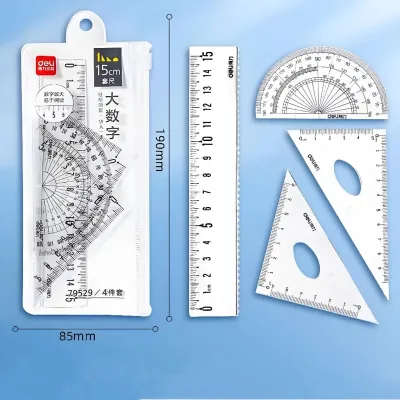
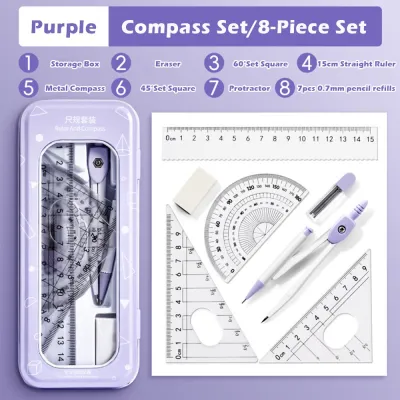
A standard, off-the-shelf geometry set typically serves as the baseline for middle and upper-grade mathematics. These pre-packaged kits usually contain a 15cm transparent ruler, a 180-degree semi-circular protractor, a compass for drawing circles, a pair of set squares (one 45-degree and one 30/60-degree), a small eraser, a short wooden pencil, and a pencil sharpener. Some comprehensive sets may also include a divider, which is used for measuring and transferring precise distances between two points.
Products mentioned in this guide
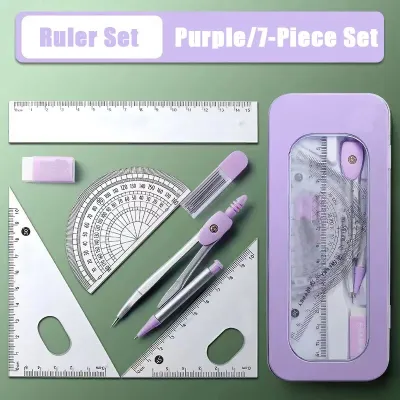
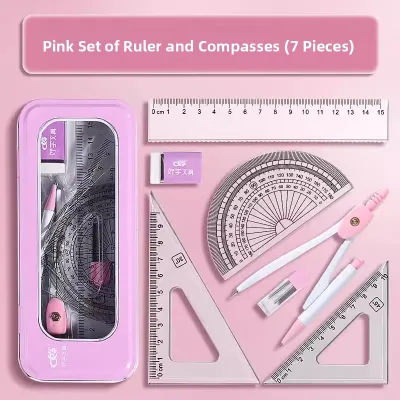
![[SG] 7-Piece Mathematical Compass Set – 3 Colors (Green Blue Pink) [Evergreen Stationery]](https://img.lazcdn.com/g/p/a26676faa26b99e644ff7bcf448e2ebc.png_400x400q80.png_.webp)
Prices are valid at publication and may change. Please refer to the product page for the latest price.
When evaluating these standard sets, the quality of the markings and the material of the tools are paramount. Rulers and protractors must be completely transparent and feature clear, non-smudging, etched markings rather than cheaply printed lines. This transparency is critical because it allows students to see the underlying grid lines, textbook diagrams, or exam paper layouts clearly. If a tool is opaque or has thick, blurry markings, aligning it with a fine pencil line becomes incredibly difficult, leading to avoidable measurement errors.
While these standard sets provide a solid starting point, they are not a one-size-fits-all solution for a student’s entire academic journey. As your child advances through the Singapore school system, the physical dimensions, precision levels, and specific types of tools they require will shift. A set that is perfectly safe and appropriate for a primary school student will likely fall short of the technical demands of secondary school geometry and national examinations.
Primary School Requirements: Building the Foundation (Primary 1–6)
During the primary school years, students transition from basic numeracy to foundational geometric concepts. In the lower primary levels (Primary 1 to Primary 3), the focus is entirely on basic measurement, identifying simple shapes, and drawing straight lines. At this stage, a full geometry set is unnecessary and can even be a distraction or a safety hazard in a young child’s pencil case.

For Lower Primary (Primary 1–3) students, a standard 15cm transparent plastic ruler is the only essential geometric tool. It is crucial to choose a ruler with clear, bold millimeter and centimeter markings that start exactly at the edge or have a distinct, easy-to-read zero line. Compasses, protractors, and set squares are not introduced in the syllabus at this stage. Keeping the stationery kit minimal and lightweight prevents clutter and ensures younger children focus on mastering basic ruler alignment and pencil control.
As students enter Upper Primary (Primary 4 to Primary 6), the mathematics curriculum introduces angles, circles, and symmetrical shapes. This shift requires a standard 180-degree semi-circle protractor and a beginner-friendly compass. The protractor should feature a dual scale (inner and outer scales running in opposite directions from 0 to 180 degrees) to help students measure angles from both the left and right sides easily.
Safety and usability are the primary concerns when choosing a compass for upper primary students. Standard compasses feature sharp metal needles that can cause accidental pricks if handled carelessly. Look for beginner compasses designed specifically for younger students, which often feature retractable needle points, capped tips, or blunt safety points that still grip the paper without being overly sharp. Additionally, rulers and protractors with slip-resistant rubber edges or small center grips can help small hands keep the tools steady on the paper.
Pencil choice is another critical factor for primary school success. It is highly recommended to use standard wooden pencils (such as 2B or HB) paired with a reliable hand sharpener for compass work, rather than mechanical pencils. Mechanical pencils are often too fragile for early compass use; the thin lead easily snaps under the rotational pressure applied by a child learning to swing a compass. Standard wooden pencils provide a sturdier point and produce darker, more legible lines that are easier for teachers to grade.
Secondary School Upgrades: Precision for Advanced Math (Secondary 1–5)
Transitioning to secondary school marks a significant leap in mathematical complexity. Students in Secondary 1 to 5 tackle advanced geometric constructions, coordinate geometry, trigonometry, and bearings. The simple, safety-oriented tools used in primary school are no longer sufficient for the level of precision required in secondary school classrooms and national examinations like the GCE O-Levels.
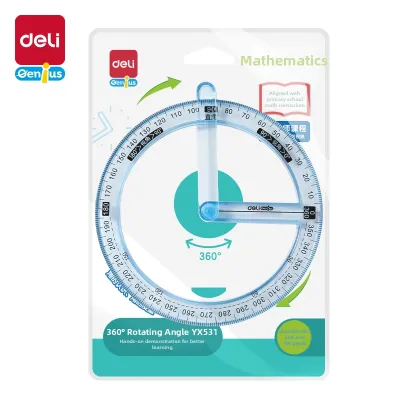
In Lower Secondary (Secondary 1 and 2), students are introduced to bearings and reflex angles (angles greater than 180 degrees). To draw and measure these effectively, upgrading to a 360-degree full-circle protractor is highly beneficial. While a 180-degree protractor can still be used by adding or subtracting angles, a 360-degree protractor simplifies the process and reduces calculation errors. Additionally, students should upgrade to a 30cm transparent ruler, as the geometric diagrams and graphs drawn in secondary school are much larger and often exceed the limits of a standard 15cm ruler.
By the time students reach Upper Secondary (Secondary 3 to 5), the margin for error in geometric constructions shrinks to less than a millimeter. For these high-stakes levels, a standard plastic compass is highly inadequate. Parents should invest in a high-quality metal compass equipped with a central micro-adjuster (a thumbwheel or gear mechanism between the legs). This micro-adjuster locks the legs of the compass firmly in place, preventing them from slipping or spreading outward when drawing large or complex arcs.
Another valuable addition to the secondary school geometry toolkit is the divider. Unlike a compass, which has one needle point and one pencil lead, a divider features two sharp needle points. It is used to transfer exact measurements from a ruler to a drawing, or to step off equal distances along a line. This tool is essential for advanced geometric proofs and technical drawing tasks where absolute symmetry and precision are graded.
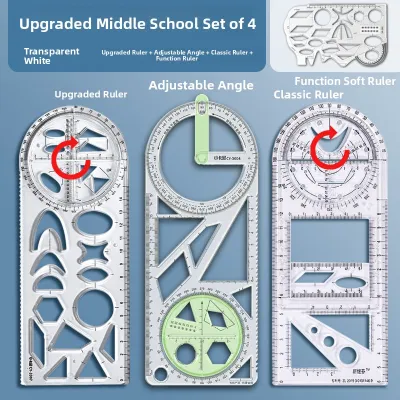
Finally, parents must be highly vigilant about exam compliance when selecting geometry tools for national examinations. The Singapore Examinations and Assessment Board (SEAB) enforces strict rules regarding materials brought into the exam hall. Geometry sets, rulers, and stencils must not contain printed mathematical formulas, trigonometric tables, or unauthorized conversion charts. Using a tool with forbidden markings can lead to immediate disqualification, so it is safest to stick to plain, transparent, unadorned acrylic tools and standard metal compasses.
Cross-Grade Compatibility: Can One Set Last Through Secondary School?
A common question among parents is whether it is possible to buy a single, premium geometry set in Primary 4 that will last all the way through Secondary 5. While this approach seems cost-effective, the physical limits of materials and the changing developmental needs of students make a single-set strategy highly impractical.
Cheap, pre-packaged plastic geometry sets are excellent for primary school because they are lightweight, affordable, and safe. However, plastic compasses rely on simple friction joints at the hinge. Over months of use, these joints inevitably loosen, and the plastic threads can strip. Once a compass hinge becomes loose, the legs will wobble or spread under the slightest pressure, making it impossible to draw a perfect circle. This subtle slippage can cause a secondary student to lose critical marks in exams where construction lines must align perfectly.
The most practical approach is to plan for a progressive upgrade. Start with a budget-friendly, safety-focused plastic set for Upper Primary (Primary 4 to 6). This ensures your child has the necessary tools to learn the basics without risking injury from sharp points. Once they transition to Secondary 1, upgrade them to a professional-grade metal or reinforced composite set. This timing aligns perfectly with the introduction of more complex syllabus requirements and ensures the high-precision tools are fresh and in peak condition for their secondary school years.
When upgrading, parents can choose between pre-packaged sets and building a modular, customized kit. While pre-packaged tin sets are convenient, they often contain low-quality accessory tools like cheap erasers or fragile plastic rulers. Building a modular kit—buying a high-quality metal compass individually, pairing it with a premium 30cm acrylic ruler, and housing them in a durable pencil case—often results in a much more reliable and long-lasting setup. This customized approach allows you to replace individual worn-out components without having to purchase an entirely new set.
Practical Buying Tips for Parents in Singapore
Before heading out to purchase a geometry set, your absolute first step should always be to review the specific school stationery list provided by your child’s school. While the national curriculum is standardized, individual schools in Singapore often have highly specific preferences. Some schools may mandate a particular brand, require clear rather than tinted acrylic tools, or specify the inclusion of specialized math stencils. Checking this list beforehand prevents you from buying redundant or non-compliant items.
When you are ready to buy, Singapore offers excellent retail options. Major local bookstores, such as Popular Bookstore, carry a wide range of school-approved geometry sets and individual drafting tools. Dedicated stationery shops and reputable e-commerce platforms also offer extensive selections. If you plan your purchase during the year-end back-to-school season (typically between November and January), you can often take advantage of bundled discounts, promotions, and school-pack deals that offer excellent value for money.
Proper maintenance is key to ensuring these tools remain accurate and safe. Teach your child to keep their geometry set stored in a hard protective case—ideally a metal tin or a rigid plastic box—rather than letting the tools float loosely in a soft pencil case. This prevents the edges of rulers and protractors from getting chipped or scratched, which can obscure the measurement markings. It also protects the sharp needle of the compass from dulling or puncturing other items in their school bag. Finally, always pack spare compass leads and standard wooden pencils, as these consumables wear down rapidly during heavy exam preparation periods.
Frequently Asked Questions (FAQ)
Do students need a 360-degree protractor for the PSLE?
No, a 360-degree protractor is not required for the Primary School Leaving Examination (PSLE). The Primary Mathematics syllabus in Singapore focuses on angles up to 180 degrees and basic geometric properties of triangles and quadrilaterals. A standard 180-degree semi-circular protractor is perfectly sufficient and is the standard tool used by students during the exam. The 360-degree protractor is typically introduced and utilized in secondary school for more advanced topics like bearings.
Are mechanical pencils allowed in national exams for drawing geometric constructions?
While mechanical pencils are generally allowed for writing and general drawing in national examinations, exam guidelines and teachers strongly recommend using standard wooden pencils (such as 2B or HB) for geometric constructions. Standard wooden pencils produce darker, thicker lines that are more easily captured by electronic exam scanners. Additionally, the thin lead of a mechanical pencil is highly prone to snapping under the rotational pressure of a compass, which can ruin a drawing and waste valuable time during an exam. Always check the latest official Singapore Examinations and Assessment Board (SEAB) candidate instructions to ensure compliance.
Community discussion
Share your experience or ask a question. Comments are reviewed before publication.