
Choosing the right carton box size is a balance between protecting your items, minimizing shipping costs, and ensuring safe handling. To match your items to the correct box, you must measure the total volume of your goods, account for protective cushioning, and verify that the box’s structural strength can support the weight. Using a box that is too large leads to shifting and damage, while an overloaded box risks bursting during transit.
Understanding Standard Carton Box Dimensions
When browsing packaging supplies, manufacturers list box dimensions using a standard sequence: Length (L) x Width (W) x Height (H). Length is always the longest side of the opening, width is the shorter side of the opening, and height is the depth of the box from the opening to the bottom. Misinterpreting this sequence can lead to ordering boxes that do not fit your items or fail to stack correctly on transport pallets.
A critical distinction to make before purchasing is the difference between internal and external dimensions. Internal dimensions represent the actual usable space inside the box, which is what you must compare against your item measurements. External dimensions include the thickness of the corrugated cardboard walls and the outer flaps, which dictate the shipping footprint and how much space the box occupies in a delivery vehicle or storage unit.
Products mentioned in this guide
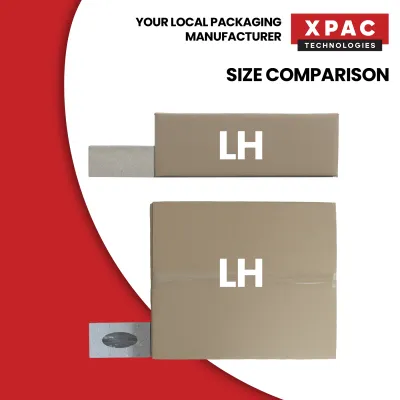
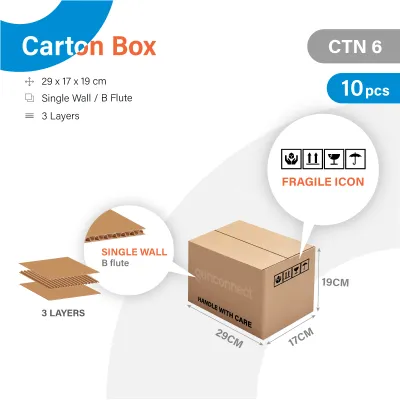
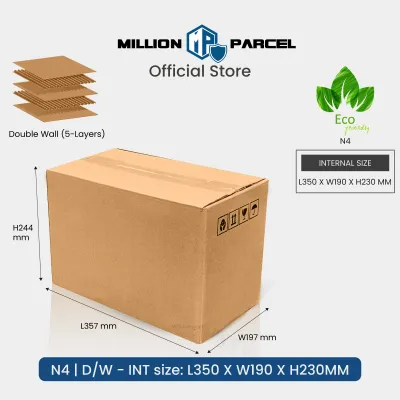
Prices are valid at publication and may change. Please refer to the product page for the latest price.
Standard boxes are generally grouped into broad categories, though exact measurements vary by manufacturer. Small boxes typically range up to 30 cm on their longest side, medium boxes generally span between 30 cm and 45 cm, large boxes cover 45 cm to 60 cm, and extra-large boxes exceed 60 cm. Because there is no universal industry mandate for these categories, you should always verify the precise millimeter or centimeter measurements on the product listing rather than relying solely on descriptive labels.
How to Measure Your Items for the Right Box
To find the correct box size, start by gathering the items you plan to pack. If you are packing a single item, use a tape measure to find its maximum length, width, and height at the widest points, including any protruding parts or handles. For multiple items, group them together in the configuration you plan to pack them, then measure the overall footprint of the entire bundle.

Never choose a box that matches your item’s exact dimensions, as you must leave adequate buffer space for protective void fill. For fragile items, plan for a clearance of at least 5 cm on all sides to accommodate bubble wrap, packing paper, or foam inserts. For sturdy, non-fragile items, a smaller buffer of 1 cm to 2 cm is usually sufficient to allow the item to slide in easily without scraping the cardboard walls.
When faced with a large volume of items, you must decide whether to use one large box or several smaller ones. A single large box might seem convenient, but it often becomes too heavy to lift safely and requires more void fill to prevent items from shifting. Splitting the load into multiple smaller boxes distributes the weight more evenly, reduces the risk of structural failure, and makes handling much more manageable.
Matching Box Sizes to Common Item Categories
Matching the physical characteristics of your items to the correct box category prevents damage and optimizes shipping efficiency. Small boxes are the ideal choice for heavy, dense items such as books, hand tools, hardware, and canned goods. Packing these items in small containers keeps the overall weight manageable and prevents the bottom of the box from bowing or tearing open under extreme pressure.
Medium boxes offer the most versatility and are best suited for mixed-weight household or office items. Use them for packing shoes, small kitchen appliances, toys, and folded clothing. Because these items have moderate density, they fill the volume of a medium box without exceeding safe lifting weights, allowing you to pack efficiently without wasting space.
Large and extra-large boxes should be reserved almost exclusively for bulky, lightweight items. Excellent candidates for these sizes include pillows, blankets, winter coats, stuffed toys, and large plastic storage containers. If you pack heavy items in these large volumes, the box is highly likely to suffer structural failure when lifted, and you risk personal injury from attempting to carry an awkward, overweight load.
Checking Box Strength and Weight Limits
Before sealing your packed items, you must verify that the box can handle the physical stress of transit. Most manufactured shipping boxes feature a round stamp printed on the bottom flap known as the Box Maker’s Certificate (BMC). This certificate lists critical structural specifications, including the Edge Crush Test (ECT) rating or the burst strength, which indicate how much stacking pressure and internal weight the box can withstand.
The construction of the corrugated cardboard determines its overall durability and weight capacity. Single-wall boxes consist of one layer of fluted paper sandwiched between two flat linerboards, making them suitable for lightweight everyday shipping. Double-wall boxes feature two layers of fluting and three linerboards, providing significantly higher puncture resistance and stacking strength for heavier or fragile items, while triple-wall boxes are reserved for heavy industrial applications.
Always inspect the physical condition of a box before deciding to reuse it for shipping or storage. Look for signs of material fatigue, such as soft corners, deep creases along the edges, or punctures in the cardboard walls. Moisture exposure severely degrades the structural integrity of corrugated paper, so any box showing water stains, dampness, or warping should be discarded or used only for very light, non-critical items.
Frequently Asked Questions (FAQ)
Can I use the same box size for shipping and moving?
While you can use similar sizes, shipping and moving have different structural demands. Parcel shipping involves automated sorting belts, drops, and heavy stacking, which require sturdy, precisely fitted double-wall boxes to prevent crushing. Local moving typically involves manual loading into a truck where boxes are stacked carefully, allowing you to use lighter, single-wall boxes as long as they are packed tightly to prevent collapse.
How do I know if a box is too heavy to lift safely?
As a general guideline, a packed box should not exceed 20 kg for a single person to lift comfortably. You can test the weight by gently lifting one corner of the box with your foot or hand; if it requires significant strain, the weight is too high. Always distribute heavy items evenly at the bottom of the box, and use a hand truck or seek assistance for any load that feels unstable or awkward.
Should I buy standard boxes or custom-sized ones?
Standard boxes are highly cost-effective and readily available, making them the best choice for most everyday items when paired with appropriate void fill. Custom-sized boxes are worth the investment if you regularly ship high-value, fragile, or oddly shaped items. Custom boxes minimize the need for expensive void fill, reduce dimensional weight shipping fees, and provide a more secure, tailored fit that prevents movement during transit.
Community discussion
Share your experience or ask a question. Comments are reviewed before publication.