
Shipping items locally within Singapore requires a balance of cost, convenience, and security. Choosing the right size of a prepaid smart pack singpost envelope or box is critical to ensuring your package arrives safely at its destination without delays or unexpected surcharges. The correct choice depends entirely on three physical dimensions—length, width, and thickness—along with the total weight of your item once it is fully wrapped for transit.
Selecting the wrong size can lead to several common shipping headaches. An oversized pack means you are paying more than necessary for shipping space you do not use, while an undersized pack risks bursting at the seams or being rejected by automated postal sorting machines. By understanding how the postal system measures these packages and matches them to residential letterboxes, you can streamline your shipping process.
To make an accurate decision, you must consider the final state of your package, including all protective inner layers. A book, a piece of clothing, or a delicate stationery set will all require different levels of cushioning, which directly alters their final dimensions. This guide breaks down the selection process so you can confidently prepare your mailings.
Products mentioned in this guide
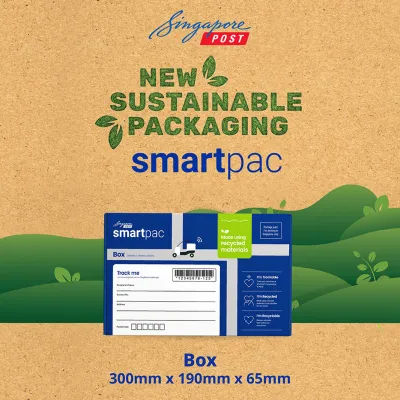
![[1/2/3/4 pcs] SingPost Smartpac Medium size - for using within Singapore only - Prepaid Packaging with Tracking](https://img.lazcdn.com/g/p/8f2c3c3994c2d6fb1e87feebed85f10b.jpg_400x400q80.jpg_.webp)
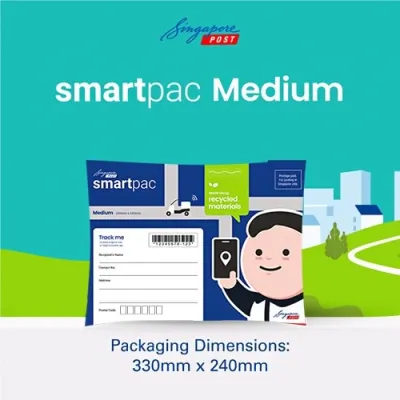
![[SINGPOST] MEDIUM smartpac - A postage-paid packaging for local delivery. Trackable via the SingPost mobile app.](https://img.lazcdn.com/g/p/3360d819ebee92c4900de5d10f98c2e8.png_400x400q80.png_.webp)
Prices are valid at publication and may change. Please refer to the product page for the latest price.
Understanding SingPost Smart Pack Size Options
Prepaid packaging solutions simplify the mailing process by combining the cost of the packaging material and the postage fee into a single upfront purchase. These packs are designed to fit directly into standard residential letterboxes across Singapore, making delivery seamless because the recipient does not need to be home to sign for the package. They are categorized into distinct size tiers, typically designated by letters or descriptive names that correspond to standard paper sizes and thickness thresholds.
Because postal guidelines, material specifications, and exact dimensions can be updated periodically, it is essential to verify the current physical limits on the official SingPost website or at a local post office counter before purchasing in bulk. The available options generally range from small, thin envelopes designed for flat documents to larger, expandable mailers meant for bulkier items.
A fundamental rule of using these prepaid mailers is that the final package must seal completely flat. The adhesive strip on the flap must close securely along the designated sealing line without stretching the material, warping the shape of the envelope, or causing the sides to bulge. If the pack cannot seal naturally in a flat profile, it indicates that the contents are too large, and a larger size category or a different shipping method is required.
How to Accurately Measure Your Item and Packaging
Determining the correct size begins with precise physical measurements of the item you intend to send. Do not rely on the dimensions printed on the item’s retail box or the manufacturer’s spec sheet, as these do not account for the protective materials needed to keep the item safe during transit. Use a firm ruler or a standard measuring tape to find the absolute maximum length, width, and height of the item.

Always measure your item after it has been fully prepared with its protective inner packaging. For example, if you are shipping a delicate ceramic coaster or a fountain pen, you will likely wrap it in several layers of bubble wrap, place it inside a protective cardboard sleeve, or seal it in a water-resistant poly mailer first. This protective layer adds significant volume, often doubling the effective thickness of the item and expanding its footprint.
Pay close attention to the maximum thickness, as this is the most common point of failure for prepaid mailers. Lay the fully wrapped inner package flat on a hard table and measure from the tabletop to the highest point of the package. Avoid pressing down on the item while measuring; the postal service’s automated sorting equipment will measure the package in its natural, uncompressed state.
When comparing your measurements to the official size limits of the mailer, always leave a comfortable margin of error of at least one to two centimeters on all sides. This extra space ensures that the item can slide smoothly into the opening without scraping against the interior or putting undue stress on the heat-sealed seams of the outer pack. Forcing an item into a tight fit often leads to torn edges during transport, exposing your contents to dust, moisture, or loss.
Matching Common Items to the Right Smart Pack Size
Visualizing how everyday items translate into specific packaging sizes can help you narrow down your options quickly. Different categories of items have distinct structural profiles—some are completely flat and rigid, while others are soft and highly compressible. Understanding these profiles allows you to choose the most efficient mailer size.
- Flat Documents and Paper Goods: Items such as legal contracts, certificates, photographs, thin greeting cards, and single sheets of stickers are highly suited for the smallest and thinnest prepaid options. Because these items have negligible thickness, they do not expand the sides of the envelope, allowing you to utilize almost the entire length and width of the smallest size tier. Ensure that any rigid backing board used to prevent bending also fits within these dimensions.
- Small Stationery and Cosmetics: Compact items like pens, markers, small pocket journals, lip balms, or lightweight jewelry accessories require a medium-sized mailer. These items possess a distinct three-dimensional shape that will push out the sides of the envelope. Choosing a medium size provides the necessary lateral slack to accommodate this thickness while still leaving room for a layer of bubble wrap to protect the items from impact.
- Apparel and Bulky Stationery Sets: Folded clothing items, such as t-shirts, light sweaters, or fabrics, along with bulkier stationery items like thick A5 planners, spiral notebooks, or multi-pack marker sets, require the largest available prepaid sizes. While clothing is compressible, it still occupies a significant volume that demands an expandable mailer. For multiple small items bundled together, grouping them inside a single inner bag before placing them in the large mailer prevents them from shifting and causing uneven bulging.
Critical Weight and Thickness Restrictions for a Smart Pack SingPost
While physical length and width are easy to see, the weight and thickness of your package are subject to strict, non-negotiable limits that are heavily enforced by postal systems. Every smart pack singpost product has a designated maximum weight limit printed directly on the packaging or listed in the official guidelines. Exceeding this weight limit, even by a few grams, violates the terms of the prepaid service.
The thickness restriction is primarily driven by the physical dimensions of automated sorting machinery and standard residential letterboxes in Singapore. If a package is too thick or too rigid to pass through the sorting slots, it cannot be processed automatically. This requirement is in place to ensure that mail carriers can easily slide the package into the recipient’s secure letterbox without leaving it exposed on top of the letterbox unit or requiring a failed delivery attempt.
If you attempt to mail a package that exceeds the weight or thickness thresholds, several complications can arise. The package may be rejected at the posting box, held at the sorting facility, or returned directly to the sender. In other cases, the package may be delivered, but the recipient will be required to pay additional postage fees, surcharges, or handling fees at a post office counter before they can collect their item, which creates a poor experience for customers or gift recipients.
For items that are exceptionally heavy, highly rigid, or naturally exceed the thickness limits—such as thick hardcover textbooks, heavy electronic devices, or framed artwork—prepaid mailers are not the appropriate solution. In these scenarios, you should opt for a standard parcel service or use a sturdy cardboard box with standard parcel postage. This ensures your item is handled through the correct logistical channel designed for bulkier cargo.
Frequently Asked Questions (FAQ)
Can I use a SingPost Smart Pack for international shipping?
No, standard prepaid Smart Packs are specifically designed and priced solely for local delivery within Singapore. The postage prepaid on these envelopes covers only the domestic postal network and does not account for international airfreight, overseas delivery networks, or cross-border processing. If you need to send items internationally, you must use designated international shipping services, complete the required customs declaration forms, and pay the appropriate international postage rates based on the destination country and package weight.
What happens if my item is slightly thicker than the Smart Pack limit?
If your sealed package bulges significantly or exceeds the maximum thickness threshold, it is highly likely to cause issues during transit. The rigid, overstuffed package can jam automated sorting conveyor belts, potentially damaging your item and other mail. When this occurs, the postal service may reclassify your shipment as a standard parcel, apply unexpected surcharges, or return the item to your return address. To avoid these delays and penalties, always upgrade to a larger mailer size or transition to a standard parcel service if you are unsure about the thickness.
Community discussion
Share your experience or ask a question. Comments are reviewed before publication.