
To ship items successfully through Singapore’s postal network, you must align your packaging with strict dimensional and weight limits. SingPost categorizes small items under different service tiers, such as Basic Mail, Tracked Mail, and Tracked Parcels. Navigating the “singpost small” parcel requirements is essential to ensure your package fits standard delivery routes, reaches its destination safely, and avoids unexpected postage surcharges.
Decoding SingPost's Size Categories for Small Items
SingPost divides its domestic postal services into distinct categories based on physical dimensions and weight. For anyone sending compact items, understanding the difference between standard letters, basic packages, and tracked parcels is critical. The term “singpost small” does not refer to a single, static product category. Instead, it represents a threshold where minor differences in millimeter thickness can shift your item from a low-cost letter rate to a significantly higher parcel rate.
To navigate this system successfully, you must look closely at the specific tiers. Standard Regular and Standard Large letters are highly economical but restricted to very thin profiles—typically up to 6mm and 14mm in thickness, respectively. Once your item exceeds these limits, it falls into the packet or parcel categories, which offer more generous thickness allowances (such as 50mm for Tracked Mail) but require different packaging strategies. Because SingPost periodically updates its service definitions, pricing structures, and dimensional limits to optimize automated sorting, you should always verify the exact, current maximum dimensions on the official SingPost website before preparing your shipment.
Products mentioned in this guide
![[SINGPOST] SMALL W/ BUBBLEWRAP smartpac - A postage-paid packaging for local delivery. Trackable via the SingPost mobile app.](https://img.lazcdn.com/g/p/3360d819ebee92c4900de5d10f98c2e8.png_400x400q80.png_.webp)
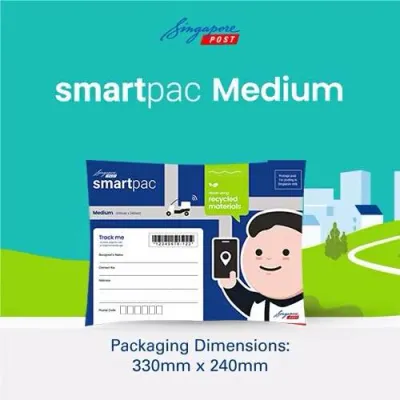
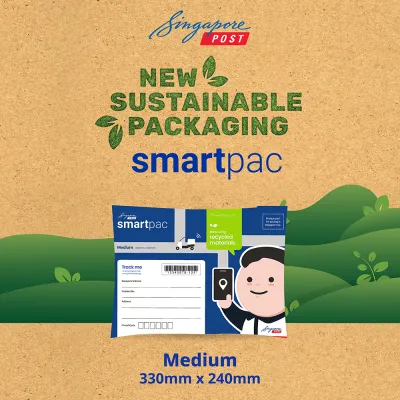
![*FREE SHIPPING* [CHOOSE OPTION] Singapore Post Smartpac Small Smartpac Medium Mini Lite 600g 1kg Singpost Smart pac Sing Post PolyM Poly M](https://img.lazcdn.com/g/p/ca35df7d5aaeef118422794879cc317a.jpg_400x400q80.jpg_.webp)
Prices are valid at publication and may change. Please refer to the product page for the latest price.
Failing to distinguish between these categories can lead to unexpected delays. For instance, a lightweight phone case might easily stay under the weight limit for a basic letter, but if packaged in a thick bubble envelope, its overall thickness will push it into the parcel category. Knowing these boundaries beforehand ensures you select the correct postage tier and avoid having your shipment returned or delayed.
How to Measure Your Product and Packaging Allowance
Accurate measurement is the cornerstone of hassle-free shipping. When preparing your item, do not rely on the manufacturer’s product dimensions alone. You must measure the fully packed item using a reliable ruler or measuring tape, capturing the maximum length, width, and height (thickness) at the widest points.

Remember that protective layers add hidden bulk. Wrapping a delicate item in tissue paper, adding cardboard stiffeners to prevent bending, or wrapping it in bubble wrap will quickly expand its physical footprint. A book that measures 1.5 cm in thickness can easily balloon to 2.5 cm once encased in protective layers. Always measure the item after wrapping it in its protective materials but before placing it into the final shipping bag.
When selecting your shipping bag, always build in a practical allowance of 1 to 2 cm for both length and width. This extra space ensures that you can slide the item into the bag easily and fold the sealing flap over securely. Without this allowance, the tension of a tight fit will stretch the shipping bag, causing the edges to round out. This rounding effect increases the overall thickness of the parcel, which could push an otherwise compliant package past SingPost’s strict thickness limits.
Choosing the Right Shipping Bag for SingPost Limits
Selecting the appropriate shipping bag requires balancing protection, weight, and thickness. The ideal packaging protects your contents from the elements and transit friction without adding unnecessary bulk that could trigger a cost reclassification. By matching your bag type to the specific physical characteristics of your item, you can ensure smooth passage through SingPost’s automated sorting systems.
Poly Mailers for Soft and Flexible Items
Poly mailers are lightweight, durable plastic bags made from polyethylene. They are highly efficient for shipping non-fragile, flexible items such as apparel, textiles, or soft stationery accessories. Because poly mailers are incredibly thin, they add virtually zero weight or thickness to your shipment, allowing you to maximize SingPost’s strict letterbox dimensions. While they offer excellent water resistance and tear protection during transit, they provide no cushioning. They rely entirely on the natural flexibility of the contents to absorb impacts and navigate automated sorting belts.
Bubble Mailers for Fragile or Rigid Items
For items that require a layer of defense against drops and pressure, bubble mailers are the standard choice. These envelopes feature a paper or plastic exterior lined with an integrated layer of plastic bubble wrap. This cushioning is ideal for semi-rigid or delicate items like cosmetics, pin badges, or hardcover notebooks. However, you must account for the built-in thickness of the bubble lining itself, which typically adds 3mm to 6mm to the flat dimensions of the empty bag. Factor this extra bulk into your calculations to prevent your parcel from inadvertently exceeding the maximum thickness allowed for your chosen SingPost service.
Understanding Usable vs. Flat Bag Dimensions
A common pitfall when buying shipping bags online is confusing flat dimensions with usable space. Manufacturers list the outer, flat measurements of the bag, which include the side seams and the adhesive sealing flap. To find the true usable space, you must subtract the width of the seams and the length of the flap. Furthermore, when a flat bag wraps around a three-dimensional object, the bag’s usable length and width shrink as the material stretches to accommodate the object’s thickness. As a general rule, subtract the thickness of your item from both the flat length and flat width of the bag to determine if the item will fit comfortably. Avoid using oversized bags, as folding down excess material can create thick, uneven layers that exceed SingPost’s limits.
Preventing Reclassification and Extra Surcharges
One of the most frustrating experiences for online sellers and casual senders alike is having a parcel reclassified at the post office or sorting facility. When a package is flagged for exceeding size or weight limits, it can incur heavy surcharges or be returned to the sender. This most commonly happens due to “bulging”—where an unevenly packed item slides to one side of the bag, creating a localized high point that exceeds the maximum thickness limit.
To prevent bulging, distribute the contents of your shipping bag as flatly and evenly as possible. If you are shipping multiple small items, lay them side-by-side rather than stacking them. Once the items are positioned, fold any excess bag material tightly against the product and secure it with high-quality packing tape. This keeps the package compact and maintains a uniform, flat profile throughout transit.
Additionally, SingPost relies heavily on automated optical sorting machines to process mail efficiently. Irregularly shaped, lumpy, or overly loose packaging can catch on sorting belts or fail to scan correctly. By ensuring your shipping bag is sealed into a neat, firm, rectangular shape, you facilitate smooth automated processing, reduce the risk of physical damage, and ensure your package arrives at its destination without unexpected fees.
Frequently Asked Questions (FAQ)
Can I use a standard A4 envelope for SingPost small parcels?
While a standard A4 paper envelope is suitable for documents and letters, it is not recommended for shipping small parcels or physical products. Paper envelopes lack the tear resistance, burst strength, and water protection needed to withstand automated postal sorting systems. For physical items, it is highly recommended to use dedicated poly mailers or bubble mailers, which are specifically engineered to resist punctures and moisture during transit.
What happens if my shipping bag is slightly too thick for the letterbox slot?
If a parcel is too thick to fit through a standard letterbox slot, SingPost cannot complete a standard letterbox delivery. In such cases, the item may be reclassified as a larger package, requiring a postage top-up. Depending on the service used, the postman may redirect the parcel to a post office or a POPStation for self-collection, or deliver a notification card to the recipient, which can cause significant delivery delays.
Do I need to weigh my shipping bag before going to the post office?
Yes, weighing your fully packed and sealed shipping bag at home is highly recommended. SingPost’s shipping rates are determined by both physical dimensions and weight thresholds. Using a simple digital kitchen scale to verify the weight of your package before purchasing postage ensures you buy the correct label online. This practice saves time at the post office and prevents your parcel from being held due to underpaid postage.
Community discussion
Share your experience or ask a question. Comments are reviewed before publication.