
Selecting the right shipping bag for SingPost deliveries requires understanding how your packed items fit into specific postal categories. Choosing an incorrect size can lead to unexpected postage fees, delivery delays, or returned mail. To ensure compliance, you must match your shipping bag’s final packed dimensions and weight to SingPost’s exact service thresholds, focusing on standard postal tiers like Standard Large, Packet, or Parcel.
Which SingPost Categories Apply to Shipping Bags?
SingPost operates several domestic mail and parcel categories, each with distinct pricing and size limits. For anyone using shipping bags—such as poly mailers or padded envelopes—the primary categories to consider are Standard Large, Packet (including Basic Packet and Tracked Packet), and Parcel (Speedpost).
The Standard Regular category, which is designed for standard letters, is generally irrelevant for shipping bags. This category has a strict thickness limit of just 6 mm, which is easily exceeded by almost any physical item packed inside a shipping bag, even a single piece of folded clothing or a thin accessory.
Products mentioned in this guide
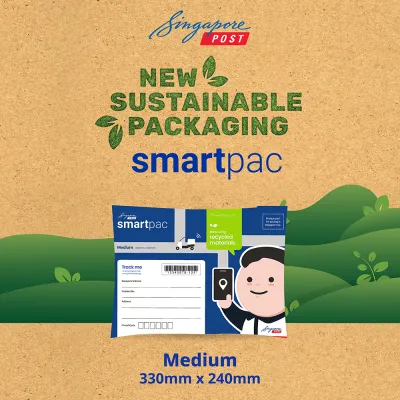
![[1/2/3/4 pcs] SingPost Smartpac Medium size - for using within Singapore only - Prepaid Packaging with Tracking](https://img.lazcdn.com/g/p/8f2c3c3994c2d6fb1e87feebed85f10b.jpg_400x400q80.jpg_.webp)
![[2pcs] SingPost Smartpac Medium size - for using within Singapore only - Prepaid Packaging with Tracking](https://img.lazcdn.com/g/p/3723bb51383d082fe8de03c34ecc0c93.jpg_400x400q80.jpg_.webp)
![[SINGPOST] MEDIUM smartpac - A postage-paid packaging for local delivery. Trackable via the SingPost mobile app.](https://img.lazcdn.com/g/p/3360d819ebee92c4900de5d10f98c2e8.png_400x400q80.png_.webp)
Prices are valid at publication and may change. Please refer to the product page for the latest price.
Consequently, your shipping bags will almost always fall into the Standard Large, Packet, or Parcel tiers. Standard Large is ideal for very flat items like documents, booklets, or ultra-thin textiles. Packets accommodate slightly bulkier items up to a moderate weight limit, while the Parcel category is reserved for larger, heavier, or highly irregular shipments.
Identifying which of these three tiers your shipment belongs to is the crucial first step before purchasing packaging. It prevents you from buying bags that are either too small for your items or too large to qualify for more economical mailing rates.
SingPost Dimensional and Weight Limits Decoded
To select a compliant shipping bag, you must understand the exact dimensional and weight boundaries set by SingPost for each relevant tier. These limits dictate not just the size of the flat bag, but the final, fully packed product.

The Standard Large tier allows for a maximum length of 324 mm, a maximum width of 229 mm, and a maximum thickness of 14 mm. The weight limit for this category is capped at 500 g. This tier is highly economical but exceptionally strict regarding thickness.
The Packet tier (covering both Basic and Tracked Packet services) offers more breathing room. The maximum dimensions are 324 mm in length, 229 mm in width, and 65 mm in thickness. The maximum allowable weight is 2 kg.
The Parcel tier (typically fulfilled via Speedpost) is used when your shipment exceeds the Packet limits. For standard domestic parcels, the maximum weight is 30 kg. The dimensional limit is based on a combined formula where the length plus two times the width plus two times the height must not exceed 300 cm, with the maximum single dimension not exceeding 1.5 metres.
When comparing these tiers, thickness is almost always the deciding factor. A shipping bag that easily fits within the 324 mm by 229 mm footprint of a Standard Large mailer will instantly be bumped to the Packet tier if its thickness exceeds 14 mm, even if it weighs only 100 g. Similarly, any bag thicker than 65 mm must be sent as a Parcel, regardless of how light it is.
Mapping Standard Shipping Bag Sizes to SingPost Tiers
Commercial shipping bags are usually sold in standard sizes, such as A5, A4, A3, or in inch-based dimensions like 6×9 inches or 10×13 inches. Bridging the gap between these retail sizes and SingPost’s official limits requires careful mapping.
- A5 Poly Mailers (approx. 170 mm x 250 mm / 6×9 inches): These compact bags easily fit within both the Standard Large and Packet dimensional footprints (324 mm x 229 mm). They are excellent for small cosmetics, jewelry, or light stationery items, provided the packed thickness remains under 14 mm for Standard Large or 65 mm for Packets.
- A4 Poly Mailers (approx. 250 mm x 340 mm / 10×13 inches): This is a highly popular size for shipping apparel on online marketplaces. However, the flat length of 340 mm exceeds SingPost's 324 mm limit for both Standard Large and Packet tiers. To comply with these tiers, you must fold the excess length of the bag over before sealing it, ensuring the final packed length is 324 mm or less.
- A3 Poly Mailers (approx. 320 mm x 450 mm): These large bags are designed for bulky winter wear or multiple items. Because the flat dimensions significantly exceed the 324 mm x 229 mm limit, these bags will almost always have to be processed under the Parcel (Speedpost) tier unless folded down to a fraction of their size.
When choosing a bag size, you must account for the difference between flat dimensions and usable space. When you place a three-dimensional item inside a flat poly mailer, the bag’s sides pull inward. This action reduces the usable width and length. As a general rule, subtract the thickness of your item from the flat width and length of the bag to estimate if the item will fit.
To ensure compliance, always cross-reference the manufacturer’s stated dimensions with your intended SingPost service. If you are shipping a rigid item, a padded bubble envelope will have even less internal usable space than a standard poly mailer due to the thick bubble lining.
How to Measure and Pack to Ensure Compliance
Ensuring your package complies with SingPost guidelines requires accurate post-packing measurements. Do not rely on the dimensions of the empty shipping bag; the only measurements that matter to postal sorters are those of the final, sealed package.
When measuring the thickness of your packed shipping bag, always measure at the thickest point of the bulge. Sorters use physical slot templates to verify dimensions. If any part of your bag—such as a folded seam, a button on a garment, or a knotted cord—fails to pass through the 14 mm or 65 mm slot, the package will be reclassified to the more expensive tier.
To avoid accidental bulging, pack items as flatly and evenly as possible. For soft goods like clothing, press out excess air before sealing the self-adhesive flap. You can use clear packaging tape to secure loose corners or compress bulky sections, preventing the bag from expanding during transit.
Always use a digital scale to verify the final weight of your packed mailer before sending. Even if your bag is physically small, heavy items like books or metal hardware can easily push the package past the 500 g Standard Large limit or the 2 kg Packet limit.
Failing to comply with these limits can result in several negative outcomes. SingPost may return the item to your return address, delay the delivery significantly, or require the recipient to pay the postage shortfall plus an administrative fee before collection.
Frequently Asked Questions (FAQ)
Do poly mailers count as parcels or packets?
Poly mailers do not automatically fall into a single category based on their material. SingPost classifies them entirely by their final, packed dimensions and weight. A flat poly mailer under 14 mm thick and 500 g is a Standard Large letter, one up to 65 mm thick and 2 kg is a Packet, and anything larger or heavier is a Parcel.
What happens if my shipping bag exceeds the thickness limit?
If your shipping bag exceeds the maximum thickness limit of your target tier, it is automatically bumped to the next tier. For example, a bag thicker than 14 mm becomes a Packet, and one thicker than 65 mm becomes a Parcel. This change requires higher postage rates, so you should always measure the packed thickness carefully before applying stamps or shipping labels.
Community discussion
Share your experience or ask a question. Comments are reviewed before publication.