
Quick Answer: Does Sanrio Have Better Paper Quality?
When comparing Sanrio notepads to other character-branded stationery, there is no single winner. Paper quality in this market is determined by the specific manufacturer, regional licensee, and product tier rather than the character brand itself.
Premium, original Japanese-imported Sanrio stationery generally offers exceptional paper quality. These notebooks feature smooth, well-sized paper that handles gel pens and fine liners beautifully. However, mass-market, locally licensed Sanrio notebooks or budget options from other major franchises (like Disney or Pokémon) frequently use standard commercial-grade paper. These budget options typically utilize 70 to 80 GSM paper that is highly prone to ink feathering, ghosting, and bleed-through.
Ultimately, your writing experience depends on the notebook’s manufacturing origin and your preferred writing instruments. To find the best notebook, you must look past the cover art and evaluate the underlying paper specifications and manufacturing partnerships.
Products mentioned in this guide
![[SG Ready Stock] Cute Sanrio Character Notebook A6 Diary Note Melody Little Twin Stars Cinnamoroll](https://img.lazcdn.com/g/p/72ff594334fe14189b6f1345dffec10d.jpg_400x400q80.jpg_.webp)
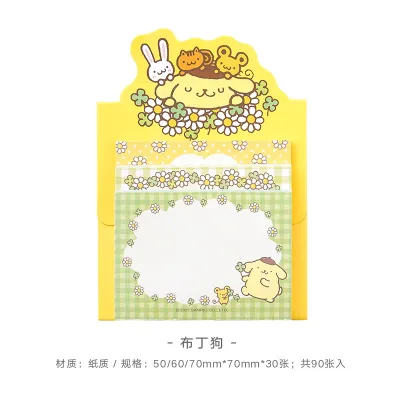
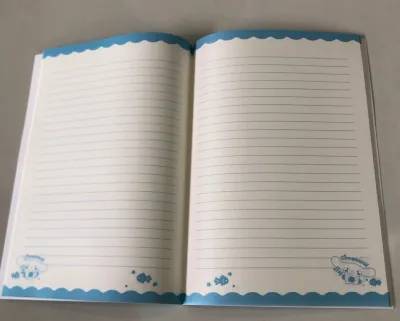
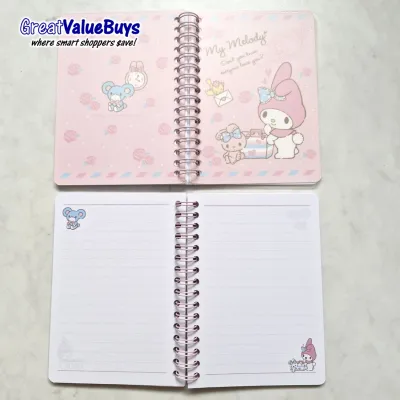
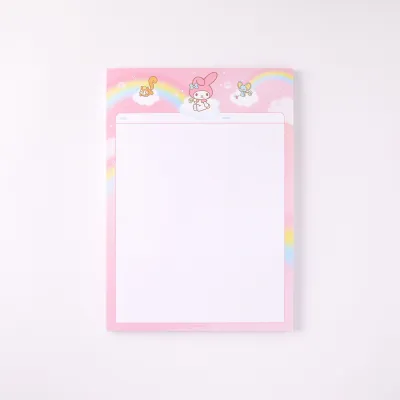
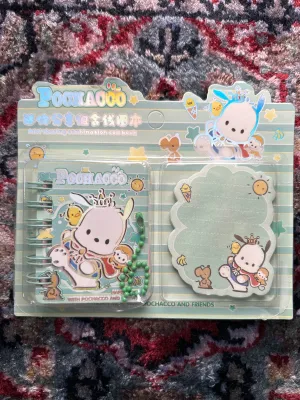
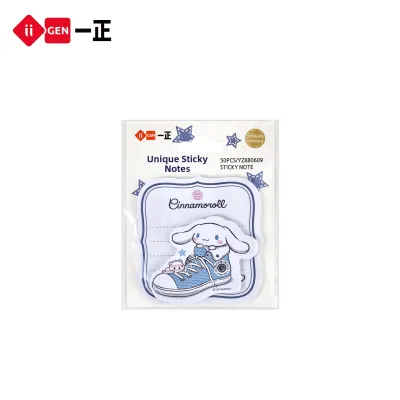
Prices are valid at publication and may change. Please refer to the product page for the latest price.
What Defines Good Paper Quality for Daily Writing?
To compare character notebooks, you must understand the physical properties that dictate how paper interacts with ink. In Singapore’s tropical climate, specific metrics determine whether a notebook is suitable for daily writing.

Grams per Square Meter (GSM) and Opacity
GSM measures the weight and density of the paper. Standard office copy paper ranges from 70 to 80 GSM, which is adequate for pencils and ballpoint pens but struggles with wet inks. For daily writing with gel pens, rollerballs, or fountain pens, a paper weight of 80 to 120 GSM is preferred. Higher GSM paper is thicker and denser, which improves opacity and prevents “ghosting” (the shadow of writing visible on the reverse side of a page), allowing you to write comfortably on both sides.
Sizing, Coating, and Surface Texture
Sizing and calendering govern smoothness and absorbency. Sizing refers to chemical additives applied to paper fibers to control liquid absorption. Highly sized paper repels liquid slightly, keeping ink on the surface to prevent feathering (ink spreading) and bleeding (ink soaking through). However, this increases drying times. Uncoated or low-sized paper absorbs ink rapidly, drying quickly but causing fuzzy lines and bleed-through. Calendering runs paper through heavy rollers to create a smooth, polished surface, reducing wear on delicate pen tips but occasionally increasing smudge risks.
The Impact of Singapore's Humid Climate
Singapore’s high relative humidity can significantly alter paper performance. Cellulose fibers in paper are hydrophilic and absorb moisture from the air. This humidity causes fibers to swell and weakens the internal sizing, making older or poorly stored notebooks much more absorbent. Consequently, a notebook that performed flawlessly in a dry climate may exhibit feathering and bleed-through in Singapore’s ambient environment. Storing notebooks in dry, well-ventilated spaces is highly recommended.
Evaluating Sanrio Notepads: Paper Traits and Performance
Sanrio licenses its characters globally, meaning the paper quality of a “sanrio notepad” varies dramatically depending on where and by whom it was produced.
Original Japanese Imports vs. Regional Licenses
When shopping in Singapore, you will encounter two main categories of Sanrio stationery:
- Original Japanese Imports: Designed for the Japanese domestic market and marked with a reflective holographic Sanrio license sticker, these notebooks use premium paper from Japanese mills. Known for precise sizing and a silky-smooth texture, these pages handle fine gel pens (like the Zebra Sarasa or Uni-ball Signo) beautifully, allowing the pen tip to glide effortlessly without catching.
- Regional and Mass-Market Licenses: Produced by third-party manufacturers for local distribution, these budget-tier notebooks use standard 70 to 75 GSM paper. While fine for casual ballpoint pen use, they suffer from ghosting and bleed-through when paired with wet gel pens or liquid highlighters.
The "Slickness" and Smudge Challenge
Premium Sanrio notepads often feature highly calendered, smooth paper. While this prevents feathering, it extends drying times. When writing with highly saturated gel pens, the ink sits on top of the page. In Singapore’s humid climate, where evaporation is slower, this can lead to smudging. Left-handed writers or fast note-takers should pair these smooth notebooks with fast-drying gel inks like the Pentel EnerGel or Zebra Sarasa Dry.
Premium Collaborations: The Gold Standard
For the best writing experience, look for official collaborations between Sanrio and Japanese stationery giants, such as the Sanrio-themed Kokuyo Campus series. Kokuyo uses proprietary “Sarasara” (smooth) and “Shikkari” (firm) paper stocks engineered to withstand heavy student use without bleeding or ghosting. These collaborations combine adorable character art with professional-grade, fountain pen-friendly paper.
How Other Character Notebooks Compare
To determine if Sanrio offers superior paper quality, we must compare it to other prominent character-branded stationery lines available in Singapore.
San-X: The Closest Competitor
San-X, the creator of Rilakkuma and Sumikko Gurashi, is Sanrio’s most direct competitor. Original Japanese-imported San-X stationery shares the same high production standards as premium Sanrio imports. The paper is exceptionally smooth, features robust sizing to prevent bleeding, and incorporates subtle illustrations that do not interfere with writing. If choosing between imported Sanrio and San-X notebooks, the paper quality is virtually identical.
Disney and Pokémon: The Mass-Market Giants
In contrast to the consistent quality of Japanese imports, global franchises like Disney and Pokémon license their characters on a massive, decentralized scale. While you can find premium, boutique-style Disney journals with heavy 100 GSM paper, most Disney and Pokémon notebooks in mainstream retail stores are mass-market school supplies. These prioritize low production costs, utilizing standard 70 GSM wood-pulp paper that is highly acidic and prone to yellowing in Singapore’s heat. This paper exhibits high absorbency, causing wet gel inks to feather and bleed heavily.
Niche and Journaling-Focused Licenses
Some character notebooks are produced by specialized journaling brands under license. These premium options feature thick 100 to 120 GSM paper, dot grid layouts, and lay-flat binding. Engineered for creative journaling, they handle heavy ink, markers, and light watercolor washes without buckling. However, they are less common, carry a significant price premium, and are typically sold in boutique stationery shops.
Key Comparison Dimensions and Verification Steps
Because paper quality in character notebooks is highly dependent on the manufacturer, you should not rely solely on the brand name. Use this practical verification framework to evaluate any notebook before purchasing.
Packaging and Label Check
Before buying, examine the physical cover or online product specifications for these quality indicators:
- Country of Origin: Notebooks marked "Made in Japan" or "Made in Korea" generally utilize higher-grade paper with superior sizing compared to budget-tier options.
- Explicit GSM Rating: High-quality notebooks display their paper weight (e.g., 80 GSM, 90 GSM, or 100 GSM). If the packaging completely omits this, assume it is standard, low-cost 70 GSM paper.
- Stationery Brand Collaborations: Look for logos of established stationery manufacturers (such as Kokuyo or Midori) alongside the character branding.
The Swatch Test
Once you purchase a notebook, dedicate the last page to a comprehensive ink swatch test:
- Step 1: Gather your daily writing tools, including your primary gel pen, a rollerball, a ballpoint pen, a highlighter, and a fountain pen.
- Step 2: Draw horizontal lines with each pen to test smoothness and drying time.
- Step 3: Draw a small, solid square with your wettest pen and color it in heavily to simulate ink pooling.
- Step 4: Highlight over a section of written text to check if the ink smudges or bleeds.
Observation Metrics
Inspect the swatch page carefully using three key observation metrics:
- Feathering Check: Look closely at the edges of your written lines. Do they remain sharp and crisp, or does the ink spread outward into the paper fibers like tiny spider webs? Sharp lines indicate high-quality sizing.
- Bleed-Through Check: Flip the page over. Did any ink physically soak through the paper to create spots on the reverse side? If so, the paper is incompatible with that pen.
- Show-Through (Ghosting) Check: Observe the shadow of the writing on the reverse side. If the writing is highly visible, the paper has low opacity, meaning you should only write on one side of each sheet.
Drying Time Test
Write a quick line with your favorite gel pen and count the seconds before lightly running your finger across the ink. If it smudges after 5 seconds, the paper has a highly polished coating that repels moisture, meaning you will need a faster-drying pen.
Review Verification
When shopping online, ignore generic marketing buzzwords like “premium paper.” Instead, scroll down to user reviews on e-commerce platforms and look for uploaded photos. Stationery enthusiasts often post close-up pictures of the reverse side of pages to show how the paper handles different inks.
Decision Framework: Which Character Notebook Should You Buy?
Use this structured decision framework based on your writing habits, budget, and pen preferences to make your final choice.
Choose Sanrio (Premium Imports or Collaborations) if:
- You primarily write with fine-to-medium gel pens (such as 0.38mm or 0.5mm tips) or standard ballpoint pens.
- You appreciate a smooth, low-friction writing surface that allows your pen to glide effortlessly.
- You are willing to pay a premium (typically S$6 to S$15) for authentic Japanese imports or official collaborations like Sanrio x Kokuyo Campus.
- You love characters like Cinnamoroll or My Melody, and having these characters on your desk motivates you to write.
Choose Other Character Notebooks if:
- You find a specialized journaling-focused licensed notebook (such as premium San-X or boutique Disney journals) that explicitly advertises thick, 100+ GSM paper.
- You are on a strict budget and only need basic paper for quick, casual note-taking, grocery lists, or pencil sketches, where the cover artwork is the primary source of joy.
- You are buying stationery for young children who primarily use pencils, colored pencils, or crayons, which perform perfectly well on budget-friendly paper.
Verify and Exercise Caution if:
- You are purchasing from online marketplaces where product listings are vague and do not specify the paper weight, page count, or country of manufacture.
- You write with wet, high-flow fountain pens, broad rollerballs, or heavy liquid highlighters. In these scenarios, untested character paper is highly likely to feather and bleed, potentially ruining your notes. Always perform a swatch test on the back page before committing to a new notebook.
Frequently Asked Questions (FAQ)
Do character notebooks usually cause gel ink to smudge?
Smudging is primarily caused by the paper’s surface coating (sizing) and local humidity, rather than the character brand itself. Highly polished, smooth papers—which are common in premium Japanese character notebooks—repel liquid initially, causing wet gel ink to sit on top of the page longer before drying. In Singapore’s humid climate, this can result in smudging. To prevent this, pair smooth notebooks with fast-drying gel pens, or choose notebooks with slightly textured, uncoated paper.
Is it worth paying more for imported character stationery?
Yes, if you value a high-quality writing experience. Imported character stationery, particularly from Japan, generally utilizes superior paper stock with consistent GSM, excellent sizing, and durable binding. This makes them highly resistant to feathering and bleeding. However, if you primarily use standard ballpoint pens or pencils, you will not notice a significant difference in paper performance, making budget-friendly local licenses a more economical choice.
Community discussion
Share your experience or ask a question. Comments are reviewed before publication.