
Selecting the ideal paper weight from the PaperOne lineup requires balancing cost, document purpose, and printer capabilities. There is no single “best” option, as each weight is engineered for distinct operational scenarios. For high-volume, single-sided internal drafts where minimizing operational costs is the primary objective, PaperOne 70gsm is the most economical choice. If you require a versatile, do-it-all paper for everyday home and office use that handles mixed text and light graphics reliably, PaperOne 75gsm serves as the optimal standard. For professional, client-facing documents, double-sided printing, or high-ink saturation tasks, PaperOne 80gsm offers the premium stiffness and opacity needed to prevent show-through and ensure a high-quality tactile feel.
Your decision should depend on your typical print volume, the complexity of your documents, and your specific hardware configurations. Choosing the wrong weight can lead to unnecessary expenses, poor aesthetic presentation, or mechanical issues like paper jams. By analyzing your daily printing workflows against the unique physical characteristics of these three grammages, you can optimize both print quality and your stationery budget.
Understanding Paper Weights: What 70, 75, and 80 GSM Actually Mean
To make an informed choice, it is essential to understand what these numbers represent. GSM stands for “grams per square meter,” which is the standard metric used globally to measure paper density and weight. It is calculated by weighing a single sheet of paper measuring exactly one square meter. Consequently, a higher GSM indicates a denser, heavier sheet of paper, which directly influences several key physical properties: thickness (caliper), opacity, stiffness, and mechanical runnability.
Products mentioned in this guide
![PaperOne™ Copier Paper 70gsm / 75gsm Copy Paper A4 [1 Box]](https://img.lazcdn.com/g/p/62f961291078a3b12171dd45eea2a9a4.jpg_400x400q80.jpg_.webp)
![PaperOne™ All Purpose Premium Quality 80gsm Copy Paper A4 [2 Reams]](https://img.lazcdn.com/g/p/6fe22f63efd1aeac13600887dc29a7da.jpg_400x400q80.jpg_.webp)
![PaperOne™ Digital Premium Quality 85gsm / 80gsm Carbon Neutral Copy Paper A4 [2 Reams]](https://img.lazcdn.com/g/p/d24c5b7df995d3fae4379d50295afa2d.jpg_400x400q80.jpg_.webp)
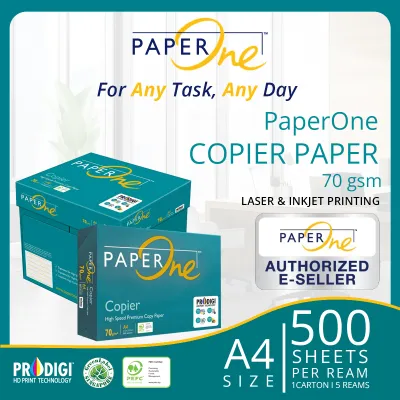
Prices are valid at publication and may change. Please refer to the product page for the latest price.
As GSM increases, the physical thickness of the paper sheet typically rises. This added thickness provides greater opacity, which is the paper’s ability to block light from passing through. High opacity is critical for double-sided printing, as it prevents text or images printed on one side from showing through to the other. Additionally, higher GSM paper possesses greater bending resistance or stiffness. This rigidity helps the paper remain flat as it travels through the high-speed rollers, belts, and fuser units of modern printers.
While PaperOne utilizes advanced manufacturing technologies—such as ProDigi HD Print Technology—to enhance surface smoothness, accelerate ink drying times, and reduce ink consumption, these surface treatments do not alter the fundamental physics of paper weight. A sheet of PaperOne 70gsm and a sheet of PaperOne 80gsm both benefit from these surface enhancements, but the 80gsm sheet will always remain physically thicker, more opaque, and stiffer due to its greater fiber density.
PaperOne 70gsm: Best for High-Volume and Internal Drafts
PaperOne 70gsm is the lightest and most economical option in the brand’s standard copy paper lineup. It is specifically engineered to cater to high-volume printing environments where cost efficiency is the overriding priority.

Ideal Use Cases
This weight is highly suited for internal office memos, high-volume black-and-white text drafts, temporary reference sheets, archiving, and daily scratchpad printing. Educational institutions, legal firms archiving discovery documents, and logistics offices printing shipping manifests often rely on 70gsm paper to manage overhead costs.
Advantages
The primary benefit of PaperOne 70gsm is its exceptional cost-effectiveness. Purchasing paper in bulk at this weight yields significant savings over time, making it highly attractive for organizations that print thousands of pages weekly. Furthermore, because the sheets are thinner, a standard carton of 70gsm paper is lighter and easier to transport, handle, and store. From an environmental perspective, producing 70gsm paper consumes fewer raw wood fibers and water resources per sheet, aligning with corporate sustainability goals.
Limitations
The main drawback of 70gsm paper is its lower opacity. If you attempt to print on both sides of the sheet, you will experience highly noticeable show-through, which compromises readability and looks unprofessional. The paper also has a noticeably thinner, more flexible hand-feel, which may not convey the desired level of prestige when presenting documents to external clients. Furthermore, because of its low rigidity, 70gsm paper carries a slightly higher risk of jamming in older, high-speed office copiers or home printers with worn feed rollers, as these machines may struggle to separate and feed the lightweight sheets cleanly.
PaperOne 75gsm: The Versatile Standard for Everyday Printing
PaperOne 75gsm represents the middle-ground option, designed to deliver a balanced performance that bridges the gap between the ultra-economical 70gsm and the premium 80gsm. It is widely regarded as the default workhorse paper for standard daily operations.
Ideal Use Cases
This weight is ideal for standard daily office correspondence, student assignments, general reports, invoices, and documents containing mixed text and light color graphics. It is a popular choice for shared office printers where users print a wide variety of document types throughout the day.
Advantages
The 75gsm variant offers an outstanding compromise between cost and print quality. It provides reliable, jam-free feeding in almost all standard inkjet and laser printers on the market. With a slightly higher fiber density than 70gsm, it offers sufficient opacity for single-sided printing and light double-sided printing of text-only documents without distracting show-through. It feels substantial enough for standard business use while still offering a cost saving of approximately 5% to 10% compared to premium 80gsm stocks, depending on local retail pricing in Singapore.
Limitations
While highly versatile, PaperOne 75gsm is not without its limitations. If your documents contain heavy, saturated ink coverage—such as full-page color charts, high-resolution photographs, or dark background graphics—the paper may suffer from slight warping (cockling) or ink bleed-through when used with inkjet printers. Additionally, for high-stakes business presentations, legal contracts, or formal proposals, the hand-feel of 75gsm may still lack the crisp, premium rigidity that commands professional authority.
PaperOne 80gsm: Premium Quality for Professional Documents
PaperOne 80gsm is the heaviest and most robust option among standard office papers. It is engineered to deliver flawless print quality, maximum durability, and a highly professional presentation.
Ideal Use Cases
This premium weight is the industry standard for client-facing proposals, legal contracts, double-sided color reports, certificates, marketing handouts, and official corporate correspondence. It is also the preferred choice for any document that features heavy graphics, color-saturated charts, or high-resolution images.
Advantages
The standout advantage of PaperOne 80gsm is its superior opacity, which virtually eliminates show-through, making it the only reliable choice for professional double-sided printing. The paper possesses a stiff, substantial hand-feel that immediately conveys high quality to anyone holding the document. From a technical performance standpoint, the increased thickness and rigidity ensure exceptional runnability in high-speed commercial printers and heavy-duty office copiers, minimizing the risk of multi-sheet feeds or jams. Furthermore, when used with inkjet printers, the dense fiber structure provides excellent ink holdout, preventing ink from feathering or bleeding through the page.
Limitations
The primary limitation of PaperOne 80gsm is its higher cost per ream. For high-volume, internal printing where documents are discarded quickly, using 80gsm paper is an unnecessary expense. Additionally, because the paper is thicker and heavier, storage cartons are physically heavier, making them more strenuous to lift and transport in large quantities.
Head-to-Head Comparison: Quality, Durability, and Printer Compatibility
To help you quickly evaluate these three options, the table below compares PaperOne 70gsm, 75gsm, and 80gsm across key operational dimensions.
| Feature / Dimension | PaperOne 70gsm | PaperOne 75gsm | PaperOne 80gsm |
|---|---|---|---|
| Best Use Case | High-volume internal drafts, archiving, text memos | Everyday home/office printing, schoolwork | Client proposals, contracts, double-sided color |
| Opacity / Show-Through | Low (high show-through risk) | Moderate (suitable for light double-sided text) | High (minimal to no show-through) |
| Double-Sided Suitability | Not recommended | Acceptable for text-only | Excellent (highly recommended) |
| Relative Cost | Lowest (budget-friendly) | Moderate (balanced value) | Premium (highest cost per ream) |
| Tactile Hand-Feel | Thin and highly flexible | Standard, moderately firm | Thick, crisp, and rigid |
| Inkjet Bleed Resistance | Low (best for light text) | Moderate (handles light graphics) | High (handles heavy ink/color) |
Printer Compatibility
Before purchasing any paper stock, it is crucial to verify your printer’s compatibility. Every printer manufacturer specifies a supported range of media weights in the user manual, typically listed under “Technical Specifications” or “Supported Paper Types.” While almost all modern office laser printers and home inkjet printers can easily handle 75gsm and 80gsm paper, some older or highly specialized machines may experience issues with 70gsm paper.
If a printer’s feed rollers are worn or if the paper tray’s tension springs have weakened over time, the machine may struggle to separate thin 70gsm sheets, leading to double-sheet feeds or misfeed jams. Conversely, using paper that exceeds your printer’s maximum supported weight can cause the paper to stiffen too much to wrap around tight internal rollers, resulting in severe internal jams. Always check your hardware specifications to ensure optimal performance.
Ink and Toner Interaction
The physical weight of the paper also dictates how it interacts with different printing technologies. Inkjet printers deposit liquid ink onto the paper’s surface, relying on absorption to dry. Thinner papers like 70gsm can absorb this moisture too deeply, leading to fiber swelling, warping (cockling), and ink bleeding.
Laser printers, on the other hand, use static electricity to transfer dry toner powder to the paper, which is then fused using high-heat rollers. The high temperature can cause moisture trapped within the paper fibers to evaporate rapidly, leading to paper curling. Heavier papers like 80gsm resist heat-induced curling much better than lighter 70gsm options, ensuring that your finished documents lay perfectly flat after exiting the printer.
How to Decide: A Practical Framework for Your Printing Needs
To streamline your purchasing decision, use the following condition-based framework to select the correct PaperOne weight for your specific environment.
Choose PaperOne 70gsm if:
- Your daily print volume is exceptionally high (hundreds of pages per day) and consists almost entirely of internal text drafts, temporary reference sheets, or single-sided memos.
- Minimizing operational stationery costs is a critical business objective.
- Your printing hardware is modern, well-maintained, and explicitly rated to feed lightweight paper stocks without jamming.
- You want to reduce the physical storage space and weight of your paper inventory.
Choose PaperOne 75gsm if:
- You require a single, versatile paper stock that can be loaded into shared office trays or home printers to handle a wide variety of everyday tasks.
- You want to balance cost savings with reliable print quality and robust printer runnability.
- Your documents consist of standard business correspondence, school reports, and forms with occasional light graphics or spot colors.
- You occasionally print double-sided text-only documents and want to minimize show-through without paying a premium price.
Choose PaperOne 80gsm if:
- You are printing external, client-facing documents, legal contracts, official proposals, or marketing materials where presentation and tactile quality are paramount.
- You frequently print double-sided documents with heavy graphics, charts, or color-saturated images.
- You use inkjet printers and want to prevent ink bleeding, feathering, or paper warping.
- Your office utilizes high-speed commercial copiers that require maximum paper rigidity to operate without frequent paper jams.
Verify First If:
- Your local climate is highly humid: In Singapore's tropical environment, relative humidity levels are consistently high. Paper is highly hygroscopic, meaning it absorbs moisture from the air. When paper absorbs moisture, it loses its stiffness. If you are printing in a non-air-conditioned space or an environment with fluctuating humidity, lighter 70gsm paper will lose its rigidity much faster than 80gsm paper, making it highly prone to curling and jamming. In such environments, storing your paper in its original, moisture-resistant wrapper until the moment of use is vital. If humidity-related jams persist, upgrading to 80gsm paper can provide the structural integrity needed to overcome moisture-induced limpness.
- Your printer rollers are worn: If your printer has been in service for several years without maintenance, the rubber feed rollers may have become smooth or coated in paper dust. These worn rollers will struggle to grip and separate thin 70gsm sheets cleanly. If you observe frequent multi-sheet feeds or "no paper detected" errors when using lighter paper, perform a trial run with 80gsm paper to determine if the increased thickness resolves the issue before scheduling professional printer maintenance.
Frequently Asked Questions (FAQ)
Can I mix different PaperOne weights in the same printer tray?
No, you should never mix different paper weights, such as 70gsm and 80gsm, within the same printer input tray. Modern printers calibrate their paper feed mechanisms, roller pressure, and separation pads based on a consistent paper thickness. When you mix weights, the feed rollers cannot apply uniform pressure, which frequently results in multi-sheet feeds, misaligned printing, or immediate paper jams. Always empty the tray completely before loading a new ream of a different weight.
Does PaperOne 70gsm jam more easily than 80gsm?
PaperOne 70gsm does not inherently jam more than 80gsm if your printer is properly calibrated and maintained. However, because 70gsm paper is thinner and less rigid, it is far more sensitive to environmental factors. In Singapore’s humid climate, exposed paper quickly absorbs airborne moisture, causing it to lose its stiffness and curl. Under these conditions, 70gsm paper will jam much more easily than the stiffer 80gsm paper. To prevent this, always store your paper in a cool, dry place and keep it sealed in its original wrapper.
Is 80gsm paper considered cardstock?
No, PaperOne 80gsm is classified as standard copy or multipurpose print paper, not cardstock. True cardstock, cover stock, or heavy bristol paper typically starts at 160gsm and can exceed 300gsm. While 80gsm paper is stiffer than 70gsm or 75gsm, it is still designed to feed through standard printer paths. Printing on actual cardstock requires specialized printer settings, manual bypass trays, or heavy-duty rollers designed to handle highly rigid media.
Community discussion
Share your experience or ask a question. Comments are reviewed before publication.